
Classroom observation
25 Plain-English Preschool Observation Examples Teachers Can Write in Under a Minute
You have sixteen preschoolers moving in different directions, a spilled pitcher of milk at the snack table, and two kids arguing over the same dump truck. The last thing you have time for is writing a six-sentence academic paragraph about "emergent prosocial self-regulation."
Good news: you don't need to.
What is an objective observation in preschool? An objective observation is a brief, fact-only record of what a child actually did or said—without guessing their feelings, labeling their personality, or using textbook jargon. A concrete note gives your teaching team and the child’s family a record of what happened.
If you want to write faster, stronger anecdotal notes—or train a brand-new hire in ten seconds—stick to one simple rule:
The Camera & Microphone Rule: If a camera couldn't see it and a microphone couldn't record it, leave it out.
Every note below follows a quick three-part formula: Context (when or where) + Action (what they did) + Exact Words (what they said, if anything).
Objective vs. Subjective: The 5-Second Fix
Most observation notes get bogged down when we accidentally mind-read ("she was frustrated") or reach for fancy terms ("demonstrated fine motor mastery"). Here is how to strip out the fluff and keep the facts:
| Skip This (Jargon or Guessing) | Write This Instead (Plain Facts) | Why It Works Better |
|---|---|---|
| "Maya was angry because she didn't want to share the truck." | "Maya pulled the red truck out of Leo's hands and yelled, 'My turn!'" | Describes the behavior without guessing what's inside her head. |
| "Noah demonstrated fine motor mastery and pincer grasp." | "Noah picked up 12 plastic beads one by one using his thumb and pointer finger." | Any parent, licensing inspector, or new hire understands it instantly. |
| "Chloe felt proud of her tall block tower." | "Chloe clapped her hands, jumped twice, and said, 'Look, Ms. Sam, it's taller than me!'" | Shows the actual evidence behind the moment. |
| "Eli wasn't listening during circle time." | "Eli rolled on his back during the story and tapped the shoe of the child next to him." | Tells you what happened instead of labeling the child. |
| "Ava tried to zip her coat and got frustrated." | "Ava pulled the zipper tab up halfway three times, then dropped her arms and said, 'It's stuck.'" | Captures persistence and shows exactly where she needs support. |
25 Copy-and-Adapt Preschool Observation Examples
Bookmark this list or print it for your classroom clipboard. Swap in [Name], jot down the date, and you can finish any of these in 20 to 45 seconds.
Social & Peer Play
- Taking turns: During block play, [Name] handed two wooden blocks to [Peer] and said, "You build the garage, I'll make the road."
- Joining a group: [Name] stood next to the playdough table for about 30 seconds, then sat in an empty chair and asked [Peer], "Can I have a piece of the blue?"
- Peer conflict: When [Peer] reached for the yellow dump truck, [Name] pushed [Peer]'s shoulder with both hands and shouted, "No, I had it!"
- Helping a classmate: After [Peer] spilled a cup of water at lunch, [Name] walked to the sink, grabbed three paper towels, and laid them over the puddle.
- Morning drop-off: [Name] cried for two minutes after Dad left, held onto Ms. [Teacher]'s leg, then walked to the train table when asked if they wanted to hold the red engine.
Language & Early Literacy
- Storytelling in conversation: At snack, [Name] looked at Ms. [Teacher] and said, "Yesterday my dog jumped on the couch and ate my cracker, and Grandma laughed."
- Asking questions: While looking at the classroom fish tank, [Name] pointed at the filter and asked, "Why are bubbles coming out of that black box?"
- Book handling: [Name] sat on the rug with Brown Bear, held the book right-side up, turned the pages one at a time, and pointed to the yellow duck while saying, "Quack."
- Name & letter recognition: At the sign-in sheet, [Name] pointed to the letter M on the chart and said, "That's my letter! M for [Name]," then drew three zig-zag lines next to it.
- Following multi-step directions: When told, "Put your cup in the gray bin, push in your chair, and grab a book," [Name] completed all three steps without a reminder.
Thinking, Math & Discovery
- Counting objects: [Name] lined up 6 plastic bears on the table, touched each bear once with one finger, and counted aloud, "1, 2, 3, 4, 5, 6."
- Sorting & grouping: At the math tray, [Name] placed all the large buttons in the red bowl and all the small buttons in the blue bowl, leaving the medium buttons in a separate pile.
- Cause & effect: At the water table, [Name] dropped a wooden block and a metal spoon into the tub, watched the spoon sink, and said, "The shiny one is heavy—it went down."
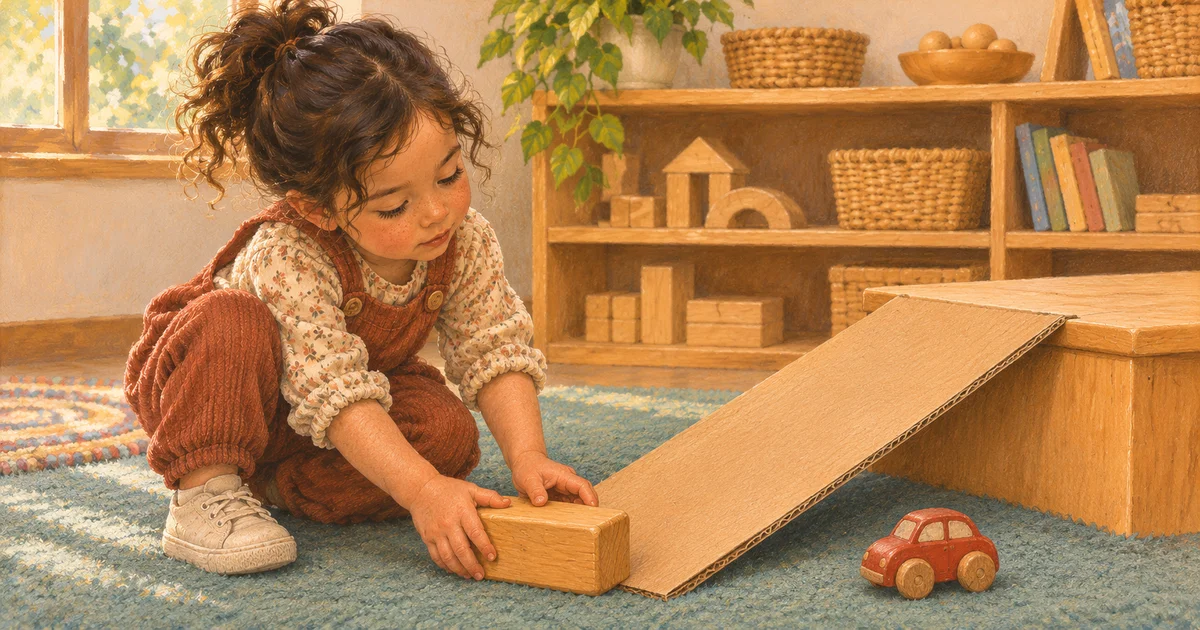
- Problem-solving: When the cardboard ramp slid off the chair, [Name] placed two heavy wooden blocks against the bottom of the ramp and rolled a car down without it moving.
- Pretend play: In dramatic play, [Name] held a wooden block to their ear, paced across the rug, and said, "Hello? Yes, the pizza is ready. That's five dollars."
Physical & Motor Skills
- Scissor use: [Name] held child scissors with thumb facing up, opened and closed the blades with one hand, and made four snips along the edge of a strip of green paper.
- Drawing & grip: Holding a marker between thumb, pointer, and middle finger, [Name] drew a closed circle, added two dots inside, and said, "That's Mom."
- Small finger control: Using plastic tweezers, [Name] moved 8 pom-poms from a bowl into an ice cube tray without dropping any.
- Climbing & balance: Outside, [Name] climbed all 5 rungs of the ladder alternating feet and walked across the 4-inch balance beam with arms stretched out to the sides.
- Throwing & catching: Standing about 5 feet from [Peer], [Name] threw a medium rubber ball overhand and trapped the return throw against their chest with both arms.
Self-Help, Focus & Daily Routines
- Getting dressed: Before outdoor time, [Name] laid their coat on the floor, put both arms in the sleeves, flipped it over their head, and asked a teacher to start the zipper.
- Handwashing: At the sink, [Name] pumped soap once, rubbed palms together under running water for about 15 seconds, turned off the faucet, and threw the paper towel in the trash.
- Mealtime independence: [Name] held the small plastic pitcher with both hands and poured milk into their cup, stopping just below the rim with no spills.
- Cleanup & transitions: When the two-minute chime rang, [Name] placed 4 puzzles back onto the shelf and walked to the rug without needing a second prompt.
- Sticking with a task: [Name] sat at the table working on a 12-piece wooden puzzle for 9 minutes, rotating pieces until each one fit, and stood up once the final piece clicked in.
10 Words to Cut From Your Observation Notes
If you catch yourself writing any of these words, pause and replace them with what your eyes and ears actually picked up:
- Happy / Excited — Did they smile, bounce on their toes, or cheer? Write that instead.
- Angry / Mad — Describe the furrowed eyebrows, stomped feet, or exact words shouted.
- Frustrated — Show the sigh, the crumpled paper, or the dropped arms.
- Shy — Note that they stood behind a parent's legs or looked down when greeted.
- Aggressive / Mean — Always record the exact physical action (pushed, bit, threw a block).
- Stubborn / Defiant — Write what happened when a direction was given (crossed arms, turned away, said "No").
- Good job / Nice — These say nothing about the skill. Describe what made the work or kindness stand out.
- Smart / Advanced — Record the specific thing they counted, built, or explained.
- Tried to / Wanted to — You can't see intentions. Write what their hands or body actually did.
- Loves / Hates — Show the habit instead ("chose the art easel three mornings in a row" or "pushed the peas off the plate").
Why Plain English Protects Everyone During Tough Conversations
Objective notes aren't just faster—they are your best tool when you have to talk to a family about challenging behavior.
Compare how a parent hears these two statements at pickup:
- The label: "Liam was really aggressive today during cleanup."
- The plain facts: "At 10:15 during cleanup, when I asked the group to put away the trains, Liam threw two wooden blocks toward the shelf and yelled, 'I'm not done!'"
The first sentence puts parents immediately on the defensive. The second sentence gives everyone a clear, neutral picture of when it happened (transitions), what triggered it (stopping play), and how to work together on a plan.
How to Capture Observations Without Stopping Class
You don't need to pull out a tablet or step away from the rug to collect great documentation. Try the 30-Second Sticky Note Method:
- Prep your clipboard. Stick a pad of Post-its—or a sheet of blank return-address labels—onto a classroom clipboard, and clip a pen to the top.
- Jot raw fragments in real time. Don't worry about full sentences while kids are awake. Just write:
Initials + Date + Raw Quote or Action(Example:JM 10/14 - water table: dropped wood + metal spoon. "Shiny one is heavy, went down."). - Transfer at nap time. Stick the labels straight onto each child's portfolio folder, or spend five minutes typing your stack of sticky notes into your center's app while the room is quiet.
Short, plain, fact-only notes take less than a minute to write—and they tell a far richer story of a child's year than a page of textbook jargon ever could. Working with older four-year-olds heading toward Kindergarten? See our Pre-K observation examples for Kindergarten readiness.
Frequently Asked Questions
What is an objective observation in preschool?
An objective observation is a brief, fact-only record of what a child actually did or said—without guessing feelings, labeling personality traits, or adding textbook jargon. If a camera couldn't see it and a microphone couldn't record it, it stays out of the note.
What is the difference between objective and subjective observation notes?
Subjective notes judge or mind-read (e.g., "Maya was angry because she wouldn't share"). Objective notes report observable facts (e.g., "Maya pulled the red truck out of Leo's hands and yelled, 'My turn!'").
What words should teachers avoid in preschool observation notes?
Cut feeling guesses and labels such as happy, angry, frustrated, shy, aggressive, stubborn, smart, good job, tried to, and loves. Replace each one with the visible movement, facial cue, or exact quote that made you notice the moment.
Can I use short anecdotal notes for family conferences and portfolios?
Yes. Specific, plain-English examples work much better at conferences than general summaries because parents can picture exactly what their child built, counted, or said—and tough behavior conversations go smoother when grounded in neutral facts.