
Classroom observation
25 Plain-English Infant Observation Examples Teachers Can Write in Under a Minute
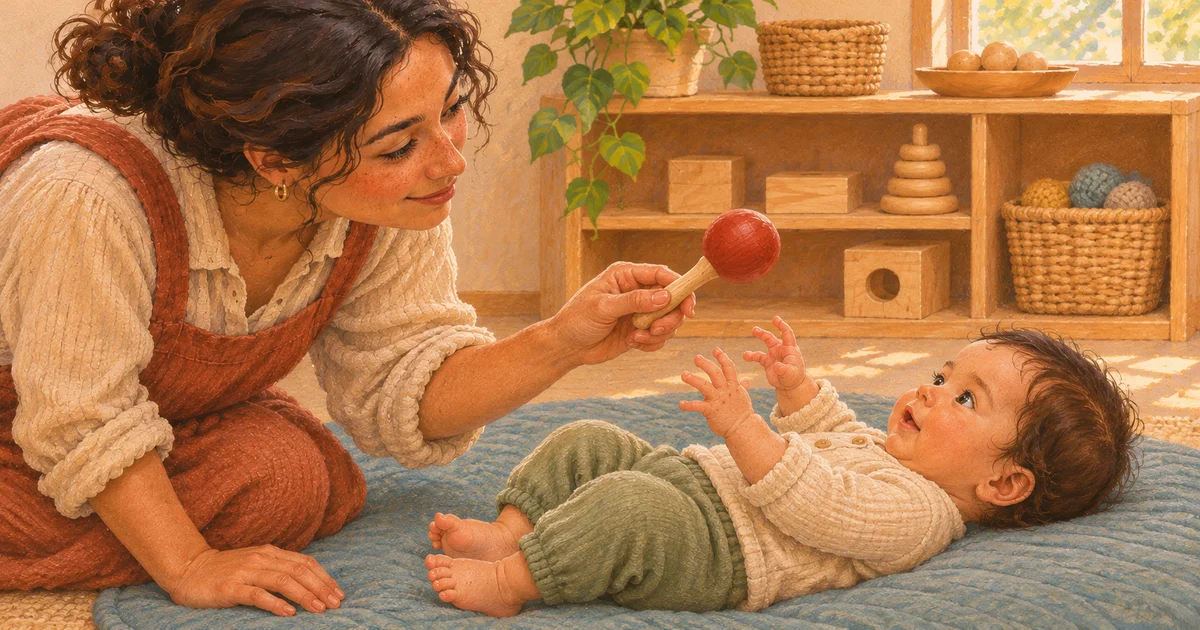
Infant teachers have the hardest documentation job in the building. Preschool teachers can quote a funny conversation or snap a photo of a block tower. Meanwhile, you are changing diapers, warming bottles, rocking a crying four-month-old, and wondering what you are even supposed to write down for a baby who isn't talking yet.
You do not need to invent milestones or fill pages with textbook phrases like "demonstrated emerging object permanence and secure caregiver attachment."
What is an objective observation in an infant room? An objective infant observation is a short, fact-only note describing a baby's exact movements, eye gaze, facial expressions, or sounds—without guessing what they feel, want, or think. A concrete note gives your teaching team and the child’s family a record of what happened.
Whether you have been in the infant room for ten years or you are training a brand-new floater, use one simple rule:
The Camera & Microphone Rule: If a camera couldn't see it and a microphone couldn't record it, leave it out.
Every note below follows a quick three-part formula: Context (when or where) + Action (what their body or eyes did) + Sounds (any coos, cries, or babbles).
Objective vs. Subjective: The 5-Second Fix
Because babies cannot tell us what they are thinking, it is extra tempting to fill in the blanks ("he was cranky," "she wanted the ball"). Here is how to trade mind-reading and jargon for plain facts:
| Skip This (Jargon or Guessing) | Write This Instead (Plain Facts) | Why It Works Better |
|---|---|---|
| "Leo was fussy and tired all morning." | "Leo rubbed both eyes, yawned three times, and cried when placed on the play mat at 9:20." | Shows the actual signs instead of labeling his mood. |
| "Maya demonstrated palmar grasp and oral exploration." | "Maya wrapped all four fingers around the wooden ring and brought it straight to her mouth." | Any parent or new teacher pictures the exact skill instantly. |
| "Sam was excited to see his favorite teacher." | "When Ms. Kim walked up and said hello, Sam kicked both legs, widened his eyes, and smiled." | Captures the visible evidence behind the bond. |
| "Chloe tried to reach the rattle and got frustrated." | "Chloe stretched her right arm toward the rattle twice, grunted, and lowered her head to the mat." | Records effort without guessing what's inside her head. |
| "Noah loved his sweet potatoes at lunch." | "Noah opened his mouth each time the spoon approached and ate four spoonfuls of sweet potato." | Tells parents exactly what happened at mealtime. |
25 Copy-and-Adapt Infant Observation Examples
Bookmark this list or clip it next to your changing table. Swap in [Name], add the date, and you can finish any of these in 20 to 45 seconds—covering babies from newborn through 12 months.
Connection, Cues & Comfort
- Recognizing a caregiver: When Ms. [Teacher] walked up to the crib and said, "Good morning, [Name]," [Name] kicked both legs, widened their eyes, and smiled.
- Morning drop-off: After Mom handed [Name] to Ms. [Teacher], [Name] cried for about 90 seconds, then stopped crying and rested their head on Ms. [Teacher]'s shoulder while patting her shirt.
- Noticing other babies: Sitting on the soft mat, [Name] turned their head toward [Peer] crying across the rug, stared for 10 seconds, and reached one open hand toward [Peer].
- Signaling "all done": While looking at a black-and-white board book, [Name] turned their head to the side, arched their back, and pushed the book away with both hands.
- Checking in while exploring: [Name] crawled three feet toward the low mirror, paused, looked back over their shoulder at Ms. [Teacher], smiled when she nodded, and kept crawling.
Sounds, Eyes & Early Communication
- Tracking a toy: Lying on their back on the play mat, [Name] kept their eyes locked on the red rattle and turned their head slowly from left to right as Ms. [Teacher] moved it.
- Cooing back and forth: During a diaper change, [Name] looked up at Ms. [Teacher]'s face and made an "ooo-aaa" sound; when she repeated it, [Name] paused, kicked, and made the sound again.
- Babbling with consonants: Sitting in the floor seat, [Name] slapped the tray with an open palm and repeated "ba-ba-ba-ba" four times in a row.
- Responding to their name: While chewing on a rubber ring across the rug, [Name] stopped moving and turned their head straight toward Ms. [Teacher] the first time she called, "[Name]!"
- Pointing to communicate: Sitting in the high chair, [Name] pointed one finger toward the basket of puffs on the counter and said, "Da! Da!" while looking back and forth between the basket and Ms. [Teacher].
Exploring & Figuring Things Out
- Exploring textures: [Name] picked up a silicone block, turned it over in both hands, brought it to their mouth, and chewed on the bumpy corner for 20 seconds.
- Finding a hidden toy: When Ms. [Teacher] draped a light scarf over the plastic duck, [Name] grabbed the edge of the scarf, pulled it off, and picked up the duck.
- Cause and effect: [Name] shook the plastic maraca twice, paused to stare at it when it rattled, then shook it five more times quickly.
- Dropping and watching: From the high chair, [Name] held a silicone spoon over the edge, opened their fingers, leaned sideways to watch it hit the floor, and looked up at Ms. [Teacher].
- Dumping and filling: Sitting next to the basket of soft balls, [Name] tipped the basket upside down, picked up two balls one by one, and dropped them back inside.
Rolling, Sitting & Reaching
- Tummy time lift: During tummy time on the foam mat, [Name] pushed up onto both forearms and held their head and chest off the floor for about 15 seconds while looking at the mirror.
- Rolling over: Lying on their back under the play gym, [Name] grabbed their right foot, rolled onto their left side, and pushed all the way over onto their tummy.
- Passing objects between hands: Sitting upright on the rug, [Name] reached forward with their right hand to grab a wooden ring, then passed it cleanly into their left hand.
- Picking up small pieces: On the high chair tray, [Name] picked up 4 oat O's one at a time using the tips of their thumb and pointer finger and put each one in their mouth.
- Pulling up and cruising: [Name] gripped the edge of the low wooden shelf with both hands, pulled up to standing, and took three sideways steps along the shelf without letting go.
Feeding, Sleep & Care Routines
- Holding the bottle: While drinking a bottle in the rocking chair, [Name] placed both open hands on the sides of the bottle and kept them there for two minutes.
- Eating solid foods: When offered a spoon of mashed sweet potato, [Name] opened their mouth, closed their lips around the spoon, swallowed, and leaned forward with an open mouth.
- Settling in the crib: Placed in the crib awake at 10:15, [Name] rolled onto their side, brought their left thumb to their mouth, rubbed the sleep sack with their right fingers, and closed their eyes within four minutes.
- Helping during diaper changes: When Ms. [Teacher] held up clean pants and said, "Lift your bottom," [Name] bent both knees and raised their hips off the changing pad.
- Drinking from a cup: Seated at the low table, [Name] gripped both handles of the straw cup, brought the straw to their lips, and took three sips before setting the cup back down.
10 Words to Cut From Infant Observation Notes
Infant notes are full of everyday shorthand that sneaks guesswork into a child's record. Catch these ten words and swap them for what you actually saw or heard:
- Fussy / Cranky — Write the exact cue: cried on and off for 10 minutes, pulled at ears, or arched away from the mat.
- Happy / Content — Describe the smile, relaxed shoulders, soft cooing, or steady eye contact.
- Tired / Sleepy — Note the yawns, eye rubbing, glazed stare, or head resting on your shoulder.
- Hungry — Record rooting toward your chest, sucking on fists, or smacking lips.
- Teething — Teachers can't diagnose teething. Write what you see: drooled through two bibs and chewed steadily on a cold ring.
- Good baby / Easy — Doesn't tell anyone what the baby is learning. Capture a real moment of focus, movement, or connection instead.
- Clingy — Write the behavior: held onto Ms. Sarah's shirt and cried when set down on the rug.
- Wanted / Tried to — You can't see intentions. Describe where they reached, looked, or scooted.
- Recognized / Knew — Show the proof: turned toward Mom's voice at the door and kicked both legs.
- Loves / Hates — Record the pattern: grinned during patty-cake three days in a row, or turned head away from green beans twice.
Why Plain English Builds Instant Trust With New Parents
Leaving a baby at daycare for the first time is emotional. Parents read daily reports and portfolio notes closely—and vague labels make them anxious.
Compare how a first-time parent hears these two notes at pickup:
- The label: "Maya was super clingy and upset after you left today."
- The plain facts: "After drop-off at 8:15, Maya cried for three minutes while I rocked her and sang softly. At 8:18 she stopped crying, watched the ceiling mobile, and reached for a soft rattle."
The first note leaves a parent worrying all evening that their baby was miserable all day. The second note shows a parent two reassuring truths: you were paying close attention to their child, and their baby is learning how to feel safe with you.
How to Capture Observations When Your Hands Are Full
Carrying a clipboard around an infant room doesn't work when you are holding a baby on one hip and a bottle in the other hand. Try the Station-Mounted Sticky Note Method:
- Put notes where you already pause. Tape a pad of sticky notes and a tethered pen at eye level in three spots: right above the changing table, on the wall beside the rocking chair, and on the counter near the high chairs.
- Jot a 5-second fragment while you're standing there. Right after washing hands at the changing table or setting a bottle down, scribble:
Initials + Date + Raw Action/Sound(Example:LM 11/4 - diaper change: looked at my face, "ooo-aaa" back and forth 2x). - Snap a photo or log it during nap overlap. When two or three babies are down at once, spend five minutes dropping those sticky notes straight into portfolios or your center's family app.
You don't need big milestones to write meaningful infant observations. The tiny, everyday moments—a head turn, a thumb-and-finger pinch, a shared coo at the changing table—are the entire story of a baby's first year. Have babies moving up to the toddler room soon? Bookmark our younger and older toddler observation examples next.
Frequently Asked Questions
What should teachers write in an infant observation when the baby isn't talking yet?
Focus on what you can see and hear: eye tracking, head turns, hand grasps, rolling, reaching, facial expressions, and sounds like cooing or babbling. Everyday care routines—like holding a bottle, lifting hips during a diaper change, or settling in a crib—provide strong, objective documentation.
How do you write an objective infant observation without guessing how the baby feels?
Use the Camera & Microphone Rule: record only observable physical cues and sounds. Instead of writing "Leo was cranky and tired," write "Leo rubbed both eyes, yawned three times, and cried when placed on the mat at 9:20."
Do plain-English infant observations meet licensing and assessment standards?
Record what you saw and heard. For example, note how the baby picked up a piece of cereal with their thumb and pointer finger. Ask your program director which details, forms, and observation schedule your program requires.
How often should infant teachers record anecdotal notes?
Aim for one brief note per baby per week across different parts of the day (floor play, feeding, and transitions). Keeping sticky notes taped near the changing table and rocking chair makes it easy to jot a 10-second fragment and log it during nap overlap.