
Classroom observation
25 Plain-English Pre-K Observation Examples for Kindergarten Readiness
Every spring, Pre-K teachers get the same nerve-wracking question from parents at conferences: "Is my child actually ready for Kindergarten?"
It is tempting to answer with vague reassurance ("She's doing great!") or bury families in assessment jargon ("Demonstrates emerging phonemic awareness and age-appropriate executive functioning"). Neither one helps a parent picture what their four- or five-year-old can actually do in a classroom.
What is an objective Pre-K observation? An objective Pre-K observation is a short, fact-only record of what a child did, built, wrote, or said—without judging whether they are "ready," guessing their mood, or using academic buzzwords. A concrete note gives your teaching team and the child’s family a record of what happened.
Whether you are prepping for spring conferences or onboarding a new assistant teacher, stick to one simple rule:
The Camera & Microphone Rule: If a camera couldn't see it and a microphone couldn't record it, leave it out.
Every note below follows a fast three-part formula: Context (when or where) + Action (what they did) + Exact Words (what they said, if anything).
Objective vs. Subjective: The 5-Second Fix
Pre-K documentation gets tricky because it is easy to slip into report-card labels ("mature," "distracted," "kindergarten-ready"). Here is how to trade labels and textbook phrases for facts that stand on their own:
| Skip This (Jargon or Labels) | Write This Instead (Plain Facts) | Why It Works Better |
|---|---|---|
| "Maya has strong phonemic awareness and orthographic mapping." | "Maya sounded out '/d/ - /o/ - /g/' aloud and wrote 'D O G' above her drawing." | Parents immediately see the exact early reading skill at work. |
| "Liam is immature and a poor sport during games." | "When his peer won Candy Land, Liam swept the game cards off the table and walked to the rug." | Gives you neutral facts to work on instead of shaming the child. |
| "Chloe is totally ready for Kindergarten." | "Chloe hung up her backpack, wrote her full name on the sign-in sheet, and worked on a Lego truck for 18 minutes." | Shows the specific independence and focus habits behind readiness. |
| "Noah lacks focus and is constantly off-task at circle time." | "During the 10-minute story, Noah called out four times without raising his hand and rolled onto his stomach twice." | Tracks frequency and timing so you can adjust support. |
| "Ava is very bossy with her classmates in centers." | "In dramatic play, Ava told two peers, 'You have to be the baby and sit on the rug, I'm the doctor.'" | Captures leadership and where coaching on compromise will help. |
25 Copy-and-Adapt Pre-K Observation Examples
Bookmark this page or print it for your classroom clipboard. Swap in [Name], add the date, and finish any of these in 20 to 45 seconds—built specifically for ages 4–5 and Kindergarten readiness portfolios.
Peer Negotiation, Teamwork & Conflict Resolution
- Solving a turn-taking conflict: When [Name] and [Peer] both reached for the magnifying glass, [Name] grabbed the two-minute sand timer from the shelf and said, "You go first until the sand runs out, then it's my turn."
- Negotiating pretend play roles: In the dramatic play area, [Name] told two peers, "I'll be the vet first, [Peer] can hold the puppy, and when the bell rings we can switch jobs."
- Building on a peer's idea: While designing a cardboard bridge with [Peer], [Name] listened to [Peer] say it needed walls, then added, "Yeah, and let's tape paper tubes underneath so heavy trucks don't bend it."
- Handling losing a game: When [Peer] reached the finish square first in Candy Land, [Name] sighed, slid their game piece back into the box, and said, "You won that one. Want to play again?"
- Standing up with words: When [Peer] knocked down the edge of a Lego wall, [Name] stepped back, held up one open hand, and said, "Stop. I'm still building that part. You can use the pieces in the green bin."
Early Reading, Letter Sounds & Writing
- Writing full first name: At the morning sign-in board, [Name] wrote all six letters of their first name from left to right—starting with an uppercase letter followed by lowercase letters—without looking at their name card.
- Hearing beginning sounds: During the alphabet game, Ms. [Teacher] held up a picture of a sun; [Name] said, "/s/, /s/, sun—that starts with S, just like Sam!"
- Spotting rhyming words: While reading Sheep in a Jeep, [Name] pointed to the page and said, "Beep, jeep, sheep! Those all end the same—and sleep rhymes too."
- Invented spelling to label art: After drawing a doghouse at the writing center, [Name] said each sound slowly—"/d/ - /o/ - /g/"—and wrote "D O G" at the top of the page.
- Retelling a story in order: After closing The Three Little Pigs, [Name] told Ms. [Teacher], "First they built houses of straw and sticks, then the wolf blew those down, and at the end they were safe in the brick house."
Math, Patterns & Early Science
- Counting up to 20: At the math tray, [Name] slid 18 wooden beads from the left pile to the right pile one by one, counting aloud from 1 to 18 without skipping or repeating a number.
- Building a repeating pattern: Using linking cubes, [Name] snapped together red-red-blue-red-red-blue-red-red-blue and said, "Two reds, one blue—next I need two more reds."
- Simple addition with objects: Looking at 4 plastic apples on their plate, [Name] counted out 2 more from the basket, pushed them together, and said, "Four and two makes six."
- Measuring and comparing length: [Name] lined up linking cubes along the edge of a shoe and a wooden block, counted both rows, and said, "The shoe is 9 cubes long and the block is 6, so the shoe is longer."
- Testing a prediction: Before placing one ice cube in the sunny window and another in the closet, [Name] said, "The sun one will melt faster." Twenty minutes later, [Name] checked both cups and said, "Look, the window one is already water!"
Fine Motor Control & Big-Body Skills
- Cutting curved lines: Holding child scissors with thumb facing up, [Name] turned the paper with their other hand and cut all the way around a drawn circle, staying right along the black line.
- Detailed drawing: At the art table, [Name] drew a person with a head, eyes, mouth, hair, body, two arms with fingers, and two legs with shoes, then wrote "DAD" beside the figure.
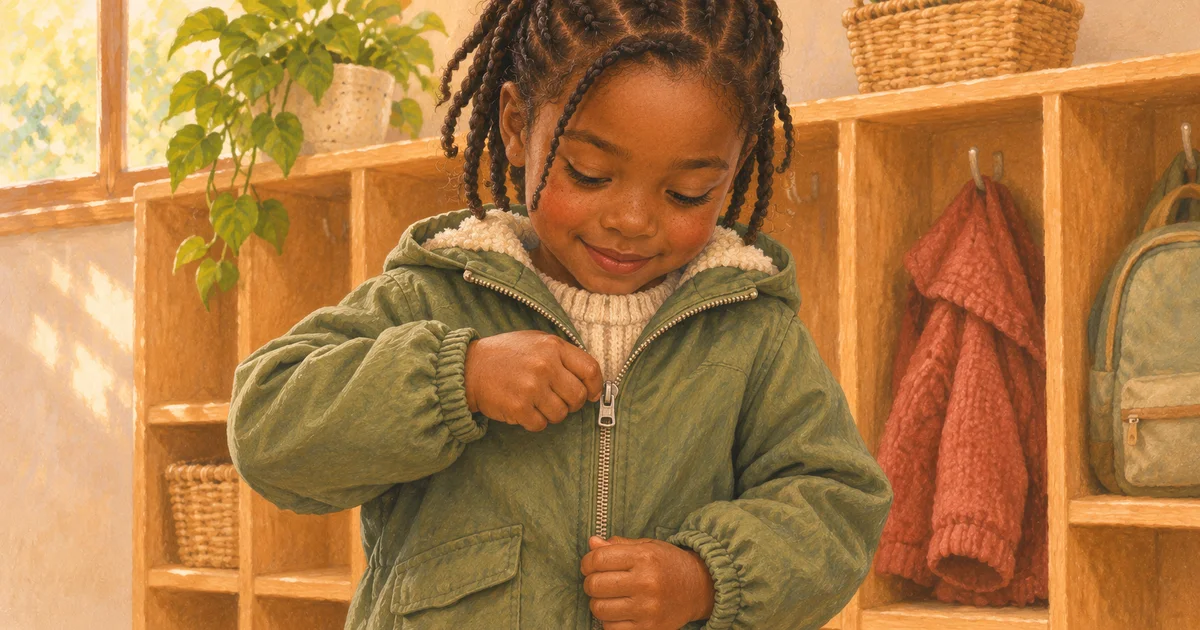
- Zipping a coat solo: Before going outside, [Name] put on their jacket, lined up the metal pin inside the bottom of the zipper on the second try, and zipped it all the way up without asking for help.
- Catching with hands: Standing about 8 feet from [Peer] on the playground, [Name] caught a tossed playground ball three times in a row using only their hands, without trapping it against their chest.
- Skipping and hopping: On the blacktop track, [Name] hopped on their right foot six times without putting their left foot down, then skipped the length of the sidewalk alternating feet.
Kindergarten Habits, Focus & Self-Management
- Waiting a turn to speak: During morning meeting, [Name] raised their hand, stayed quiet for about 20 seconds while two classmates shared, and waited to talk until Ms. [Teacher] called their name.
- Sustained project focus: [Name] worked at the Lego table for 18 minutes straight, sorting wheels by size and attaching a roof to their truck before holding it up to show Ms. [Teacher].
- Fixing a mistake without quitting: When [Name] drew a backward letter E on their journal page, they flipped the pencil over, erased the mark, checked the wall chart, and rewrote the E facing right.
- Managing lunch and belongings: At lunch, [Name] unzipped their lunchbox, opened their yogurt tube and plastic sandwich container without asking for help, and packed their ice pack back inside when finished.
- Following a multi-step routine: After walking into the classroom at 8:30, [Name] hung up their backpack, moved their attendance magnet to "Here," washed their hands, and picked a book from the bin without a single reminder.
10 Words to Cut From Pre-K Observation Notes
Pre-K notes are packed with sneaky judgment words—especially when teachers are thinking ahead to Kindergarten. Catch these ten words and swap them for observable facts:
- Ready / Not ready — Means nothing on its own. Show the exact habit: "zipped own coat" or "needed three prompts to join circle."
- Mature / Immature — Always a label. Write what the child actually did during the transition, conflict, or routine.
- Smart / Bright — Record the specific proof: counted to 18, predicted which ice cube would melt first, or explained a pattern rule.
- Distracted / Off-task — Note what pulled their attention and for how long ("looked out the window and tapped pencil for 2 minutes").
- Bossy — Quote their exact words to peers so you can see whether they are organizing play or excluding others.
- Confident / Insecure — Show the body language: spoke loudly enough for the whole rug to hear, or whispered answers only when seated next to a teacher.
- Poor sport / Upset — Describe what happened right after losing a turn or game (crossed arms, pushed board away, or asked to play again).
- Knows / Understands — You can't see inside a child's brain. Write what they sorted, matched, explained, or built to show it.
- Neat / Messy — Be specific: "stayed along the black cutting line" or "wrote letters across the whole page in different sizes."
- Tried to / Meant to — Stick to visible action: "restarted the zipper three times before asking a teacher to hold the bottom."
Why Plain English Saves Spring Kindergarten Conferences
Few conversations make parents more anxious than hearing their five-year-old might struggle in Kindergarten. Vague labels trigger panic; plain facts invite teamwork.
Compare how a family hears these two statements across the conference table:
- The label: "Jordan is smart with letters, but he's just not emotionally ready for a Kindergarten classroom yet."
- The plain facts: "Jordan already writes his full name and spots beginning letter sounds. Right now, when a group activity ends before he's finished—like blocks or art—he cries and throws the materials about three times a week. When we give him a five-minute timer and a 'save my work' sign, he cleans up without throwing."
The first statement leaves parents scared and defensive. The second statement shows parents their child's real strengths, pinpoints the exact skill to practice over the summer, and hands them a strategy that already works.
How to Capture Observations Across Busy Pre-K Centers
In a room of 18 to 20 Pre-K students, the hardest part isn't writing one note—it's realizing on Friday that you have six notes on your loudest kid and zero on your quietest one. Try the 5-Kids-a-Day Clipboard Rotation:
- Divide your roster by weekday. Put four or five children's names on a strip of masking tape at the top of your clipboard for Monday, the next five for Tuesday, and so on through Thursday (keeping Friday open for absences or catch-up).
- Catch them during centers or routines. You only need one 30-second sticky note per focus child that day. Jot:
Initials + Date + Raw Quote or Action(Example:KT 3/12 - math tray: red-red-blue pattern 3x, "next I need 2 more reds."). - File during rest time. Stick the five notes straight into portfolios or type them into your center's app in under five minutes. By Thursday afternoon, every single child in your room has fresh, objective documentation—and spring conferences practically write themselves.
Frequently Asked Questions
What skills should Pre-K observation notes focus on for Kindergarten readiness?
Document both early academics and classroom habits: writing their name, hearing beginning sounds, counting up to 20, making patterns, zipping coats, opening lunch containers, sticking with a task for 15+ minutes, and solving turn-taking conflicts with words.
How do you talk about Kindergarten readiness without labeling a child "not ready"?
Pair concrete strengths with specific, observable habits the child is still practicing. Instead of saying a child is "immature," note what happens during transitions—for example, "cries when block time ends three times a week, and cleans up smoothly when given a five-minute timer."
How are Pre-K observations different from 3-year-old preschool observations?
Preschool notes often capture early sharing, counting to 6–10, snipping paper, and following basic directions. Pre-K notes document higher-level independence, like invented spelling, rhyming, cutting along curved lines, negotiating pretend-play roles, and completing multi-step morning routines without reminders.
How can Pre-K teachers make sure quiet students get just as many observations as loud ones?
Use a 5-kids-a-day clipboard rotation. List four or five names on masking tape for Monday through Thursday, capture one 30-second sticky note per focus child during centers or routines, and keep Friday open for absences so every child gets documented weekly.