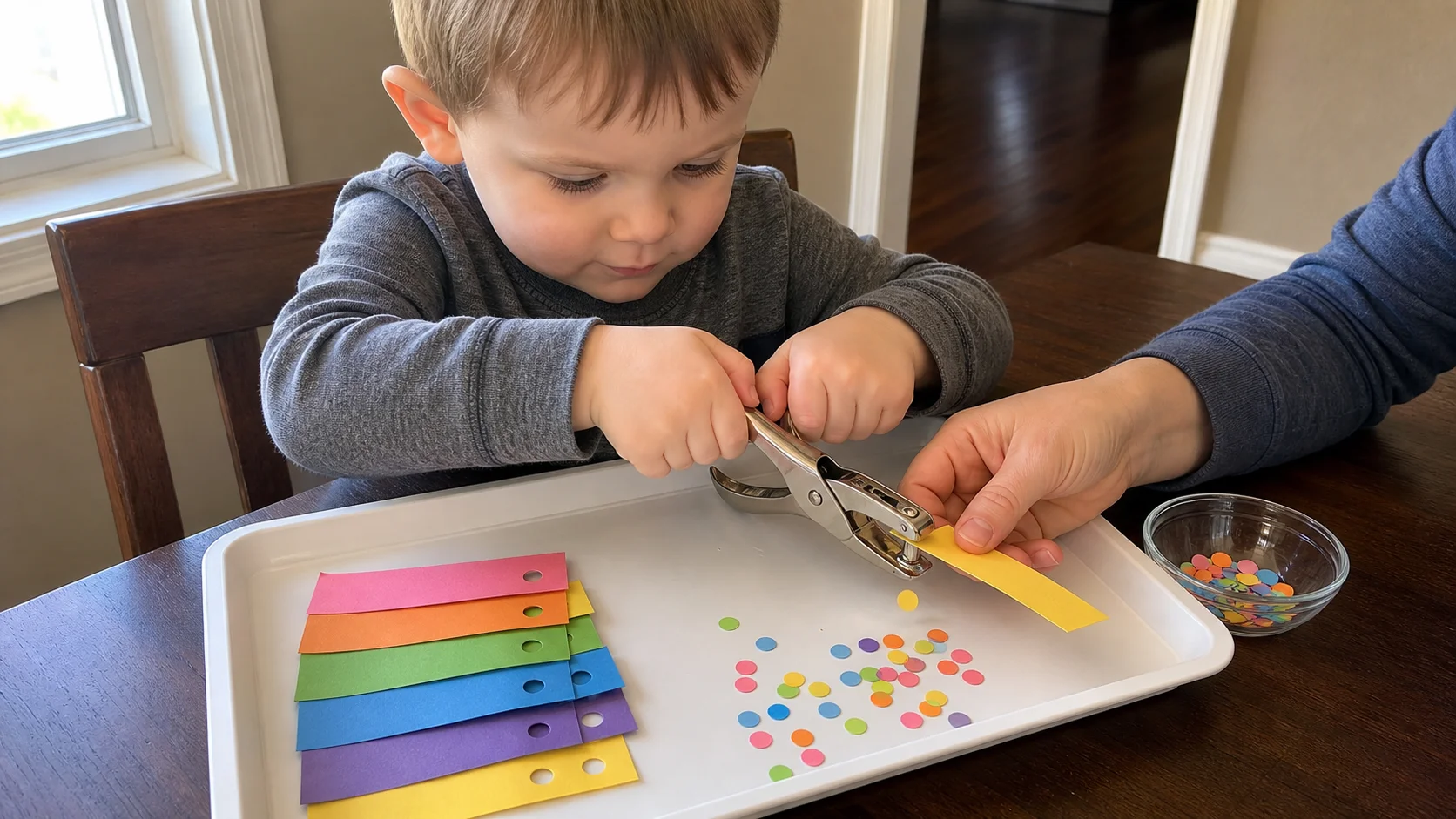
Child pressing a handheld hole punch over a tray while a grown-up keeps fingers safely on the handle
Fine motorSqueeze And ReleaseIndoor

Hole Punch Confetti.

A supervised hole-punch loop turns scrap paper into tiny dots your child can pop, collect, dump, and repeat.
Play time
5-10+ min
Age
2-3 years
Energy
Low
Mess
Low
Effort
Low
Where
Indoor
Start here

The recipe.

Low parent effort
6 things

What you need

  • 1 handheld hole punch
  • 4 to 8 small pieces of scrap paper
  • 1 tray, placemat, or shallow box lid
  • 1 small bowl or cup
  • 1 adult
  • 1 child
5 min minimum

Setup

Then start the loop
Step 01
On the table or floor, put the tray, placemat, or box lid directly in front of your child so every punch happens over one clear surface.
Step 02
In the middle of the tray, put the hole punch in front of you first, not in your child's hands, and check that it opens and closes smoothly.
Step 03
Beside the punch, stack the scrap paper pieces so one piece can slide into the punch without folding or flopping.
Step 04
At the top corner of the tray, put the bowl or cup where punched dots can go.
Step 05
Beside your child, sit close enough to control the punch, check finger placement, and model the first safe squeeze.
Step 06
Before the first squeeze, make sure your child's fingers touch only the handle area, not the paper slot or punch opening.
"Handle hands."
The loop

How play unfolds.

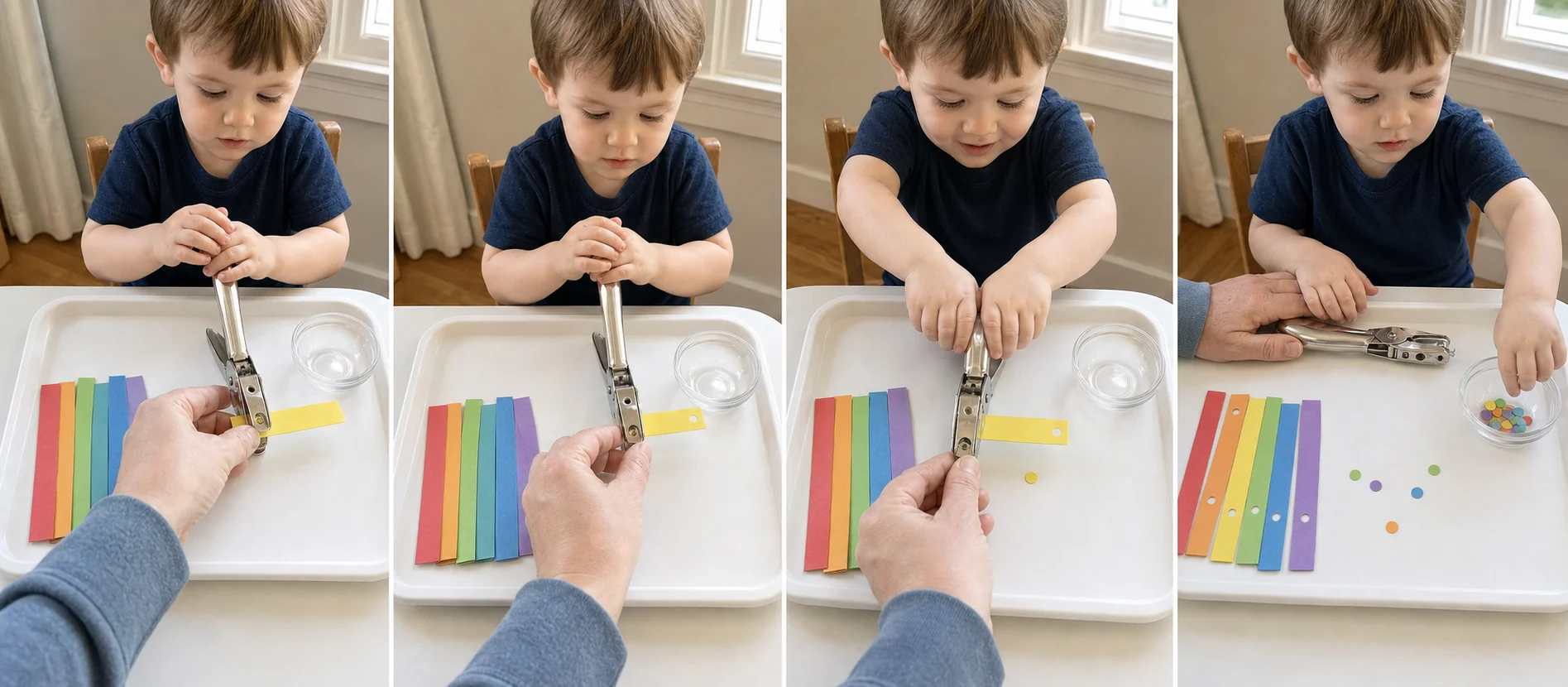
Sequence showing a grown-up lining up scrap paper, child squeezing the hole punch, paper dots falling, and dots being swept into a bowl
  1. 01
    Hold the punch steady, slide in one paper edge, and say, "Handle hands. Squeeze, pop."
  2. 02
    Help your child press once until a hole appears and the dot drops.
  3. 03
    Let your child tip the catcher, pinch one dot, or sweep dots into the bowl.
  4. 04
    Reset with a clean paper edge and repeat while fingers stay on the handle and dots stay on the tray.

Safety Check

  • Stay close enough to control the hole punch for every squeeze.
  • Keep fingers on the handle and away from the paper slot and punch opening.
  • Stop the punch part if your child reaches toward the opening, mouths paper dots, throws the tool, or keeps trying to use it without help.
  • Put the hole punch away first during cleanup, then sweep up the tiny paper dots.
Supporting the play

What to say in the moment

Match what you say to what you see.

Prompt ladder
Level 1 (Start)
Put one hand on the handle and squeeze one safe pop.
Level 2 (Keep going)
Pop another dot and drop it in the bowl.
Level 3 (Stretch)
Find a new paper edge and make one more pop.
Level 4 (Extend)
Make a tiny confetti pile before dumping it.
If your child seems...
What you'd see
Focused
What to do
Say
"Pop, then bowl."
Add
Name the dot or hole after the squeeze.
Extend
Let your child choose the next clean edge before you line it up.

Make it easier

Younger end
  • -Use only one paper scrap until the squeeze-and-dot pattern is clear.
  • -Let your child do the bowl job between adult-supported squeezes.
  • -Count any visible dent, partial hole, or fallen dot as the successful turn.

Make it harder

Older end
  • +Ask your child to find an unpunched edge before each squeeze.
  • +Wait for your child to say or gesture "pop" before you help squeeze.
  • +Do two safe pops before dumping the dots.

If it's not working

If you see
If child ignores it
Punch one hole yourself, make the dot fall into the bowl, and offer the simple job of dumping or sweeping dots first.
If you see
If child misuses it
Take the punch back into adult hands, say "handle only," and offer one supported turn. Stop the punch part if fingers, mouth, or throwing keep happening.
If you see
If child gets frustrated
Start the squeeze yourself and let your child finish the last push, or make one adult punch and let your child collect the dot.
Skill spotlight
Squeeze Control

Squeeze-and-release hand control

The hand gets a clear job: press with enough force, let go, and aim a small tool without losing control. That same control helps with markers, stamps, clothing fasteners, containers, and small cleanup jobs.

  • The squeeze-and-release loop gives your child a clear hand-control task with a visible result.
  • The falling dot shows right away that the squeeze worked, so the reset is easy to understand.
  • Collecting the dots adds small pinching, sweeping, and target-drop practice without changing the game.
Real-world transfer
  • Pressing markers, glue sticks, stamps, and tape with enough control.
  • Opening and closing small tools or containers with less grabbing.
  • Getting ready for later scissor, zipper, and button work.
  • Doing tiny cleanup jobs like sweeping pieces into a bowl.

Parent questions