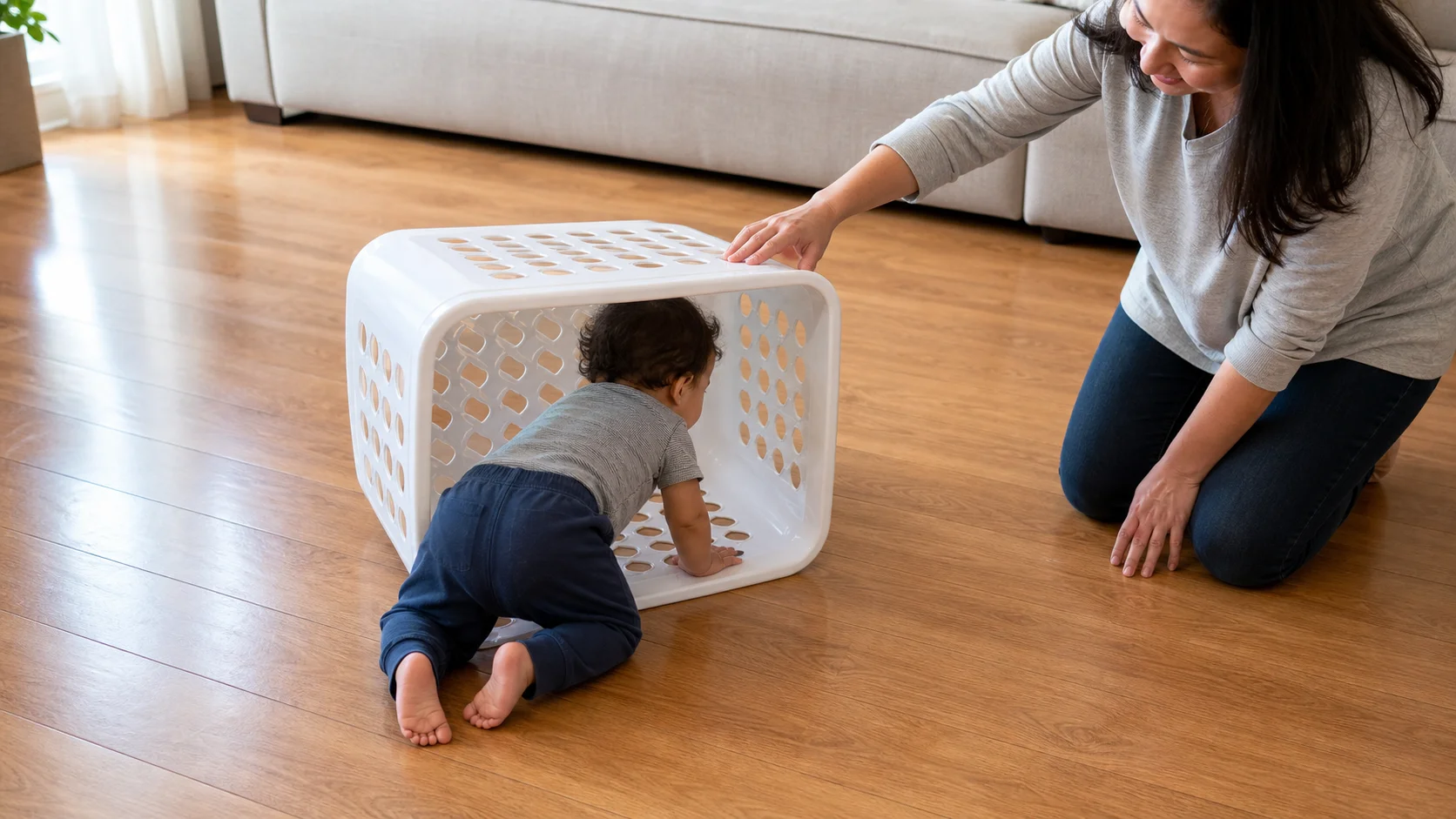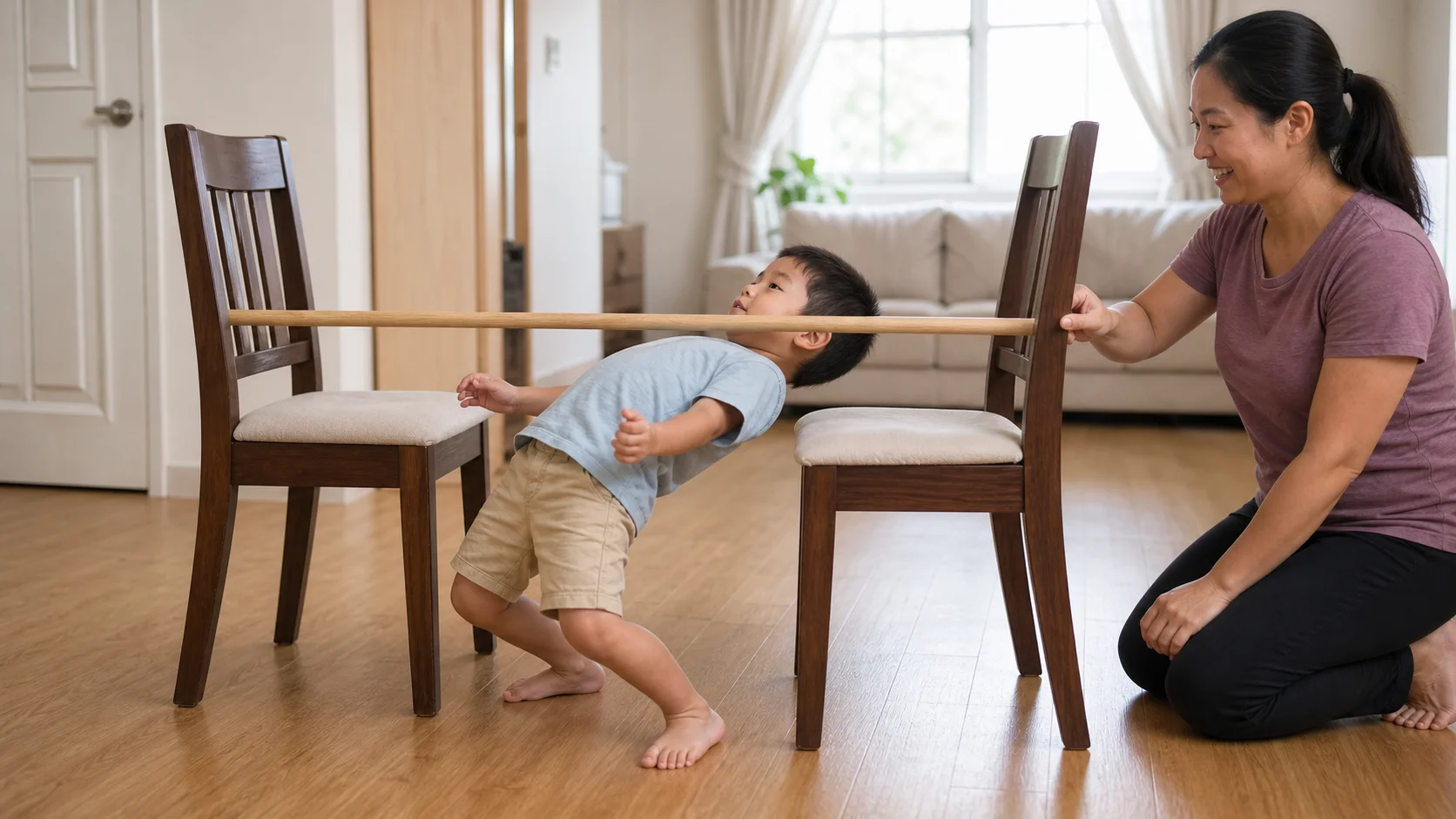
A preschooler bending backward to pass under a broom balanced across two sturdy chairs while a grown-up spots nearby.
Fine motorOT-adjacent supportChange Body LevelIndoor

Broom Limbo Pass.

Build a quick broom limbo path so your child can bend back, pass under, stand tall, and try again.

Play time
3-5+ min
Age
3-4 years
Energy
Medium
Mess
No
Effort
Low
Where
Indoor
Start here

The recipe.

Low parent effort
5 things

What you need

  • 1 broom
  • 2 stable chairs
  • 1 clear indoor floor path
  • 1 adult
  • 1 child
3 min minimum

Setup

Then start the loop
Step 01
On the floor, place two stable chairs back-to-back with enough space between them for your child to walk through without squeezing.
Step 02
Across the chair backs, lay the broom at your child's chest or shoulder height for the first round.
Step 03
On both sides of the broom, clear toys, rugs, and hard objects so your child has an easy approach and exit.
Step 04
Beside the chairs, stand close enough to steady the broom and see your child's feet.
"Slow feet, bend back."
The loop

How play unfolds.

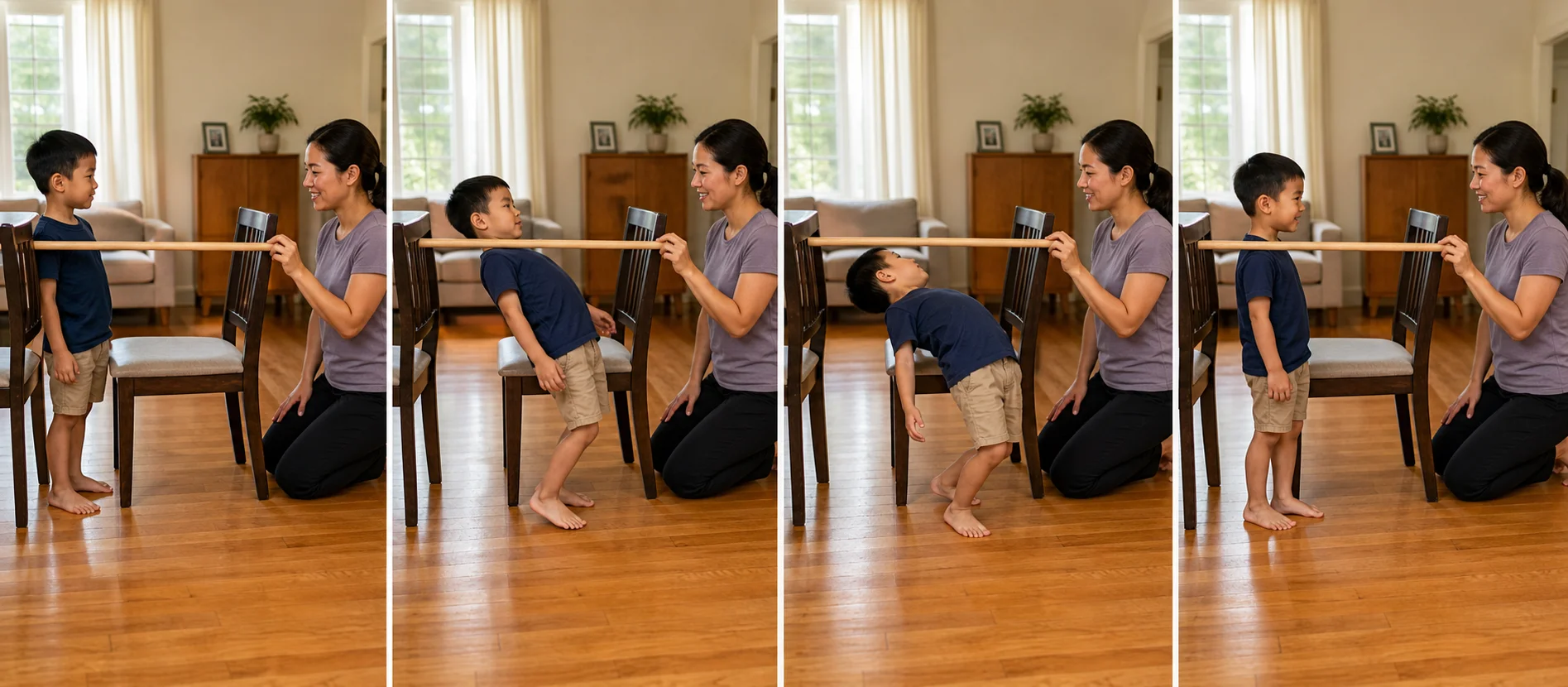
A multi-panel sequence showing a grown-up setting a broom across chairs, a child passing under slowly, and the child standing tall before the next turn.
  1. 01
    Show one slow pass yourself and say, "Watch: bend back, go under, stand tall."
  2. 02
    Let your child pass under the broom, stand tall on the other side, and turn around.
  3. 03
    Say, "Freeze and stand tall," before the return pass.
  4. 04
    Count one round when your child goes under and back from both sides.
  5. 05
    Keep the broom at the same height, or lower it a tiny bit only after a steady round.

Safety Check

  • Use sturdy chairs only. If either chair shifts when you lightly touch the broom, use heavier chairs or stop.
  • Stay beside the setup so you can steady the broom and stop the pass.
  • Keep the first height easy. Do not lower the broom when your child wobbles, rushes, touches the broom, crouches forward, or looks unsure.
  • Choose another activity if backward bending feels scary, painful, or too hard for your child to control.
Supporting the play

What to say in the moment

Match what you say to what you see.

Prompt ladder
Level 1 (Start)
"Go slow under the broom and stand tall."
Level 2 (Keep going)
"Try one more pass back to me."
Level 3 (Stretch)
"Can you make a quiet pass without touching the broom?"
Level 4 (Extend)
"Choose same height or a tiny bit lower."
If your child seems...
What you'd see
Focused
What to do
Say
"You are moving slowly and staying balanced."
Add
Ask one body word per round, such as "back," "feet," or "head."
Extend
Let your child choose whether the next pass stays the same height or drops a tiny amount.

Make it harder

Older end
  • +Ask for a silent pass with no broom bump.
  • +Add a brief stand-tall freeze after the pass before your child turns around.
  • +Let your child decide whether the next round stays the same or gets slightly lower.

If it's not working

If you see
If child ignores it
Take one exaggerated slow pass yourself and invite, "Can you go under after me?"
If you see
If child misuses it
If your child grabs the broom or bumps the chairs, remove the broom, reset the chairs, and restart with, "Hands stay free. Feet go slow."
If you see
If child gets frustrated
Raise the broom back to the easy height, do one same-height pass, then offer "again" or "all done."
Skill spotlight
Body Level Control

Balance while changing body level

This helps your child use core strength and balance to move through space without rushing, which can support climbing, playground movement, dressing, and careful indoor movement.

  • Your child practices changing body level without rushing through the movement.
  • The broom gives a clear spatial target: under, through, stand tall, turn around.
  • Quick resets help a missed pass stay part of the game instead of becoming a loss.
  • Short choices like same height or tiny bit lower add communication without slowing the movement.
Real-world transfer
  • Moving around furniture without bumping into it.
  • Climbing and playground movement with better body control.
  • Dressing motions that need bending, stepping, and staying balanced.
  • Slowing down when a movement challenge feels tricky.