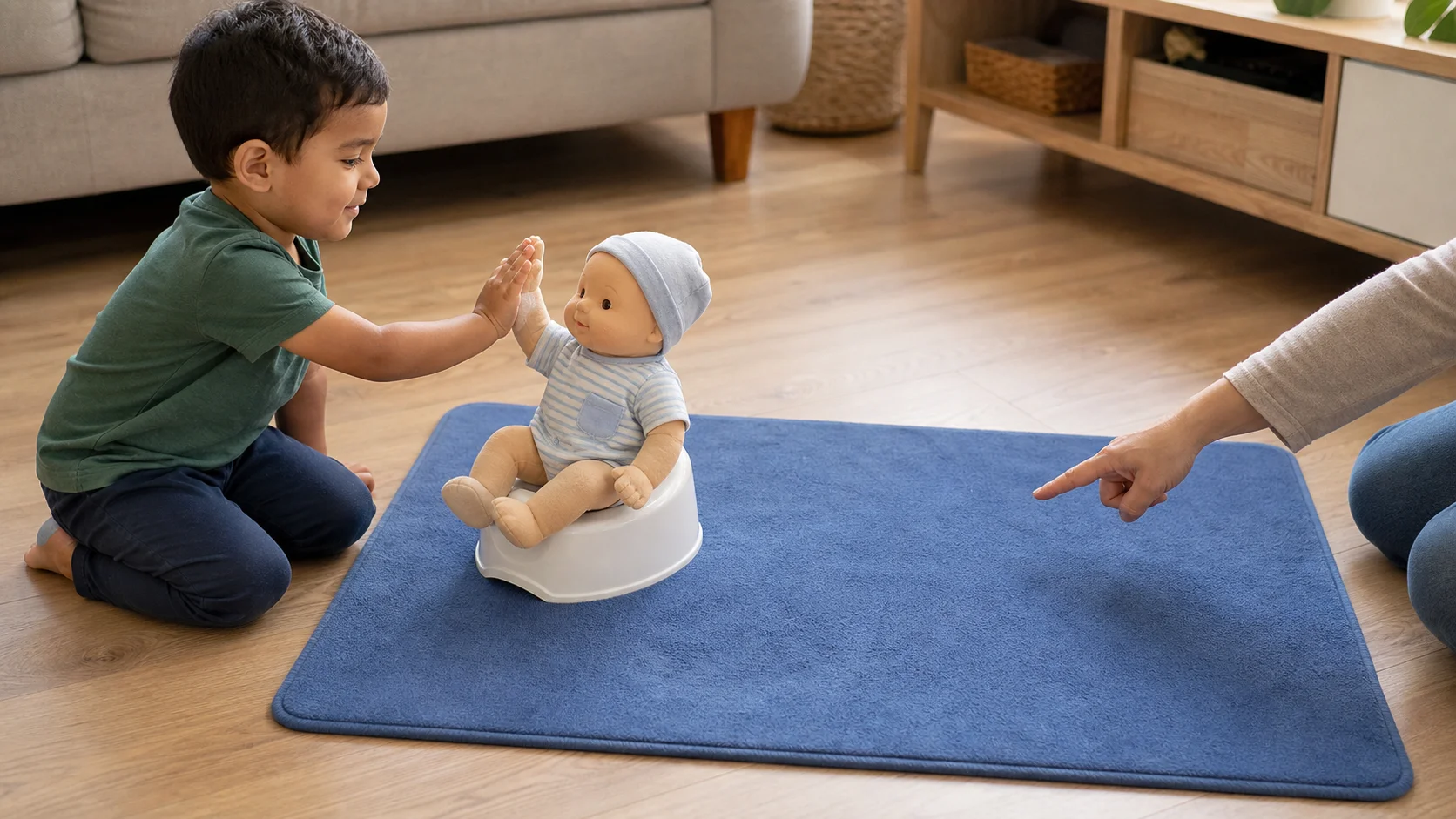
Toddler helping a doll sit on a pretend potty while a grown-up points to an all-done spot.
Skill builderSensory-friendly supportFinish And ResetIndoor

Doll Potty Praise.

Practice sit, wait, praise, and all done with a doll-only potty routine that stays calm and pretend.

Play time
5-10+ min
Age
2-4 years
Energy
Low
Mess
No
Effort
Low
Where
Indoor
Start here

The recipe.

Low parent effort
5 things

What you need

  • 1 doll, teddy, or stuffed toy that can sit upright
  • 1 pretend potty, clean small box, or sturdy bowl used only for pretend play
  • 1 small mat, tray, or clear floor spot
  • 1 adult
  • 1 child
5 min minimum

Setup

Then start the loop
Step 01
On the floor or a low table, place the mat, tray, or clear floor spot in front of your child.
Step 02
In the middle of that space, place the pretend potty, clean small box, or sturdy bowl with the open side or front facing your child.
Step 03
Beside the pretend potty, place the doll facing your child.
Step 04
Next to the pretend potty, leave one empty reset spot for "all done."
Step 05
Seat the doll on the pretend potty, count slowly to three, give the doll a high-five or clap, and move the doll to the reset spot.
"Dolly's turn."
The loop

How play unfolds.

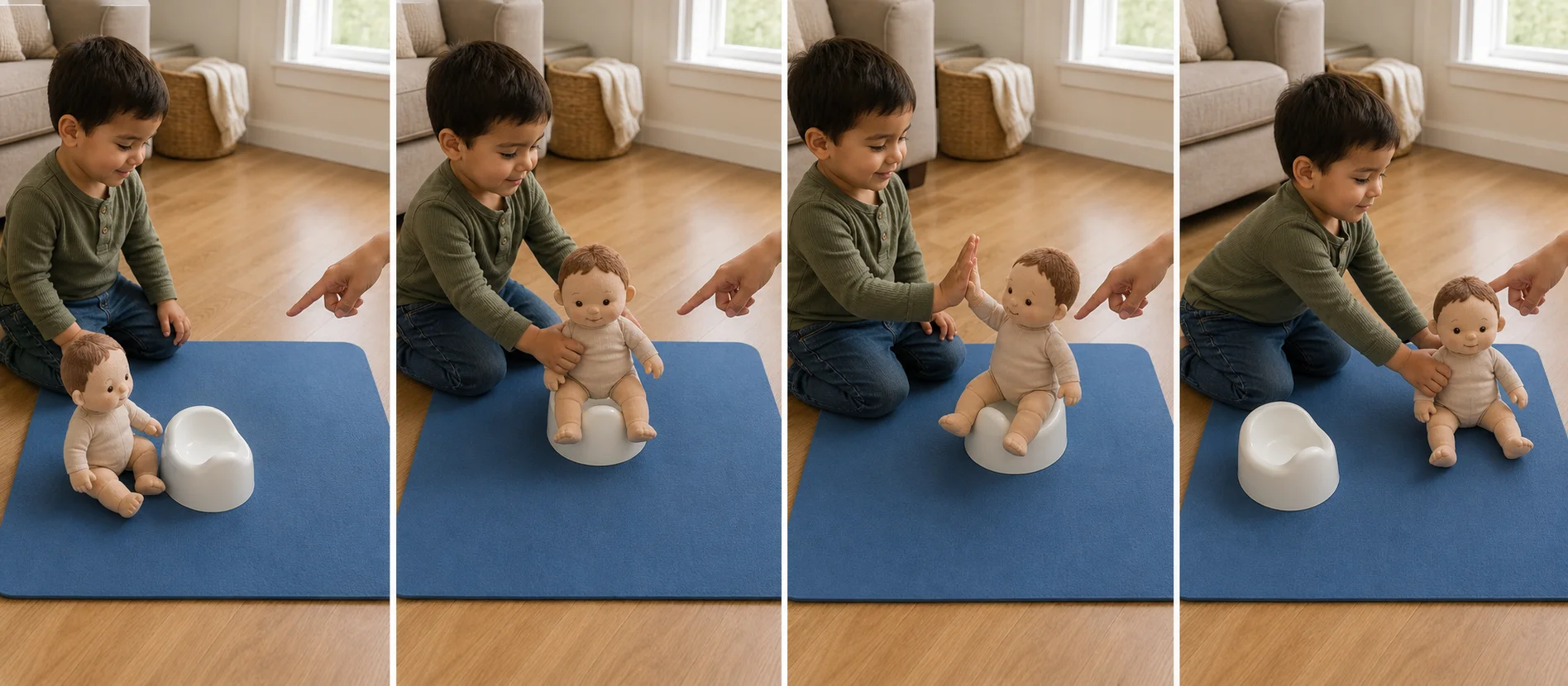
Three-panel sequence showing the doll sitting, the child giving a cheer, and the doll moving to an all-done spot.
  1. 01
    Say, "Dolly is going to try. Sit, wait, high-five, all done."
  2. 02
    Let your child put the doll on the pretend potty.
  3. 03
    Count to three together, or wait silently if that feels calmer.
  4. 04
    Let your child give one praise action, such as a high-five, clap, thumbs-up, or "Good trying."
  5. 05
    Move the doll to the reset spot and say, "All done."
  6. 06
    Bring the same doll back, or swap in another stuffed toy and repeat the same sequence.

Safety Check

  • Keep the potty stand-in sturdy and clean because the child may lean on or handle it.
  • Keep the activity doll-only. Do not turn the game into a real toileting request.
  • Avoid pressure, shame, or demand language. Keep the play calm and relaxed.
Supporting the play

What to say in the moment

Match what you say to what you see.

Prompt ladder
Level 1 (Start)
"Dolly tries, then we cheer."
Level 2 (Keep going)
"Put dolly on, wait, then all done."
Level 3 (Stretch)
"You choose dolly's praise this time."
Level 4 (Extend)
"Can dolly remember the same order again?"
If your child seems...
What you'd see
Focused
What to do
Say
"You remembered the order."
Add
Ask one sequence prompt, such as "What comes next?"
Extend
Let the child lead the next doll turn while you copy their words.

Make it easier

Younger end
  • -Use a silent thumbs-up instead of spoken praise.
  • -Let the adult move the doll while the child controls only the cheer.
  • -Stop after the doll reaches the reset spot once.

Make it harder

Older end
  • +Ask the child to run the whole sit, wait, praise, all-done order.
  • +Have the child choose a calm praise phrase before the next turn starts.
  • +Pause before the reset spot and let the child tell you where the doll goes.

If it's not working

If you see
If child ignores it
Do one complete doll turn yourself, make the praise the fun part, and offer the child only the high-five job.
If you see
If child misuses it
Pause, put the potty stand-in back on the mat, and say, "Potty stays here. Doll sits, then all done."
If you see
If child gets frustrated
End after one successful praise moment and say, "Dolly tried. All done." Try again later instead of pushing another turn.
Skill spotlight
Finish And Reset

Finishing a short care routine and resetting it

This helps the child feel how a care routine can start, pause, finish, and reset without pressure on their own body.

  • The doll-only setup lets your child practice the routine order without putting pressure on their own body.
  • The visible all-done spot makes the finish easy to see and repeat.
  • The praise action gives your child one clear job even if they are not ready to run the whole sequence.
  • The same short loop supports waiting, reset language, and calm participation.
Real-world transfer
  • Hearing a routine script without feeling rushed
  • Waiting briefly before a next step
  • Seeing that a care step can end calmly
  • Using praise and all-done language around body-care routines

Parent questions