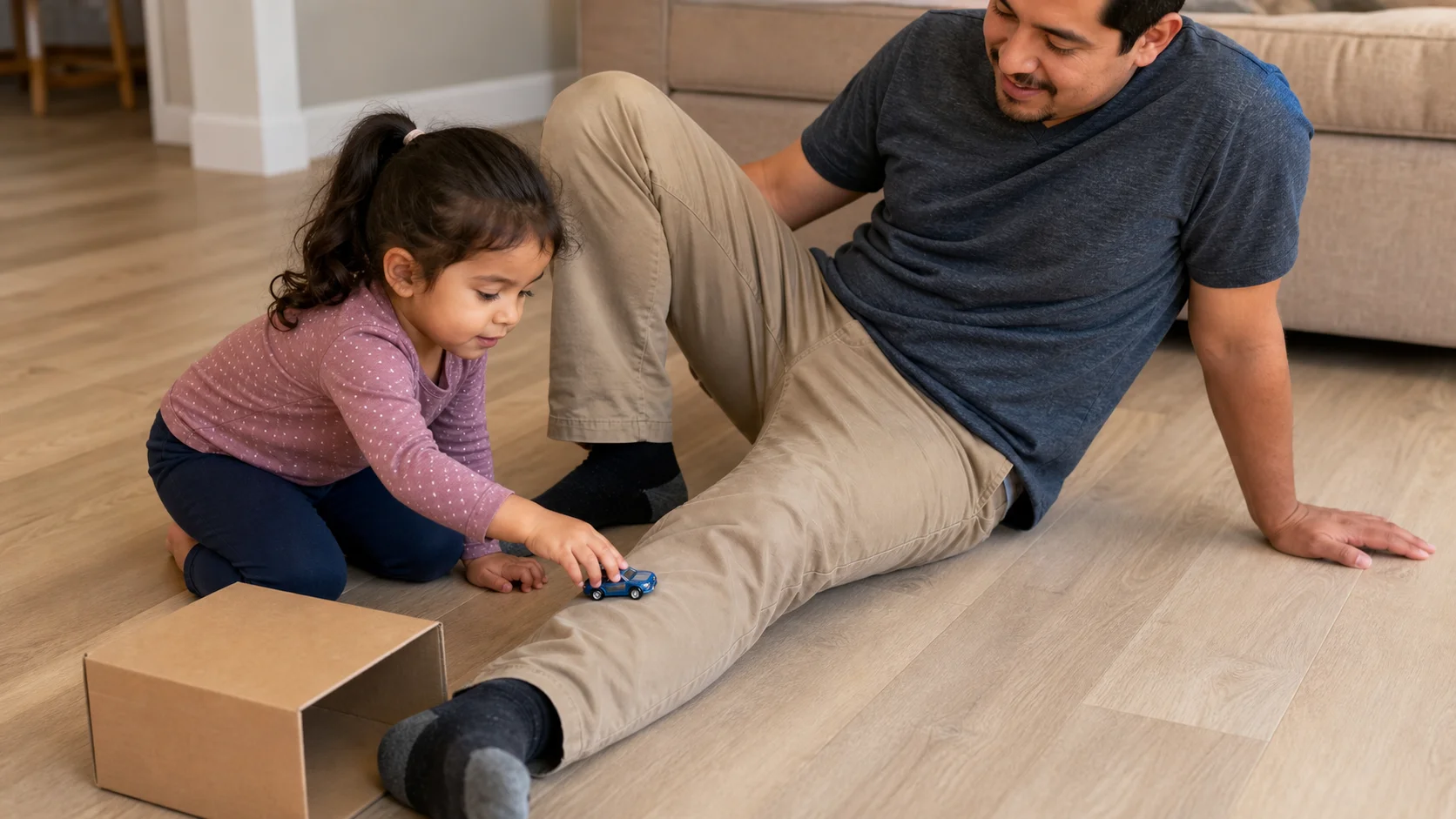
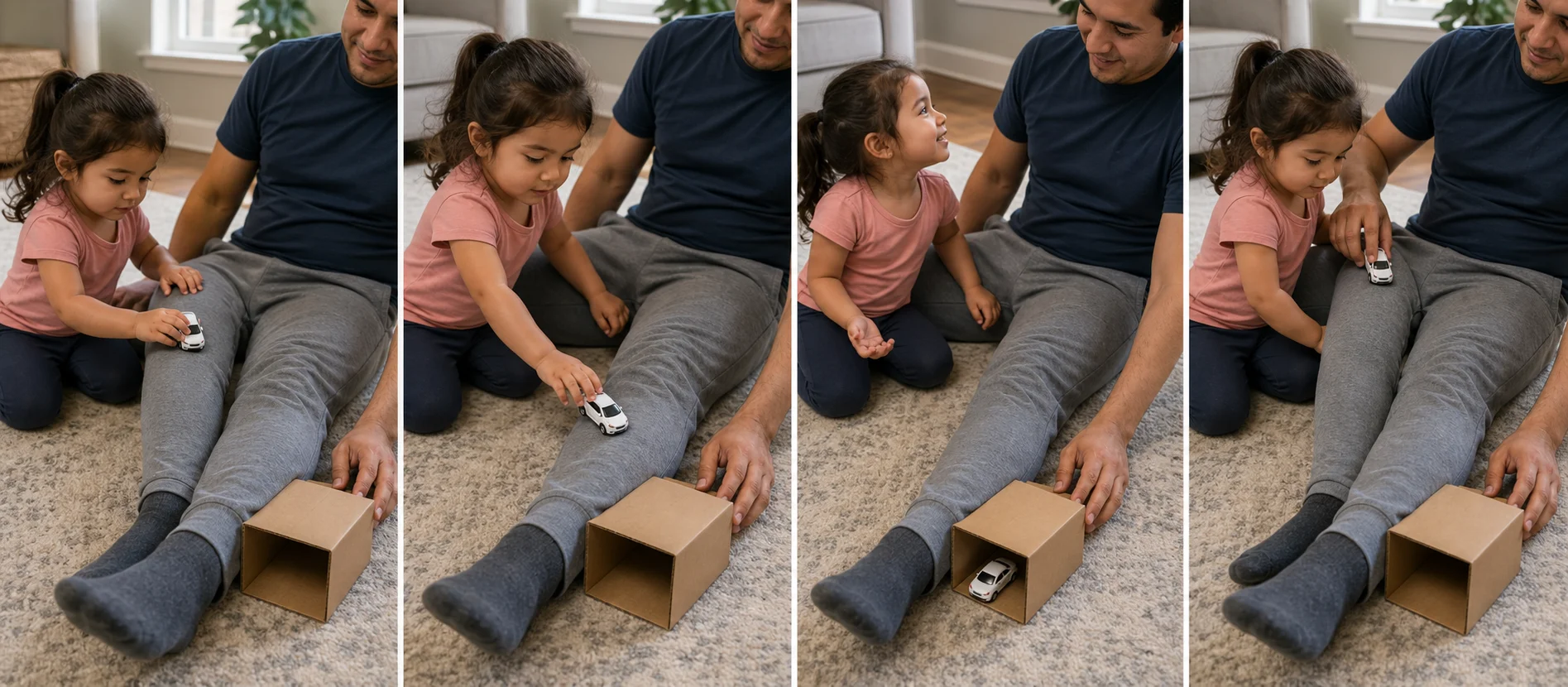
A child rolling a toy car down a grown-up's clothed leg toward a small box garage on the floor.
ThinkingSensory-friendly supportMove Through PathIndoor

Car Down Leg Garage.

Drive a toy car down a clothed body road, park it in a small box garage, and pause for another-turn signals.
Play time
2-5+ min
Age
2-4 years
Energy
Low
Mess
No
Effort
Low
Where
Indoor
Start here

The recipe.

Low parent effort
5 things

What you need

  • 1 toy car
  • 1 shoebox or small open box
  • 1 adult
  • 1 child
  • Clothing that covers the arm or leg used as the car track
2 min minimum

Setup

Then start the loop
Step 01
On the floor or couch, sit with your child where you can both see the body track and box.
Step 02
On the lower end of the clothed arm or leg, place the shoebox or small open box with the opening facing the car path.
Step 03
On the clothed arm or leg, make a gentle road toward the box. Start with the adult's body track unless your child clearly wants the car on their own body.
Step 04
At the top of the clothed road, place the toy car where your child can reach it.
Step 05
Show one slow drive from the top of the road into the box garage.
"Car ready."
The loop

How play unfolds.

A multi-panel sequence showing a toy car starting at the top of a clothed leg, rolling down the body road, parking in a box, and resetting for another turn.
  1. 01
    Say, "Ready? Car goes down the road and into the garage."
  2. 02
    Let the child push or roll the car down the clothed road.
  3. 03
    Count the car as parked when it reaches or touches the box.
  4. 04
    Pause for a look, point, sign, word, or hand-back, then return the car to the top and repeat.

Safety Check

  • Keep the body track clothed and stop if the child pulls away, freezes, or refuses another turn.
  • Use a toy car large enough not to be a mouthing or choking concern.
  • Keep the car path slow and away from the face unless the child clearly chooses and tolerates that input.
  • Keep the adult's arm or leg stable so the child is not leaning or climbing on an unstable body position.
Supporting the play

What to say in the moment

Match what you say to what you see.

Prompt ladder
Level 1 (Start)
Put the car at the top and watch it drive into the garage.
Level 2 (Keep going)
"Your turn: top, road, garage."
Level 3 (Stretch)
"Can the car park slowly this time?"
Level 4 (Extend)
"Choose arm road or leg road for the next drive."
If your child seems...
What you'd see
Focused
What to do
Say
"Again? Top, road, garage."
Add
Let the child reset the car before you add words.
Extend
Offer one small choice: arm road or leg road.

Make it easier

Younger end
  • -Place the car just above the garage so one small push finishes the turn.
  • -Move the garage opening close to the clothed road so the car has a wider target.
  • -Treat a car that touches the box as a successful park.

Make it harder

Older end
  • +Let the child return the car to the top without adult help.
  • +Pause at the top until the child gives a "go" look, sign, or word.
  • +Try one slow drive and one regular drive, then keep the one the child likes.

If it's not working

If you see
If child ignores it
Do one adult model run with a small sound effect, then hand over the car and say, "Your turn to park it."
If you see
If child misuses it
If the child throws the car, drives it away, or bangs the box, shorten the path and say, "Car stays on the road, then garage."
If you see
If child gets frustrated
Move the car closer to the box, use the adult's clothed body track, count a box touch as a park, or stop after one successful garage park.
Skill spotlight
Path And Direction

Moving a toy along a body path, Staying with object touch for another turn

The repeated road-to-garage path helps the child stay with safe body contact, follow a visible path, and keep a simple shared play turn going.

  • The top-to-garage path gives your child a clear start, finish, and reset to repeat.
  • The clothed body road keeps touch visible and optional, which matters when body contact feels unpredictable.
  • The pause after parking creates a natural reason to look, point, sign, say "again," or hand the car back.
Real-world transfer
  • Staying with gentle touch during care routines.
  • Following a simple start-to-finish path.
  • Asking for another turn in shared play.
  • Resetting a toy to try the same action again.

Parent questions