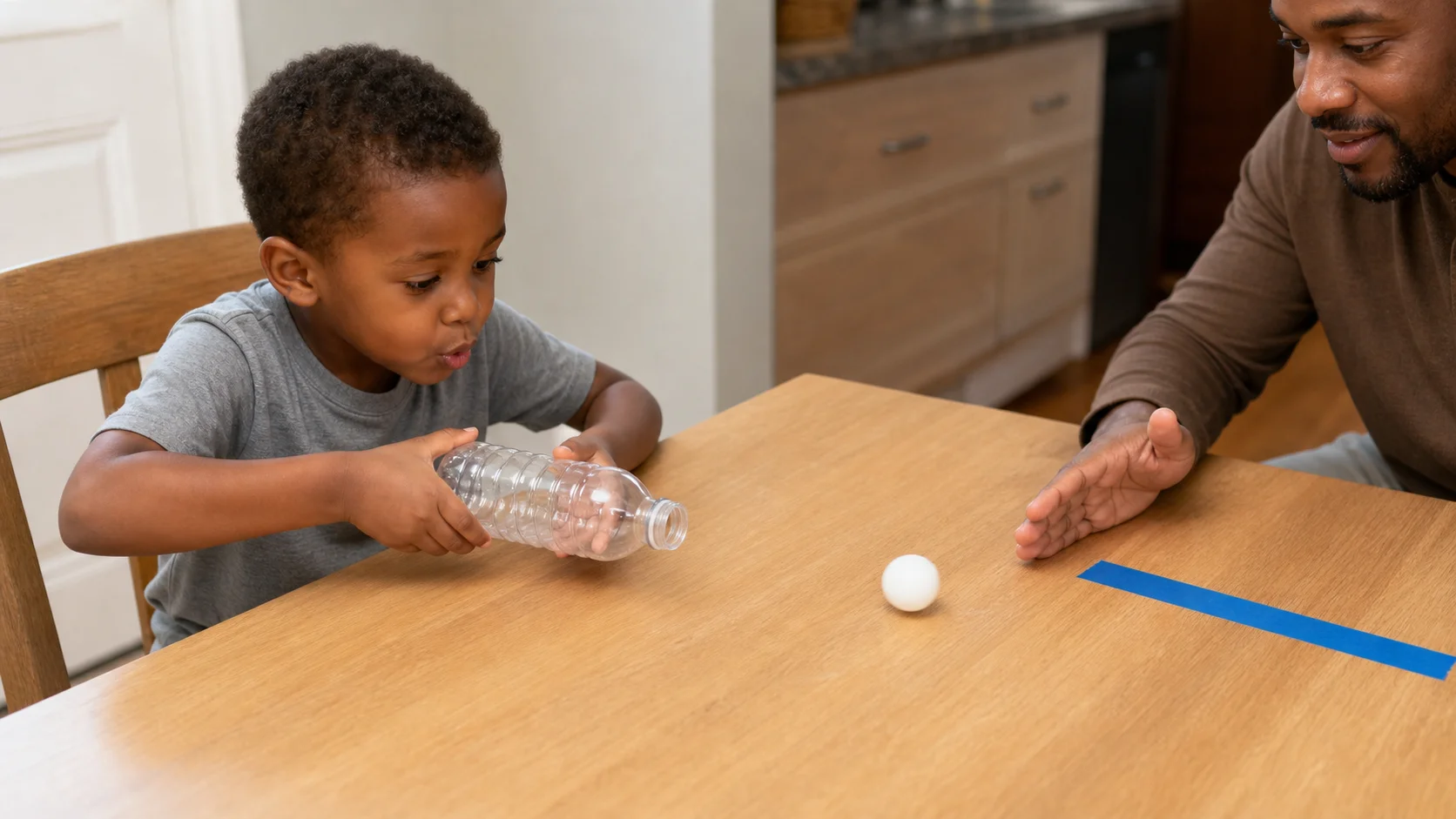
A child squeezing an empty plastic bottle to move a ping-pong ball toward a tape finish line on a table.
Fine motorOT-adjacent supportSqueeze And Release`Indoor

Bottle Puff Race.

Aim an empty bottle at a lightweight racer, squeeze a puff of air, and reset for another run to the tape.

Play time
3-5+ min
Age
3-4 years
Energy
Low
Mess
No
Effort
Low
Where
Indoor
Start here

The recipe.

Low parent effort
6 things

What you need

  • 1 empty plastic bottle with cap removed
  • 1 feather, pom-pom, or ping-pong ball
  • 1 strip of painter's tape
  • 1 clear table surface
  • 1 adult
  • 1 child
3 min minimum

Setup

Then start the loop
Step 01
On the table, clear one straight lane from your child to the far edge.
Step 02
Across the far side of the table, press the tape down as the finish line.
Step 03
Near your child, place the feather, pom-pom, or ping-pong ball at the start of the lane.
Step 04
Out of reach, put the bottle cap away.
Step 05
In your child's hands, place the empty bottle with the open neck facing the racer.
"Aim here."
The loop

How play unfolds.

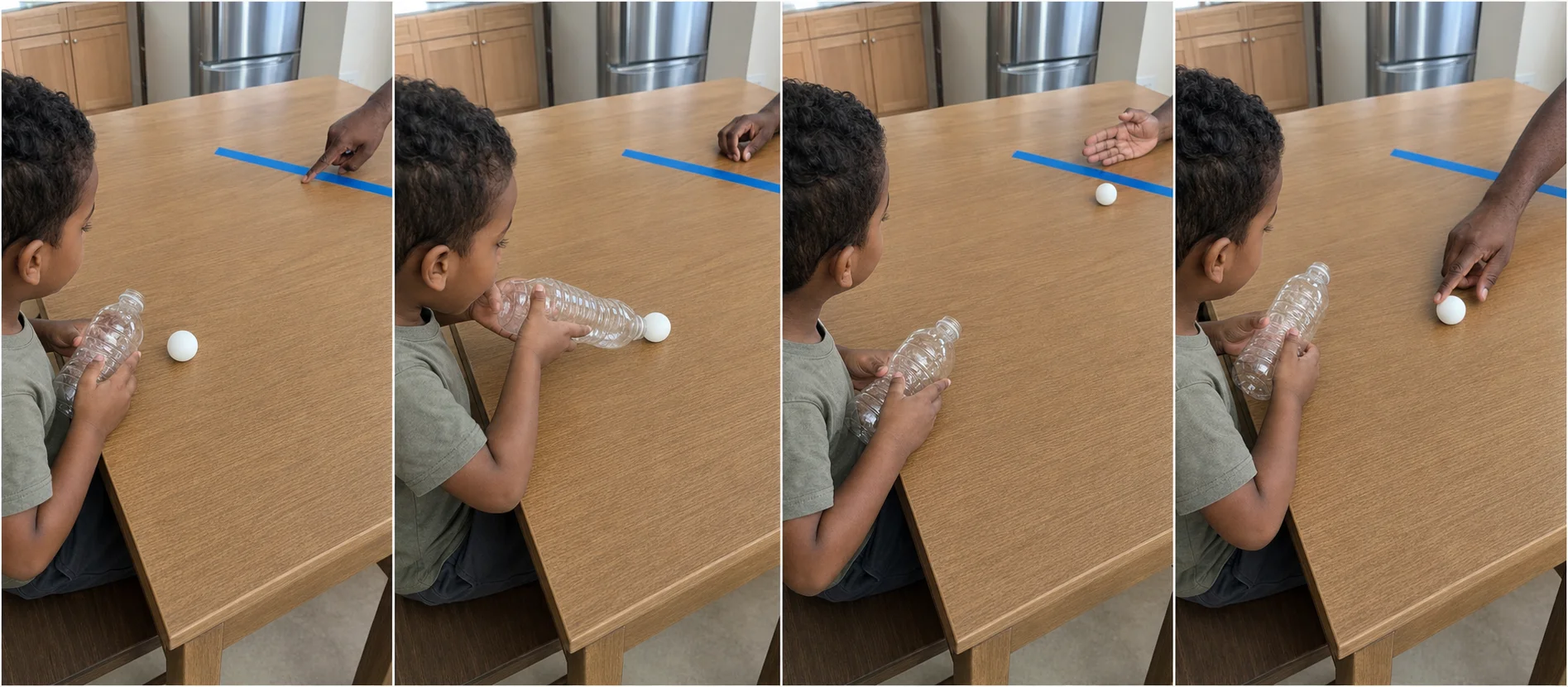
A multi-panel sequence showing a child aiming the bottle, squeezing air, watching the racer move, resetting it, and trying another puff.
  1. 01
    Point from the racer to the tape and say, "Let's puff it to the line."
  2. 02
    Let your child aim the open bottle at the racer and squeeze once or twice.
  3. 03
    Name the result: "It moved," "It stopped," or "It made it."
  4. 04
    Slide the racer back to the start and invite another puff.

Safety Check

  • Remove the bottle cap from the play area before starting because it is a small choking hazard.
  • Use a racer large enough not to be a choking hazard, and supervise closely if your child mouths objects.
  • Stay close enough to catch or block the racer before it falls off the table.
  • Stop or switch activities if your child climbs, leans far over the table, mouths the materials, throws the racer, or strains to squeeze the bottle.
Supporting the play

What to say in the moment

Match what you say to what you see.

Prompt ladder
Level 1 (Start)
"Aim at the racer and squeeze."
Level 2 (Keep going)
"Bring it back to start and puff again."
Level 3 (Stretch)
"Try one tiny puff, then one big puff."
Level 4 (Extend)
"Can you stop it right on the tape?"
If your child seems...
What you'd see
Focused
What to do
Say
"You are aiming right at it."
Add
"Name the racer before the next puff."
Extend
"Take turns choosing tiny puff or big puff."

Make it easier

Younger end
  • -Let your child hold the bottle with both hands while you lightly guide the neck angle.
  • -Count any forward wiggle as a completed race turn.
  • -Keep the bottle very close to the racer.

Make it harder

Older end
  • +Ask your child to choose tiny puff or big puff before squeezing.
  • +Try to make the racer stop close to the tape instead of blasting past it.
  • +Start the racer a little farther from the tape while keeping it safely on the table.

If it's not working

If you see
If child ignores it
Do the first puff yourself, celebrate when the racer moves, and hand the bottle back for "your turn."
If you see
If child misuses it
Pause and restate one rule: "Bottle points at the racer." If the racer gets mouthed or thrown, switch to a safer large option or end the turn.
If you see
If child gets frustrated
Move the racer closer to the tape, use the lightest object you have, or let your child squeeze with two hands while you help aim.
Skill spotlight

Squeeze control

This helps with the hand pressure used for squeeze bottles, art tools, feeding tools, and later open-close tools.

  • Squeezing the bottle gives your child repeated hand-pressure practice with an immediate result they can see.
  • Aiming at the racer connects the squeeze to the movement, so the action has a clear cause and effect.
  • Resetting the racer after a weak puff gives your child a quick, low-stakes way to try again.
Real-world transfer
  • Using squeeze bottles in art or water play
  • Pressing small tools with steadier hands
  • Preparing for scissors and other open-close tools
  • Trying again after a tool does not work the first time

Parent questions