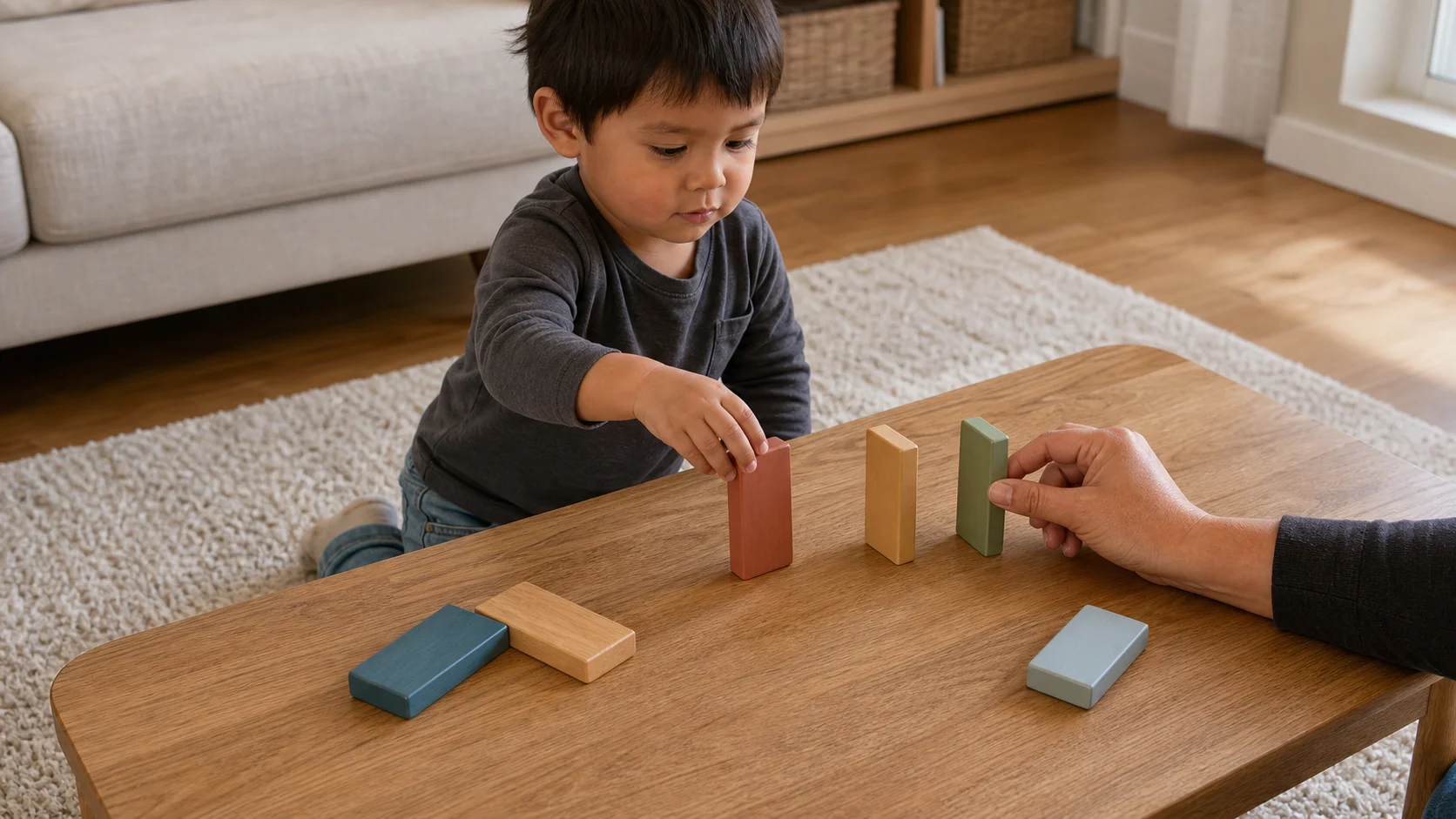
Toddler standing a short line of dominoes while a grown-up steadies one piece nearby.
Fine motorOT-adjacent supportPlace With Control`Indoor

Domino Rally Reset.

Turn a short domino rally into a stand, tap, fall, and reset loop your toddler can repeat.

Play time
5-10+ min
Age
2-4 years
Energy
Low
Mess
No
Effort
Low
Where
Indoor
Start here

The recipe.

Low parent effort
4 things

What you need

  • 6 to 10 dominoes or small rectangular blocks
  • 1 flat floor spot or low table
  • 1 adult
  • 1 child
5 min minimum

Setup

Then start the loop
Step 01
On the floor or a low table, clear enough space for a short line of pieces to fall sideways.
Step 02
Beside the build space, put 6 to 10 dominoes or rectangular blocks in a loose reset pile.
Step 03
In front of the child, stand 2 pieces in a short straight starter line.
Step 04
Near the child's hand, place 1 loose piece so the first job is obvious.
Step 05
Beside the child, sit close enough to steady a piece, shorten the line, or reset quickly.
"Ready, stand."
The loop

How play unfolds.

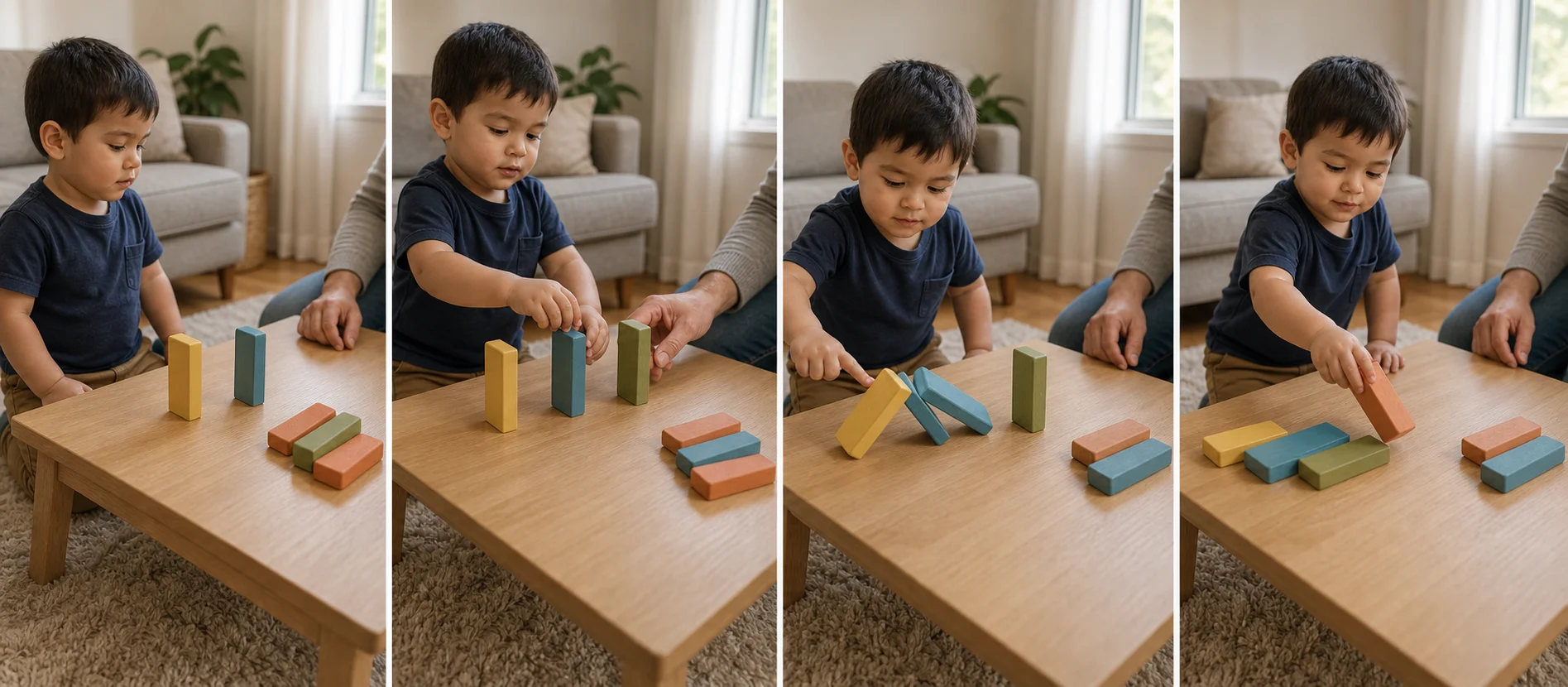
Three-panel sequence showing a child standing dominoes, tapping the first piece, and rebuilding the fallen line.
  1. 01
    Stand two pieces, tap the first one, and say, "I stand it. I tap it. Fall down. Your turn."
  2. 02
    Let your child stand one piece, tap the first piece, or hand you a piece to stand.
  3. 03
    Watch the line fall. Count the turn as successful when one piece knocks another down or when your child intentionally taps the starter line.
  4. 04
    Rebuild from the reset pile and repeat with the same simple words: "stand," "tap," "fall," and "try again."

Safety Check

  • Use dominoes or blocks large enough that they are not a choking risk for the child.
  • Use lightweight pieces and keep the line short so falling pieces do not hit the child's face, fingers, table edges, glass, or breakable objects.
  • Pause if pieces are thrown, mouthed, slammed, or used near the child's face.
  • Shorten the line if repeated accidental falls create frustration.
Supporting the play

What to say in the moment

Match what you say to what you see.

Prompt ladder
Level 1 (Start)
Stand one piece and invite the child to tap the start piece.
Level 2 (Keep going)
Let the child choose which fallen piece to stand back up.
Level 3 (Stretch)
Add one more piece after the short line falls successfully.
Level 4 (Extend)
Try the quietest tap that still makes the rally fall.
If your child seems...
What you'd see
Focused
What to do
Say
"Stand, tap, reset."
Add
Count only the pieces already standing.
Extend
Try a softer tap or one extra piece.

Make it easier

Younger end
  • -Give the child only one loose piece at a time so the next job is obvious.
  • -Use your finger as a brief wall while the child straightens a wobbly piece.
  • -Let the child be the tapper for several rounds before asking for standing again.

Make it harder

Older end
  • +Ask for a soft tap, then a medium tap, and notice which one works.
  • +Add a small bend in the line only after straight lines are falling reliably.
  • +Let the child repair one fallen piece without rebuilding the whole row.

If it's not working

If you see
If child ignores it
Build only 2 pieces, knock them down yourself, and offer the first standing piece again without asking for a full rebuild.
If you see
If child misuses it
If pieces are thrown, mouthed, or slammed, pause the rally and switch to putting pieces in the pile for one minute before trying again later.
If you see
If child gets frustrated
Shrink the job to one adult-standing piece and one child tap, then say, "That was the whole turn."
Skill spotlight
Placement Control

Careful placement

This supports the small hand control used for blocks, puzzles, dressing fasteners, table tools, and other careful everyday jobs.

  • Standing each piece gives your child a small placement job with an immediate visual result.
  • The tap and fall make cause and effect easy to see without a long explanation.
  • Rebuilding the same short line turns a collapse into the next round instead of a mistake.
  • The reset pile keeps the finish visible and gives the loop a clear way to start again.
Real-world transfer
  • Placing puzzle pieces and blocks more carefully
  • Using small table toys without scattering them
  • Handling simple fasteners, crayons, and utensils with steadier pressure
  • Resetting after a miss instead of quitting right away

Parent questions