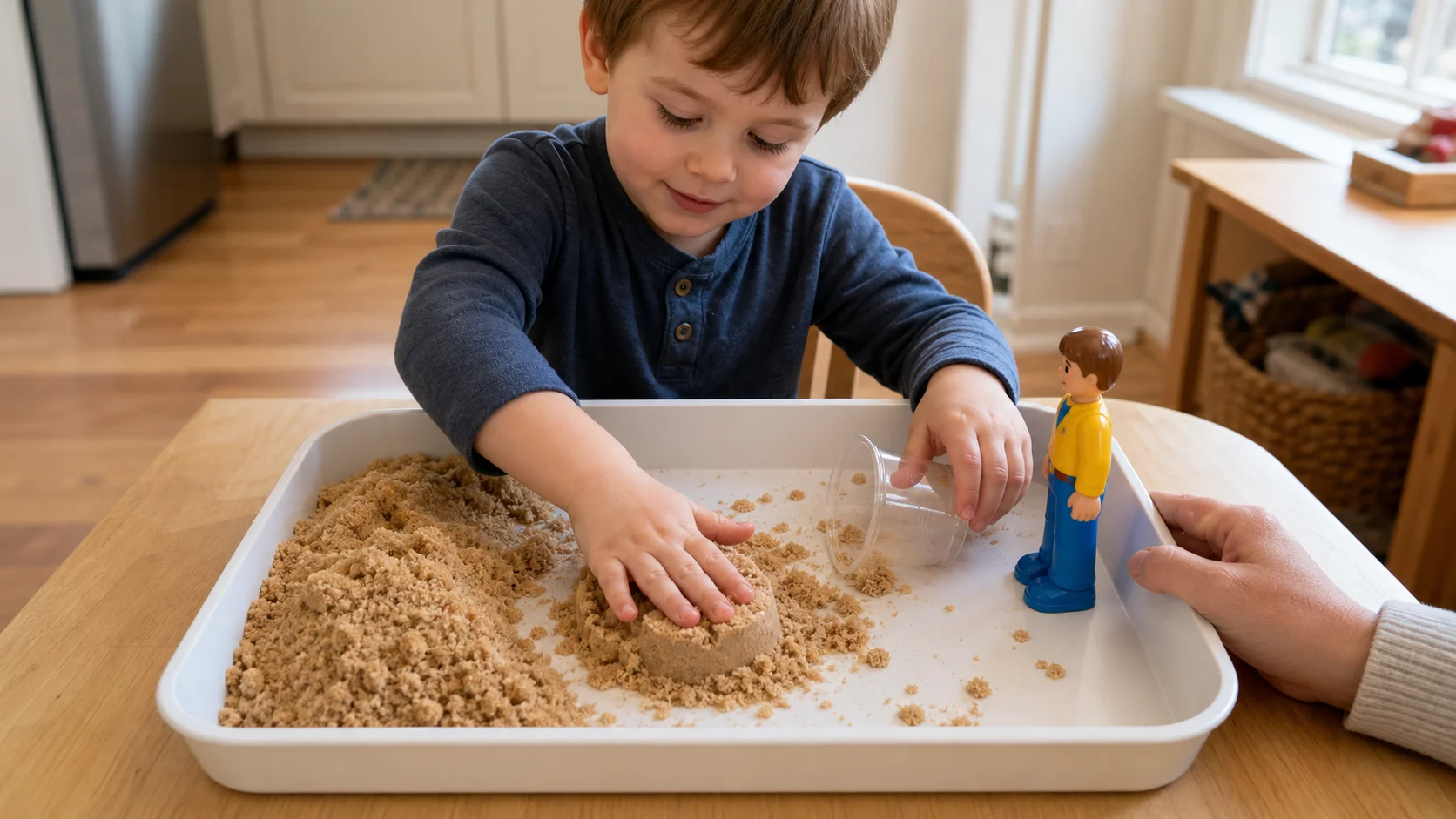
A child pressing brown sugar into a small cup on a shallow tray while a grown-up keeps the tray steady.
Fine motorAutism supportPush Through Resistance`Indoor

Brown Sugar Castle Crush.

Pack brown sugar into a small cup, reveal a tiny castle, add a figure, crush it, and rebuild from the same tray.

Play time
5-10+ min
Age
3-4 years
Energy
Low
Mess
Low
Effort
Medium
Where
Indoor
Start here

The recipe.

Medium parent effort
6 things

What you need

  • 1 shallow tray or large shallow container
  • Enough dry brown sugar to fill the small cup a few times
  • 1 small plastic cup or small food-storage container
  • 1 washable toy figure large enough not to be a choking hazard
  • 1 adult
  • 1 child
5 min minimum

Setup

Then start the loop
Step 01
On a stable table or floor spot, set the tray where you can sit beside your child.
Step 02
On one side of the tray, pour the brown sugar so the other side stays open for building and crushing.
Step 03
Inside the tray, place the small cup open-side up.
Step 04
At the far edge of the tray, place the toy figure until the first castle is ready.
Step 05
In the open build area, model one quick turn
scoop sugar into the cup, press it with your palm, flip the cup, and lift it away.
"Build, lift, crash."
The loop

How play unfolds.

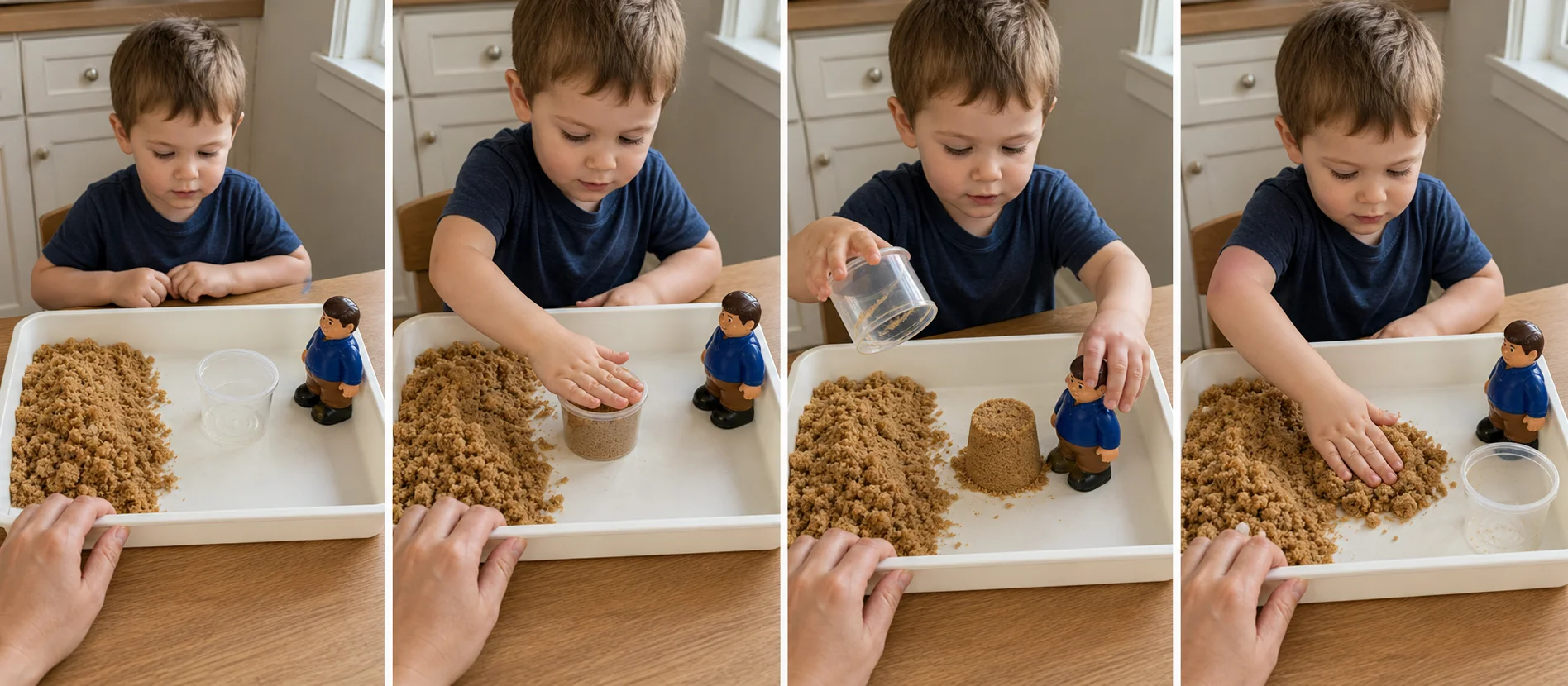
A multi-panel sequence showing brown sugar packed into a cup, flipped into a small castle, decorated with a toy figure, crushed, and rebuilt.
  1. 01
    Say, "Let's make a sugar castle, pop it out, and crash it down."
  2. 02
    Help your child fill the cup with brown sugar and press it so the sugar holds together.
  3. 03
    Flip the cup onto the open part of the tray and lift it to reveal the castle.
  4. 04
    Let your child place the toy figure on or beside the castle.
  5. 05
    Let your child crush the castle back into the tray, then rebuild with the same sugar.

Safety Check

  • Stay close because this is food play, not a snack routine, and the child may mouth or scatter the sugar.
  • Use a toy figure that is washable and large enough not to be a choking hazard.
  • Keep the tray stable on the table or floor to reduce spills and slipping.
  • Keep the play no-pressure. Do not force touching, tasting, or continued participation.
  • Choose another activity if food texture play is currently stressful for the child or if eating concerns need professional guidance.
Supporting the play

What to say in the moment

Match what you say to what you see.

Prompt ladder
Level 1 (Start)
Watch me make one castle, then you can choose the crash.
Level 2 (Keep going)
Press the sugar flat, lift the cup, and crash it back into the tray.
Level 3 (Stretch)
Put the figure by the castle before you crush it.
Level 4 (Extend)
Make the next castle slower, taller, or flatter before the crash.
If your child seems...
What you'd see
Focused
What to do
Say
"You are making the castle hold together."
Add
"Is this one tall or flat?"
Extend
Let the child lift the cup while you steady the tray.

Make it easier

Younger end
  • -Start with the crush role only, then invite one press when the child is ready.
  • -Keep the toy figure off to the side until the child is settled in the build-crush rhythm.
  • -Handle the flip together so the child does not have to manage the cup alone.

Make it harder

Older end
  • +Let the child decide whether the figure goes on top, beside, or behind the castle.
  • +Count three firm presses before the cup flips.
  • +Ask the child to make one tiny castle and one full-cup castle in separate turns.

If it's not working

If you see
If child ignores it
Keep the no-pressure rule and do one quick demo while saying, "You can watch or help when you're ready."
If you see
If child misuses it
If the sugar starts flying or the figure becomes the only focus, slide the tray closer, pause the figure, and return to one slow build-and-crush turn.
If you see
If child gets frustrated
If the castle sticks or falls apart, dump the sugar back into the tray, make one simple adult castle, and offer the easy crash role.
Skill spotlight
Pressing Control`

Hand strength and control, Food texture comfort

The repeated pressing and crushing helps the child use fingers and palms with enough pressure to shape, hold, and break apart small materials.

  • The fill, press, flip, and lift sequence gives your child repeated practice using firm hand pressure.
  • The tray loop gives the activity a clear start and reset, so a collapsed castle still leads into the next build.
  • Optional touch keeps the food texture low-pressure: your child can watch first, use the cup, or do only the crash.
Real-world transfer
  • Pressing, pinching, and shaping during food prep or art.
  • Using enough hand pressure for buttoning, cutting, and drawing later.
  • Staying with a simple household task from start to finish.
  • Exploring food textures without pressure to eat.

Parent questions