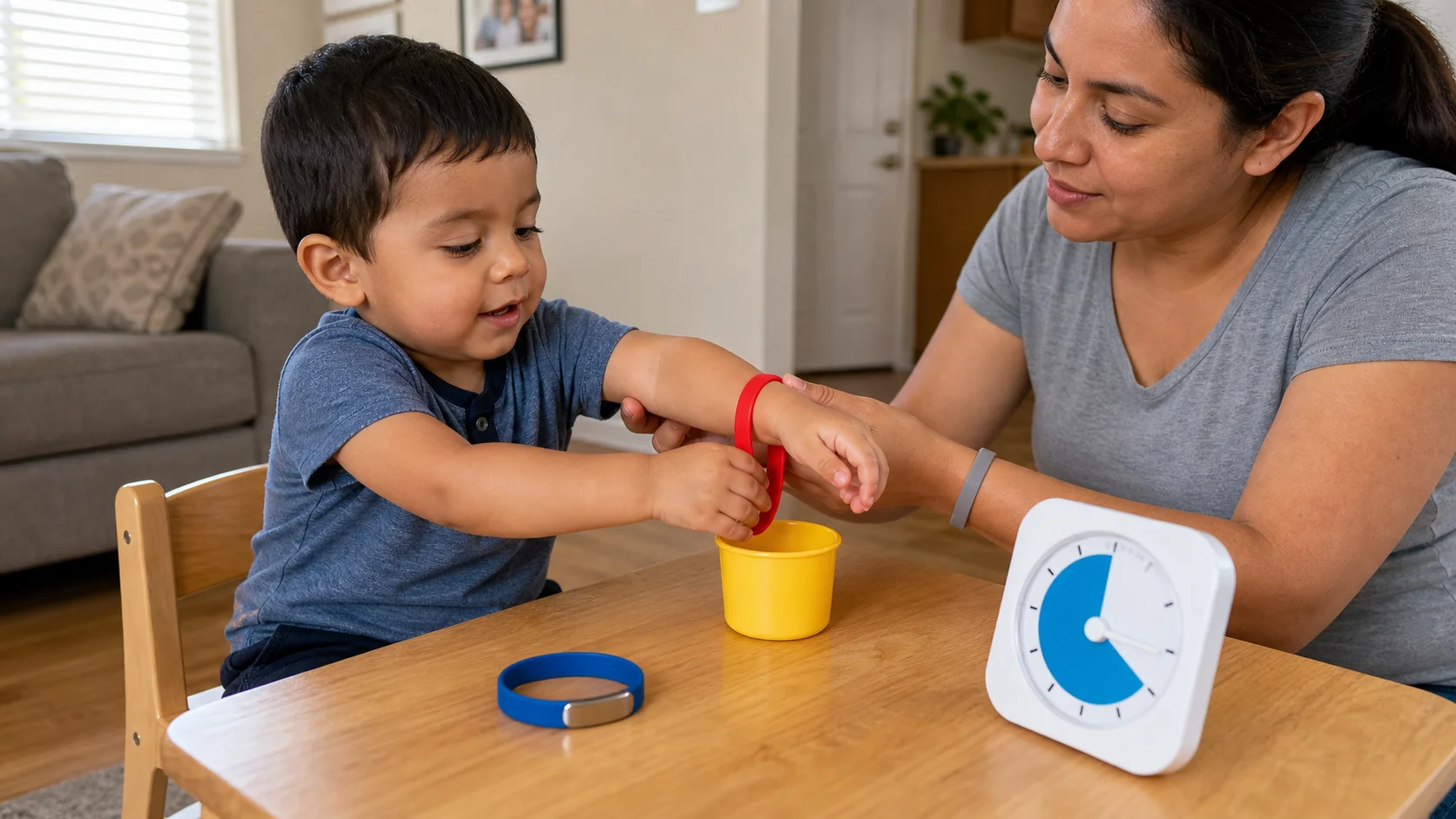
A toddler sitting at a low table with a loose colorful wristband on one wrist, a visual timer nearby, and a done cup beside two extra bands.
Skill builderAutism supportPause Before ActionIndoor

Wristband Countdown Try.

A short countdown and done cup make trying a loose wristband predictable and low pressure.
Play time
5+ min
Age
2-3 years
Energy
Low
Mess
Low
Effort
Low
Where
Indoor
Start here

The recipe.

Low parent effort
7 things

What you need

  • 2 loose comfortable wristbands in different colors for your child
  • 1 loose comfortable wristband for the adult to wear as a model
  • 1 simple visual timer, countdown strip, or sand timer
  • 1 small cup or bowl for the finished wristband
  • 1 small reward or preferred next activity
  • 1 child
  • 1 adult
5 min minimum

Setup

Then start the loop
Step 01
Seat your child at a low table or floor spot where the wristbands, countdown, and done cup can all stay within reach.
Step 02
Place the two child wristbands side by side in front of your child, put the visual countdown beside them, and set the done cup on the other side.
Step 03
Wear the model wristband on your own wrist and keep the reward or preferred next activity ready before the first turn starts.
Step 04
Sit close enough to slide the band on gently, start the countdown right away, and remove it fast if discomfort starts.
`Red or blue?`
The loop

How play unfolds.

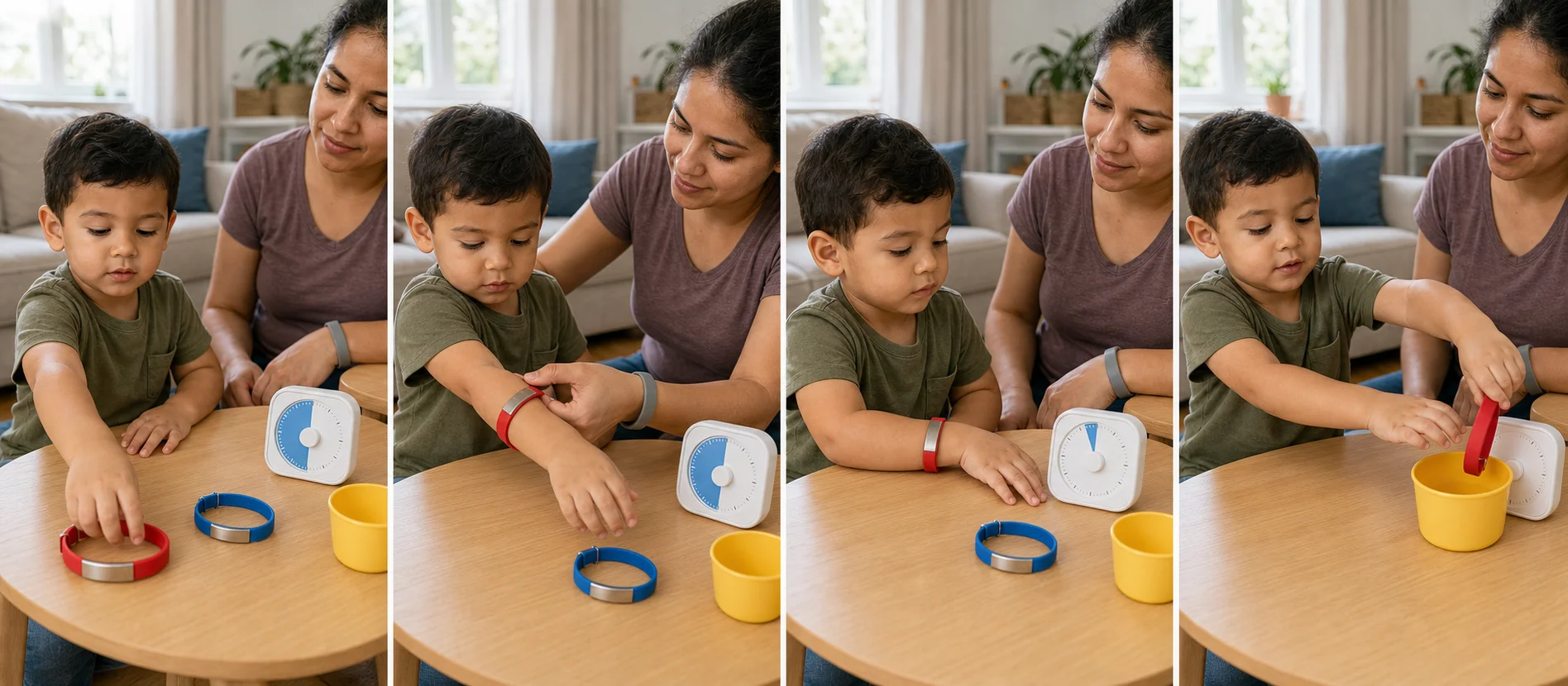
A multi-panel sequence showing a child choosing a wristband color, wearing it through a short timer, taking it off, and dropping it into a done cup.
  1. 01
    Show the wristband on your own wrist, offer the color choice, and slide the chosen loose band onto your child's wrist. Say, `Band on. Timer on.`
  2. 02
    Start the short visual countdown and let your child watch it while keeping the band on.
  3. 03
    When the countdown ends, say `All done`, help your child pull the band off if needed, and drop it into the done cup.
  4. 04
    Offer another short turn only if your child stayed calm, or stop after one success and move into the promised next activity.

Safety Check

  • Keep the wristband loose. It should slide on and off easily and should not leave marks or squeeze the wrist.
  • Stay close and remove the band right away if your child shows distress, panic, or unsafe mouthing, whipping, or yanking.
  • Keep only one child wristband active at a time if handling both bands starts to make the turn feel too busy.
Supporting the play

What to say in the moment

Match what you say to what you see.

Prompt ladder
Level 1 (Start)
Pick red or blue.
Level 2 (Keep going)
Band on, timer on.
Level 3 (Stretch)
Watch it almost finish.
Level 4 (Extend)
Last band, then done.
If your child seems...
What you'd see
Focused
What to do
Say
`You picked one.`
Add
Ask one light prompt like, `Which color is next?`
Extend
Let your child choose the next band before you touch it.

Make it easier

Younger end
  • -Use the same color for two turns before offering the other color if choosing slows the start.
  • -Let your child rest their wrist on the table during the countdown so holding still takes less effort.
  • -End after one calm successful turn and still give the full praise and reward.

Make it harder

Older end
  • +Wait one beat for your child to point to the color before you name it.
  • +Let your child start the visual countdown after the band is on.
  • +Pause one beat before helping remove the band so your child can try the first pull.

If it's not working

If you see
If child ignores it
Let your child touch or hold the band first, point to the band on your own wrist, and offer the same color choice again before starting the countdown.
If you see
If child misuses it
Keep the spare band in your hand, and if your child throws, mouths, or whips the band around, pause and restart with one loose band and one short countdown only.
If you see
If child gets frustrated
Remove the band right away, praise any tiny win, end the session, and retry later with the same calm short plan.
Skill spotlight
Wait Through Short Countdown

Waiting through a short wristband countdown, Staying with a short wear-and-remove routine

This helps a child hold back the quick pull-it-off impulse, stay with one short predictable wear routine, and expect a clear ending instead of a sudden demand.

  • The band, timer, and done cup make the start, middle, and finish easy to see.
  • The short countdown gives your child a visible end point instead of an open-ended demand.
  • One calm wear-and-remove turn lets parents and caregivers practice a wearable routine without stretching it too far.
Real-world transfer
  • Tolerating a loose wristband or other short wear item when the ending is clear
  • Waiting for a visible end point before taking off a familiar item
  • Moving through a small safety or care routine with less panic or rushing

Parent questions