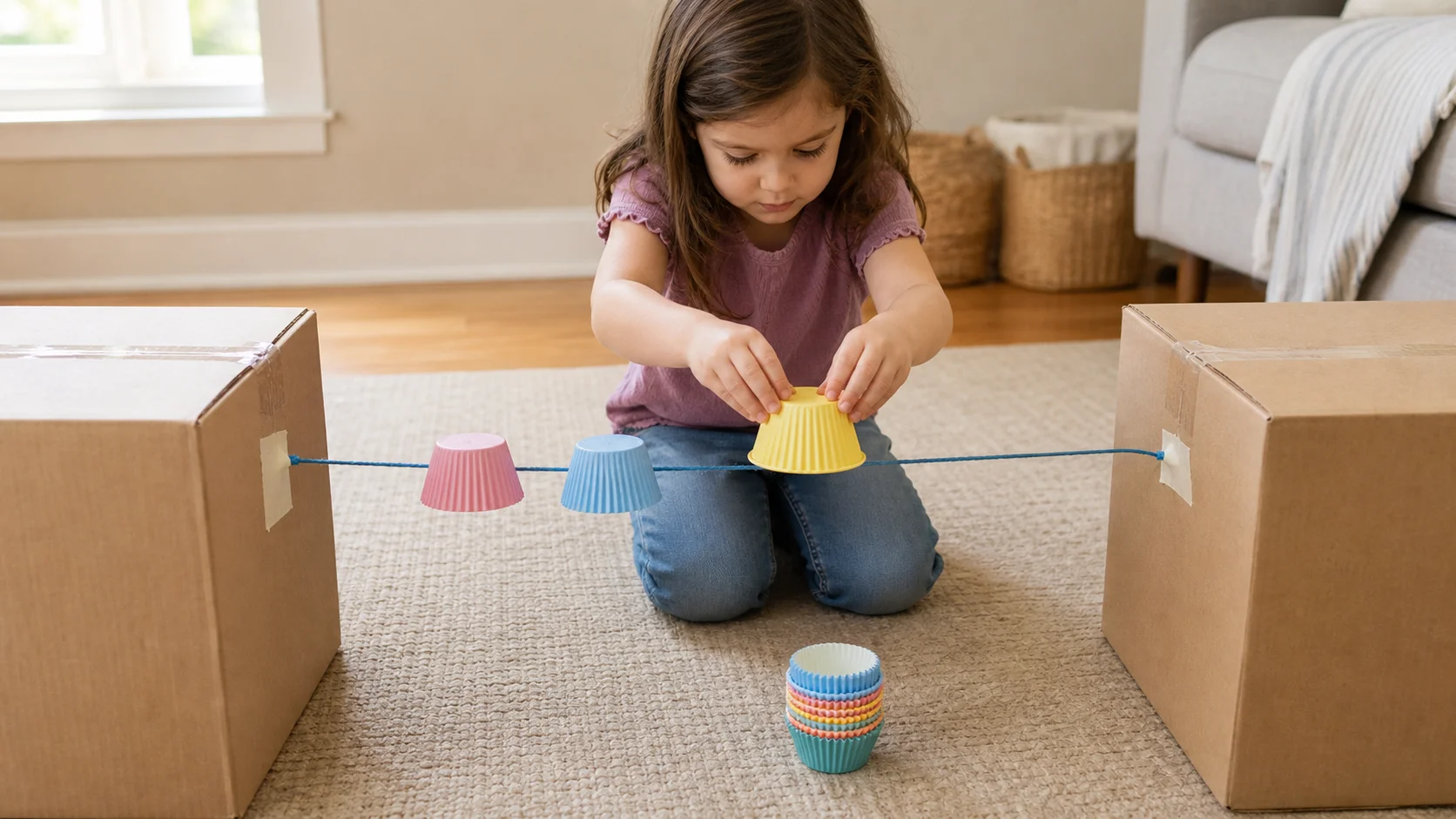
A preschool child carefully balancing upside-down paper baking cups on a taut yarn line between two boxes.
Fine motorOT-adjacent supportPlace With ControlIndoor Floor Space

Baking Cup Tightrope Balance.

Turn two boxes, yarn, and paper baking cups into a careful hands balance challenge.

Play time
5-10+ min
Age
3-5 years
Energy
Low
Mess
Low
Effort
Medium
Where
Indoor Floor Space
Start here

The recipe.

Medium parent effort
5 things

What you need

  • 2 large heavy boxes
  • Masking tape
  • 1 long piece of yarn
  • Colorful paper baking cups
  • 1 adult for setup and direct supervision
5 min minimum

Setup

Then start the loop
Step 01
On the floor, place two large, heavy boxes about 2 feet apart with a clear gap between them.
Step 02
Between the boxes, tape one end of the yarn firmly to the inside of one box.
Step 03
Across the gap, pull the yarn straight and very taut, then tape the other end to the inside of the second box so the line sits about 6 inches off the floor.
Step 04
Beside the yarn, place the stack of colorful paper baking cups within your child's reach.
Step 05
Beside the line, have your child sit or kneel with both hands free.
"Make it balance."
The loop

How play unfolds.

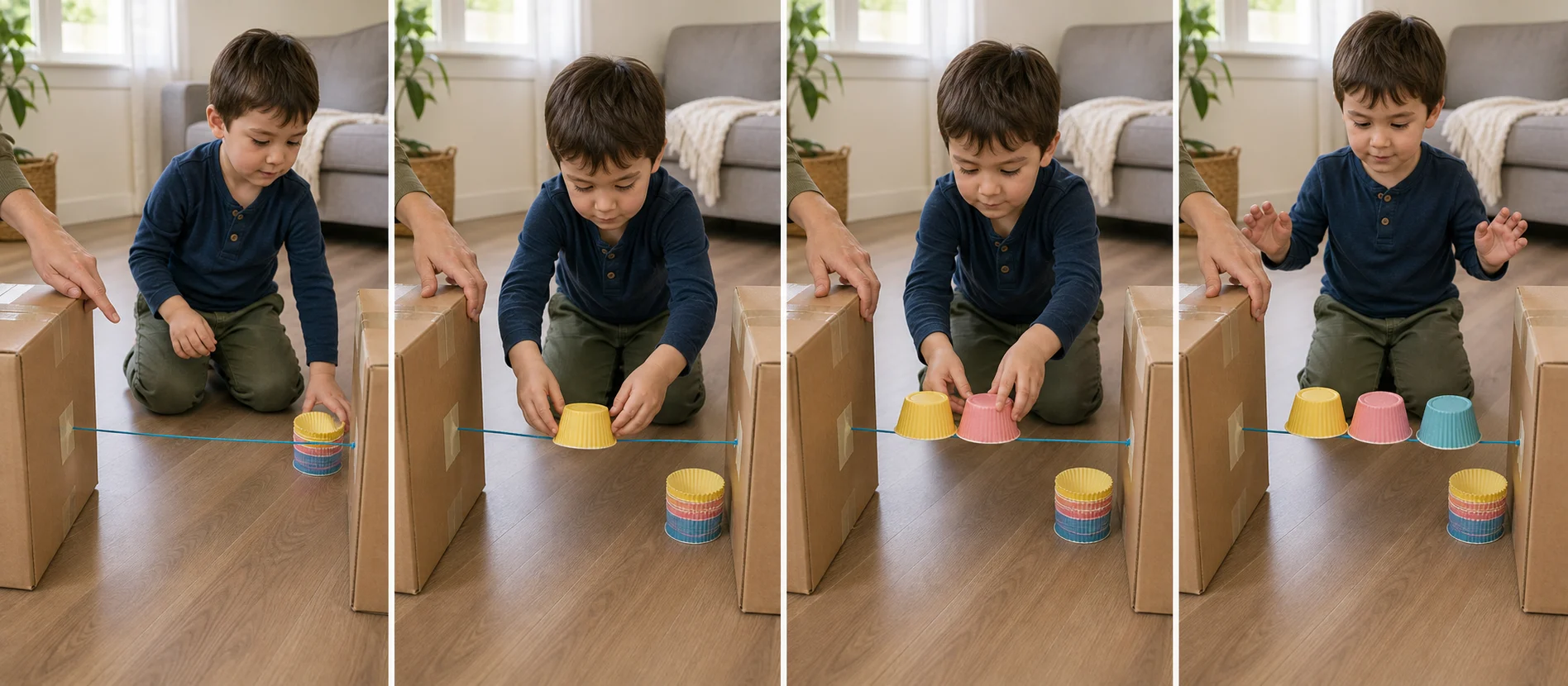
Panels show a grown-up setting up the yarn, a child lowering a baking cup onto the line, a tipped cup retry, and a finished row.
  1. 01
    Turn one baking cup upside down, lower it onto the yarn, and say, "Can you make this cup rest on the tightrope?"
  2. 02
    Let your child flip a cup, center it on the yarn, and let go slowly.
  3. 03
    If the cup tips, hand back the same cup and try again with slower hands.
  4. 04
    If the cup stays, add another upside-down cup beside it.
  5. 05
    When up to five cups are balanced or your child is finished, lift the cups off together and reset for another round.

Safety Check

  • Use direct adult supervision so the yarn is used safely and the boxes stay stable.
  • Use boxes heavy enough that they do not slide or tip when the yarn is pulled.
  • Keep the yarn taut and low to the floor.
  • Pause and reset if your child pulls the yarn, bumps the boxes, mouths the materials, climbs on the boxes, or becomes upset by repeated tipping.
Supporting the play

What to say in the moment

Match what you say to what you see.

Prompt ladder
Level 1 (Start)
Put one cup on the line and invite your child to make the next cup stay.
Level 2 (Keep going)
Point to the next open spot and say, "Slow hands for the next cup."
Level 3 (Stretch)
Ask your child to choose where the next cup should go before placing it.
Level 4 (Extend)
Try a quiet round where each cup is lowered as slowly as possible.
If your child seems...
What you'd see
Focused
What to do
Say
"That one stayed."
Add
Count the cups that are still balanced.
Extend
Invite your child to leave a small space before adding the next cup.

Make it easier

Younger end
  • -Start with the cup already upside down so your child only has to lower it onto the yarn.
  • -Offer the cup from directly above the line so the placement path is shorter.
  • -Let the cup touch the yarn while your child still has two hands on it before letting go.

Make it harder

Older end
  • +Ask your child to place each new cup without touching the cups already balanced.
  • +Leave a finger-width space between cups instead of sliding them together.
  • +Try placing the cup with the helping hand resting on the floor for a steadier body position.

If it's not working

If you see
If child ignores it
Balance the first cup yourself, react softly when it stays, and hand your child the next cup without adding more directions.
If you see
If child misuses it
Pause the game, say, "The tightrope has to stay still," reset the boxes and yarn, and offer one cup again.
If you see
If child gets frustrated
Switch to a one-cup win. Help your child hold both sides of the upside-down cup, lower it together, and stop after one successful balance.
Skill spotlight
Placement Control

Careful hand placement

This helps the child control hand force and placement before letting go. That same careful control matters for drawing, writing, and other small table tasks.

  • The narrow yarn gives your child a visible target for careful hand placement.
  • Each tip gives quick feedback, so your child can try the same cup again more slowly.
  • Flipping, centering, and releasing the cup gives both hands a small, repeated job.
  • The one-cup version keeps the challenge available when a full row feels like too much.
Real-world transfer
  • Using gentler pressure with crayons, markers, and early writing tools.
  • Placing small craft pieces without scattering them.
  • Handling light objects during cleanup or table play.
  • Slowing down when a task needs careful hands.

Parent questions