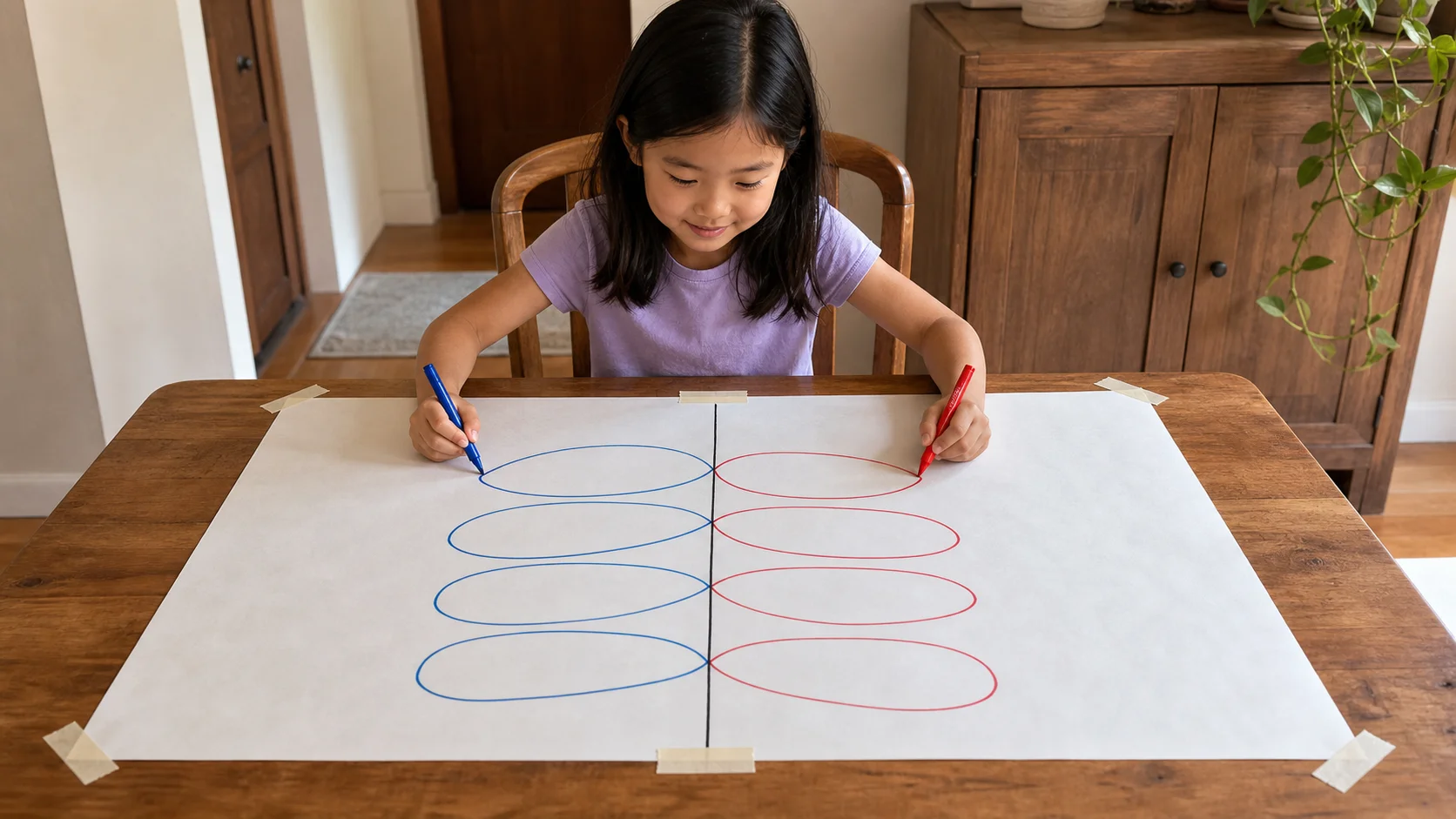
Child using two markers to draw mirror-image loops on a large taped paper sheet.
Fine motorOT-adjacent supportTwo Hand CoordinationIndoor Table Workspace

Bilateral Mirror Track Drawings.

Tape down a large sheet, draw a center line, and let your child make matching loops with two markers.

Play time
5-10+ min
Age
6-9 years
Energy
Low
Mess
Low
Effort
Low
Where
Indoor Table Workspace
Start here

The recipe.

Low parent effort
5 things

What you need

  • 1 large piece of butcher paper
  • 2 markers
  • Masking tape
  • 1 stable table
  • 1 adult for setup and supervision
5 min minimum

Setup

Then start the loop
Step 01
On a stable table, tape the butcher paper flat so it will not slide when both hands move.
Step 02
Down the middle of the paper, draw one straight line from the top edge toward the bottom edge.
Step 03
Near the top of the paper, place one marker on the left side of the line and one marker on the right side.
Step 04
At the table, seat or stand your child where both hands can reach the markers without leaning.
Step 05
Before starting, check that your child's shoulders look relaxed and wrists can rest comfortably at the table height.
"Two markers ready."
The loop

How play unfolds.

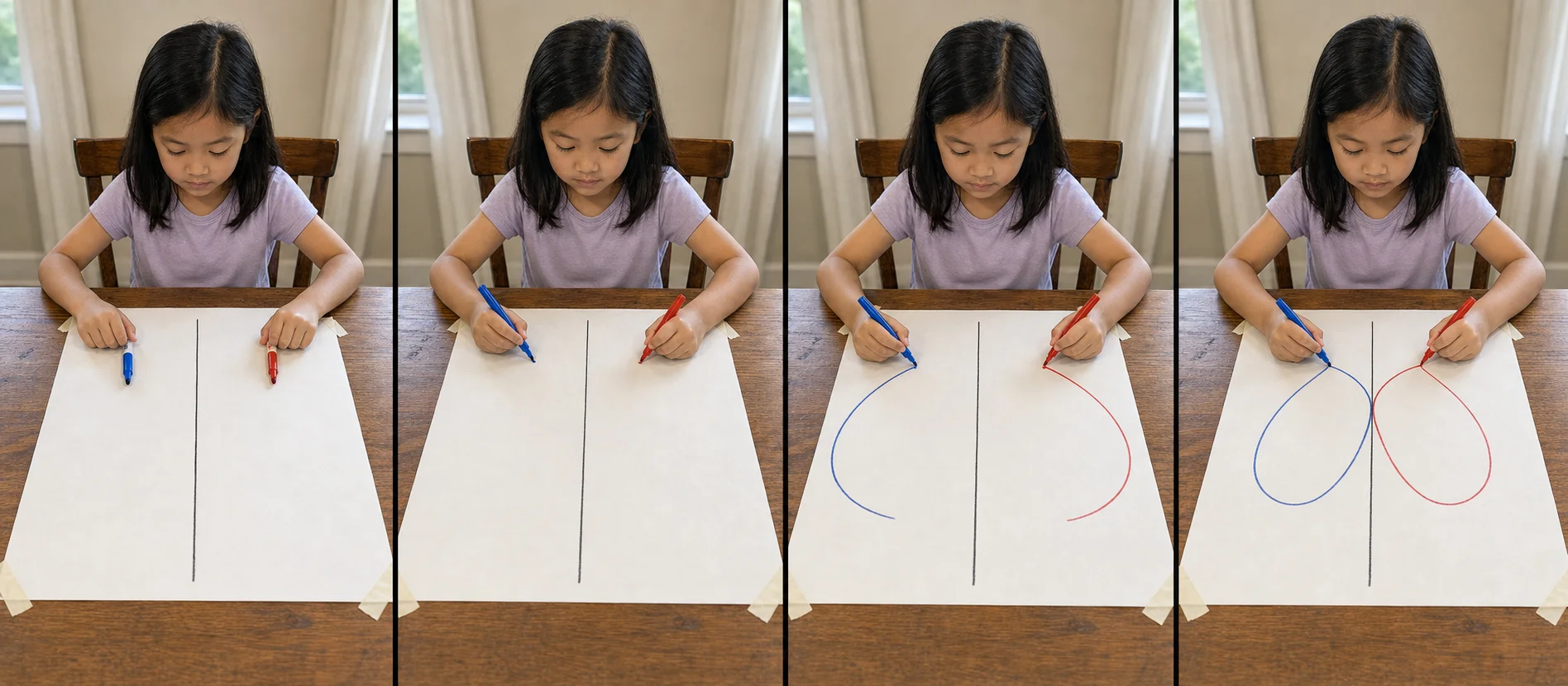
Multi-panel sequence showing two markers starting near a center line, moving outward, curving inward, and resetting for another mirrored shape.
  1. 01
    Put one marker in each hand and set both tips near the top of the paper, one on each side of the center line.
  2. 02
    Say, "Out together, in together."
  3. 03
    Your child moves both hands outward, then curves both hands back toward the center line to finish one mirror loop.
  4. 04
    Reset near the top or on a fresh blank spot and repeat with another loop, heart, or butterfly shape.
  5. 05
    Stop after a few mirrored shapes, or after one good loop if that is the right amount for the day.

Safety Check

  • Keep the table at a comfortable height to prevent wrist or neck strain.
  • Keep the paper taped flat so it does not slide while both hands move.
  • Use ordinary marker supervision and cap the markers when the activity is done.
Supporting the play

What to say in the moment

Match what you say to what you see.

Prompt ladder
Level 1 (Start)
Put both marker tips near the top and make one slow out-and-in loop together.
Level 2 (Keep going)
Try another loop and watch both hands move at the same time.
Level 3 (Stretch)
Make the next mirror shape wider while staying on your side of the line.
Level 4 (Extend)
Choose a simple shape and draw both sides together.
If your child seems...
What you'd see
Focused
What to do
Say
"Both hands are matching."
Add
Ask for one more slow mirrored loop.
Extend
Let the child choose a heart, butterfly, or big rainbow loop.

Make it easier

Younger end
  • -Use short rainbow loops instead of hearts or butterflies.
  • -Start both marker tips closer to the center line so the motion is smaller.
  • -Let the child copy your slow hand motion in the air before touching marker to paper.

Make it harder

Older end
  • +Ask for a wider mirror loop without crossing the center line.
  • +Try one shape with both markers moving slowly from top to bottom.
  • +Pause at the widest point, then curve both hands back in together.

If it's not working

If you see
If child ignores it
Draw the first outward-and-inward motion slowly with your fingers in the air, then reset both marker tips and try one short loop.
If you see
If child misuses it
Pause the markers, flatten the paper again, and restart with the cue, "Two markers move at the same time."
If you see
If child gets frustrated
Make the next round smaller and simpler, such as one short rainbow loop out and back in.
Skill spotlight
Two-Hand Coordination

Moving both hands together

This helps the child use both hands as a team while watching where each hand goes. That matters for drawing, clothing fasteners, scissors, and other two-hand table tasks.

  • Holding one marker in each hand gives both hands a shared job.
  • The center line gives your child a visible boundary for matching left and right movement.
  • Repeating the same out-and-in loop lets your child practice timing without needing a perfect picture.
  • Resetting on a fresh blank spot keeps mistakes small and easy to recover from.
Real-world transfer
  • Using both hands during drawing and early writing.
  • Holding paper steady while the other hand works.
  • Managing clothing fasteners that need two hands.
  • Using scissors or other table tools with more control.

Parent questions