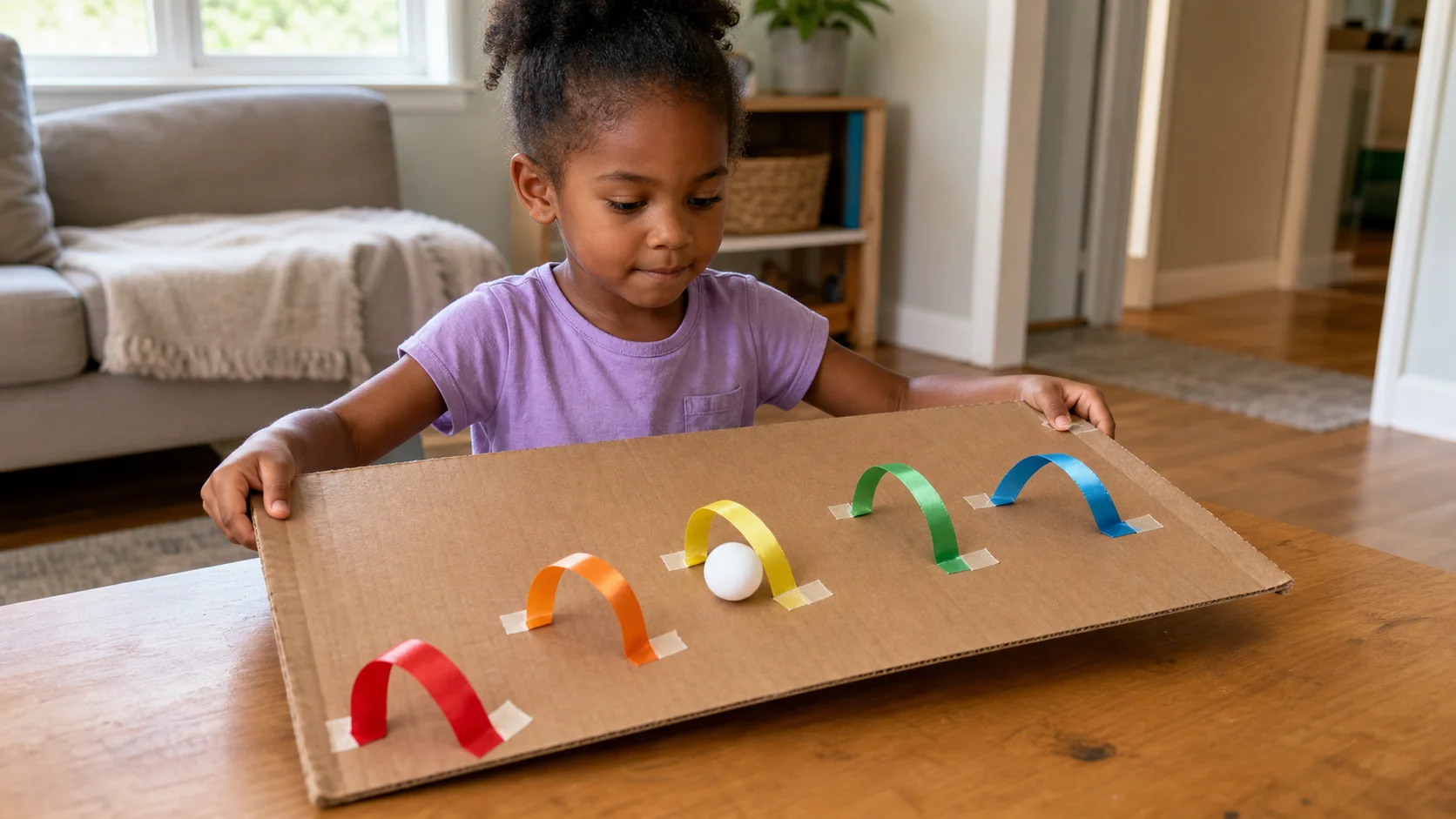
A child holds both sides of a cardboard board and tilts a ping pong ball through ribbon arches.
Fine motorTwo Hand CoordinationIndoor Floor Or Low Table Play

Wobbly Ribbon Tunnel Run.

A cardboard board and ribbon tunnels turn one ping pong ball into a steady tilt-and-steer game.

Play time
5-10+ min
Age
3-5 years
Energy
Low
Mess
Low
Effort
Medium
Where
Indoor Floor Or Low Table Play
Start here

The recipe.

Medium parent effort
6 things

What you need

  • 1 flat cardboard sheet large enough for 5 ribbon tunnels
  • masking tape
  • 5 short ribbon pieces
  • 1 pair of scissors for adult setup
  • 1 ping pong ball
  • 1 indoor floor space or low table
5 min minimum

Setup

Then start the loop
Step 01
Cut 5 short ribbon pieces.
Step 02
Tape one ribbon piece onto the cardboard so both ends stick down and the middle arches up like a small tunnel.
Step 03
Repeat until 5 ribbon arches make a simple path from one side of the board to the other.
Step 04
Move the scissors away before your child joins.
Step 05
Set the board on the floor or low table and place the ping pong ball at the start side.
Step 06
Test-roll the ball once to make sure it fits under each ribbon arch without pulling one loose.
"Both hands on."
The loop

How play unfolds.

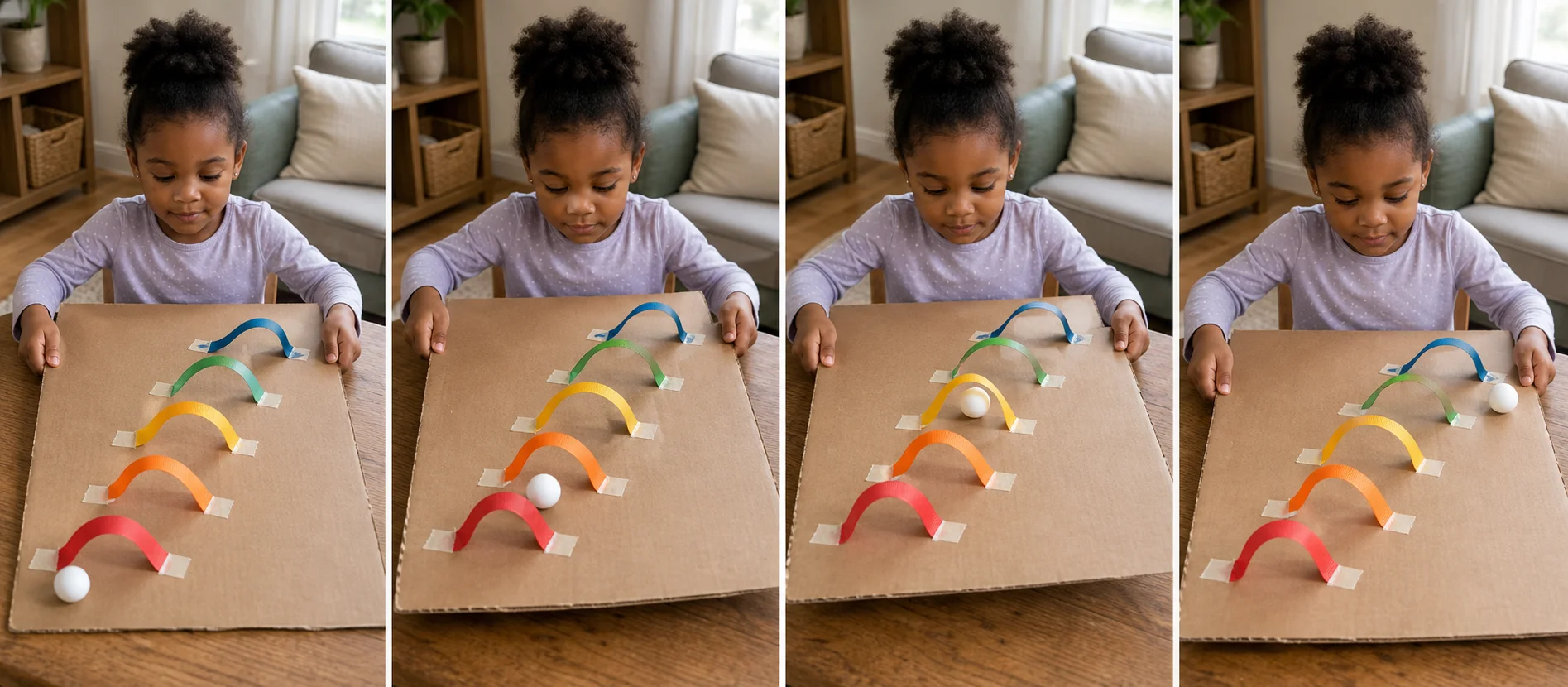
Four panels show a grown-up taping ribbon arches onto cardboard, setting a ping pong ball at the start, a child holding both sides of the board, and the child guiding the ball through the tunnel path.
  1. 01
    Place the ping pong ball at the start and say, "Tiny tilt. Send it through."
  2. 02
    Let your child hold both side edges and tip the board enough to roll the ball under one ribbon arch at a time.
  3. 03
    Level the board between tunnels, then tip again toward the next arch.
  4. 04
    When the ball reaches the end or rolls off early, place it back at the start or the last cleared tunnel and run it again.

Safety Check

  • Stay close the whole time and keep the ping pong ball out of your child's mouth.
  • Stop and reset if the ball gets thrown, mouthed, or the board starts getting shaken hard.
  • Use the scissors only for setup, then move them out of reach before play starts.
Supporting the play

What to say in the moment

Match what you say to what you see.

Prompt ladder
Level 1 (Start)
Tip it a tiny bit and watch where the ball goes.
Level 2 (Keep going)
Help it roll through the next tunnel.
Level 3 (Stretch)
Slow it down before the ribbon, then send it through.
Level 4 (Extend)
Try a smooth run from the first tunnel to the last.
If your child seems...
What you'd see
Focused
What to do
Say
"You are steering with both hands."
Add
Name the next ribbon tunnel before your child tips toward it.
Extend
Invite 1 slow tunnel followed by 1 medium-speed tunnel.

Make it easier

Younger end
  • -Begin each round with the ball already lined up with the first tunnel.
  • -Use only the first 2 tunnels for a short success run.
  • -Block the far edge quietly with your hand so the ball stays on the board.

Make it harder

Older end
  • +Ask your child to pause the ball near a tunnel before rolling through.
  • +Try to clear 2 tunnels before you name the next direction.
  • +Switch between very slow rolls and medium rolls without letting the ball leave the board.

If it's not working

If you see
If child ignores it
Roll the ball through the first tunnel yourself and stop it there. Say, "Can you get it through the next one?"
If you see
If child misuses it
Take the ball back, hold one board edge steady, and go back to one slow tunnel at a time.
If you see
If child gets frustrated
Start with the board almost flat and aim only for the first ribbon arch. Add the next tunnel after one easy success.
Skill spotlight
Two-Hand Coordination

using both hands to steer

This helps a child keep both hands on one shared job while making small movement changes on purpose. That same control shows up when carrying something without tipping it, keeping a board or book steady, and slowing down for careful tabletop play.

  • Holding both edges keeps both hands on one shared job instead of letting one hand drop out while the other one chases the ball.
  • The ping pong ball gives quick visual feedback, so your child can see when a tiny tilt works better than a big one.
  • Each ribbon arch creates a small target, which makes misses easier to reset and turns the full path into a string of short wins.
Real-world transfer
  • Carrying a light tray, book, or toy with both hands without tipping it
  • Slowing down and changing movement when something loose starts to roll or slide
  • Guiding a ball, car, or other small object through a simple path during play