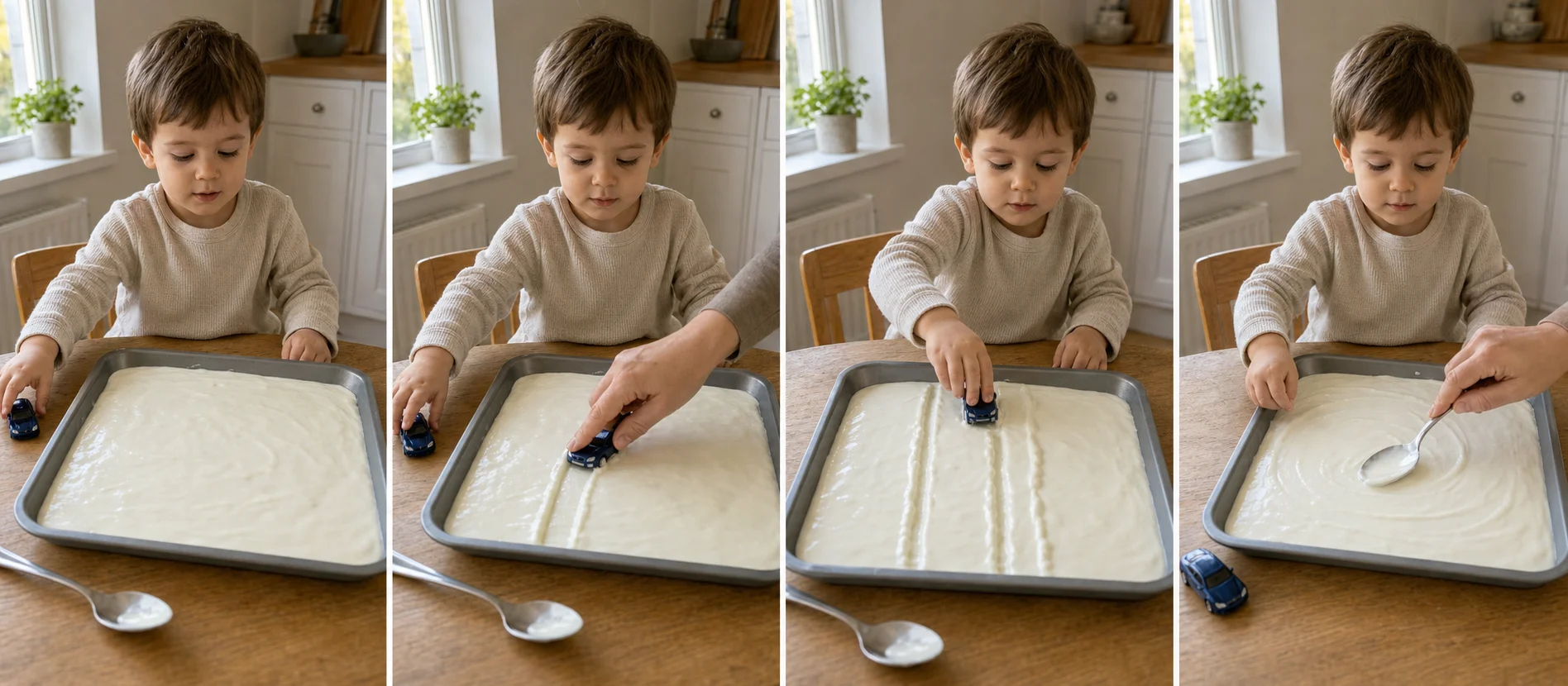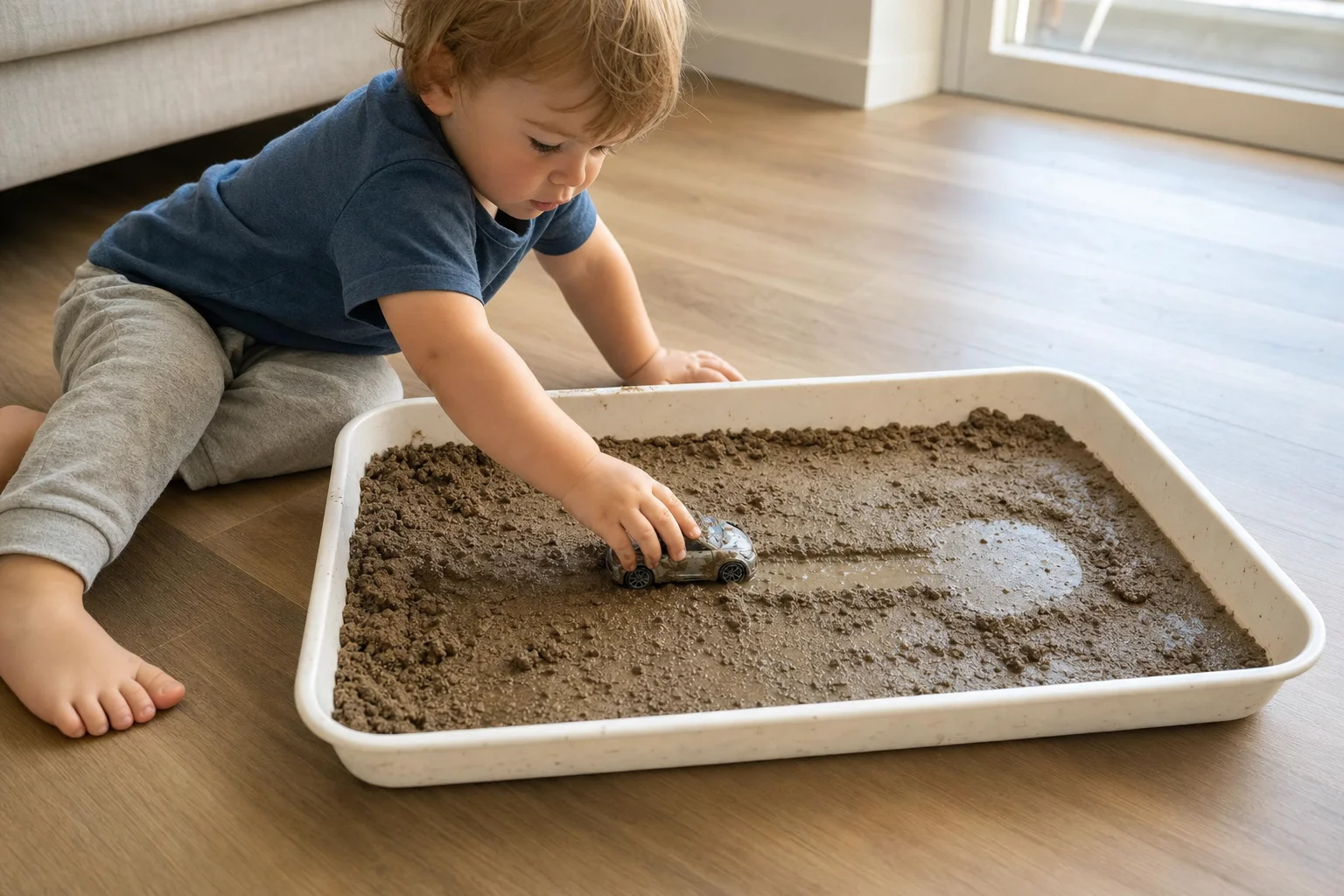
Toddler sitting beside a shallow tray of wet sand, pushing a toy car through it to make a visible track
ThinkingSensory-friendly supportAction ResultIndoor Or Outdoor

Wet Sand Track Push.

Offer wet-sand play without asking your toddler to touch it with bare hands. They push a toy car or plastic animal through a thin layer of wet sand, watch a track appear, and practice noticing how one action changes a material.

Play time
5-10+ min
Age
2-3 years
Energy
Low
Mess
Medium
Effort
Medium
Where
Indoor Or Outdoor
Start here

The recipe.

Medium parent effort
3 things

What you need

  • 1 shallow tray or bin
  • Wet sand
  • 1 toy car or 1 plastic animal
5 min minimum

Setup

Then start the loop
Step 01
Spread a thin layer of wet sand across the bottom of a shallow tray, using enough that a toy leaves a visible track.
Step 02
Add one toy car or plastic animal.
"Push through."
The loop

How play unfolds.

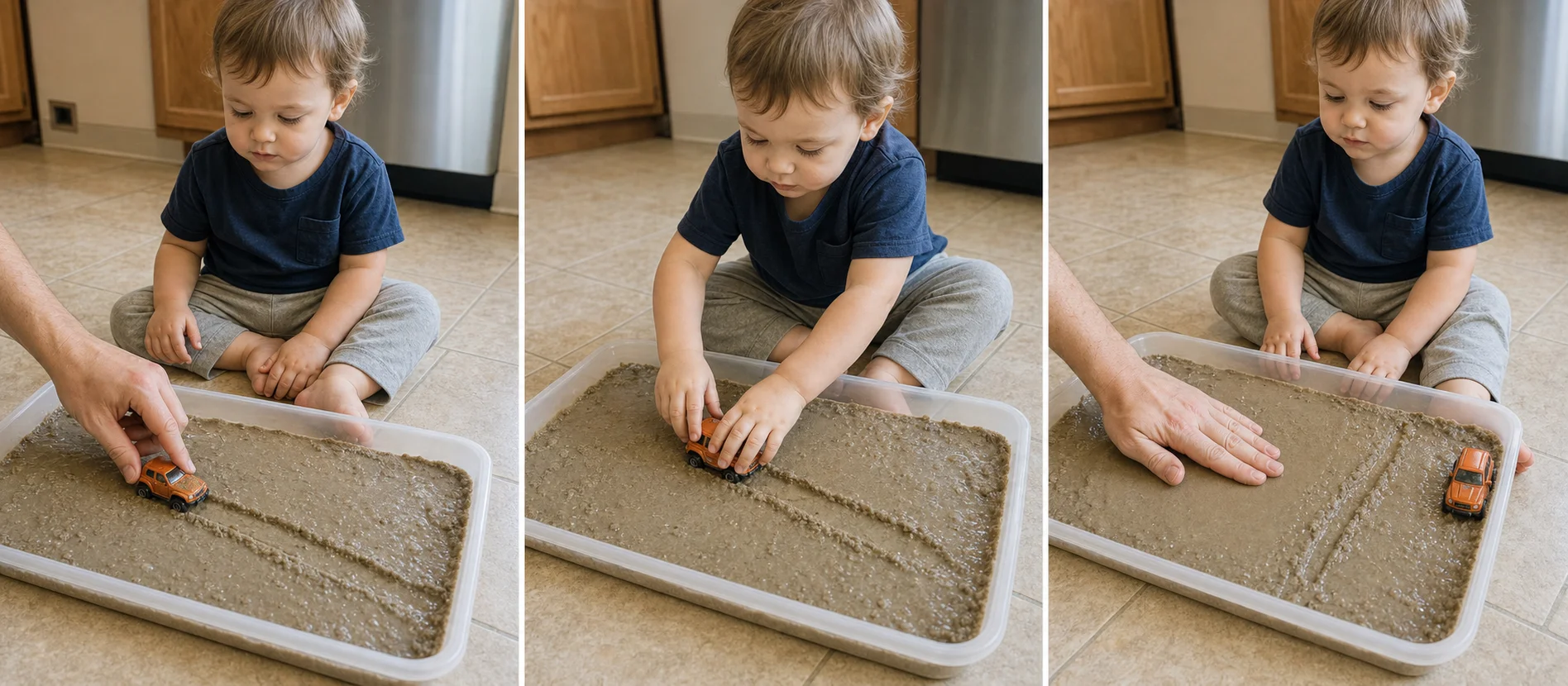
Three-panel toddler activity showing a grown-up modeling one toy pass in wet sand, the child pushing the toy to make a track, and the tray reset for another short turn
  1. 01
    Push the toy through the wet sand once so your child can see a track appear.
  2. 02
    Give your child the toy and let them push it through a fresh patch.
  3. 03
    Pause to look at the new track, then smooth one patch of sand and repeat.

Safety Check

  • Stay close and supervise the whole activity.
  • Never force touch. Stop if your child looks distressed, pulls away, or shows that the texture feels unpleasant.
  • Use a toy that is safe for your child's age and large enough not to become a mouthing hazard.
Skill spotlight
Action Result

Noticing that one push changes the sand in a visible way

This helps a child learn that their actions can change a material in a clear predictable way while keeping the task simple enough to repeat.

  • The toy gives your child a little distance from the wet texture, which can make first contact feel more manageable.
  • Each short push leaves a clear track, so your child gets an immediate result without needing lots of words.
  • The activity is easy to stop after one good turn, which helps on days when messy play tolerance is low.
Real-world transfer
  • Noticing how one action changes a material, surface, or object
  • Building confidence with early messy play by starting through a tool
Supporting the play

What to say in the moment

Match what you say to what you see.

Prompt ladder
Level 1 (Start)
"Make a track."
Level 2 (Keep going)
"One more path."
Level 3 (Stretch)
"Can it go the other way?"
Level 4 (Extend)
"Now make a track for me."
If your child seems...
What you'd see
Focused
What to do
Say
"You made a long track."
Add
Name one simple action, like push or slide.
Extend
Let your child choose whether the next turn uses the car or the animal.

Make it easier

Younger end
  • -Use a toy with wide wheels or a broad base that glides more easily through the sand.
  • -Keep the tray close so your child does not need to reach far over the sand.
  • -Count a single push across one small patch as a full turn.

Make it harder

Older end
  • +Ask your child to start at one edge and finish at the other.
  • +Let your child make two tracks side by side before resetting the sand.
  • +Pause before helping so your child can decide where to push next.

If it's not working

If you see
If child ignores it
Make one more quick track yourself and park the toy at the end like a tiny finish line.
If you see
If child misuses it
Keep only one toy in play and hold the tray close so the game stays push-and-watch instead of throw-and-dump.
If you see
If child gets frustrated
Use a thinner patch of sand, shorten the path, and stop after one successful pass.