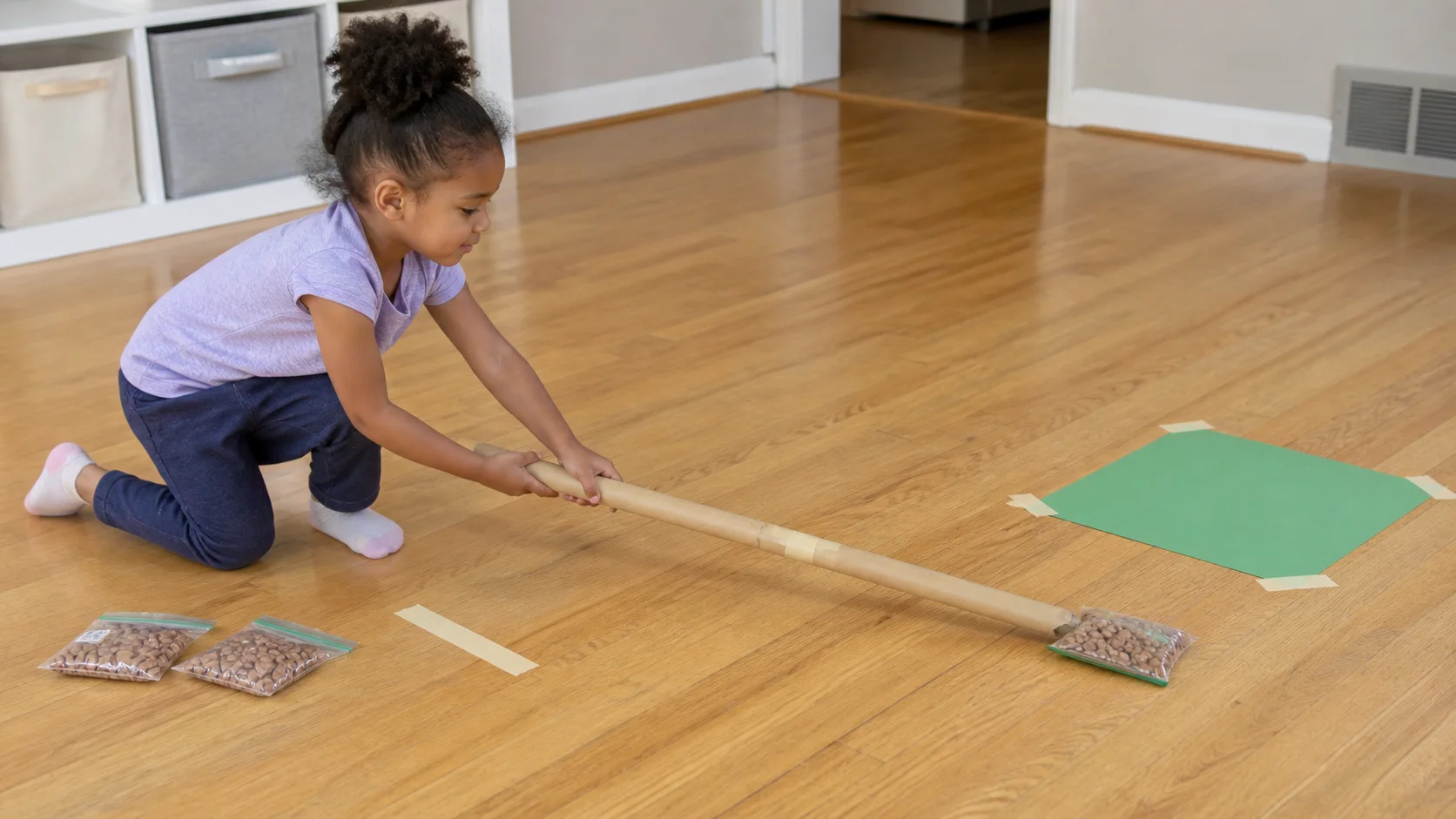
A child kneels on the floor and uses a taped paper-roll stick to push a bean-filled puck toward a paper goal.
Gross motorPush Against ResistanceIndoor Floor Space

Weighted Puck Push.

Bean-filled pucks and a paper-roll stick turn floor pushing into a simple target game.

Play time
5-10+ min
Age
3-5 years
Energy
Medium
Mess
Low
Effort
Medium
Where
Indoor Floor Space
Start here

The recipe.

Medium parent effort
8 things

What you need

  • several small Ziplock bags
  • dry beans or rice
  • 2 paper rolls
  • masking tape
  • construction paper
  • 1 clear floor area about 6 feet long
  • 1 adult for setup and direct supervision
  • 1 child
5 min minimum

Setup

Then start the loop
Step 01
At a table or on the floor, fill several small Ziplock bags about 1/4 full with dry beans or rice, press out extra air, and seal each bag tightly so it lies flat like a puck.
Step 02
At the same spot, tape 2 paper rolls end to end to make 1 long push stick.
Step 03
On the floor about 6 feet from the starting side, tape down the construction-paper goal and clear the space between the goal and the pucks.
Step 04
On the floor at the starting side, place the pucks together with the push stick beside them, then help your child half-kneel behind the pucks facing the goal.
"One puck ready."
The loop

How play unfolds.

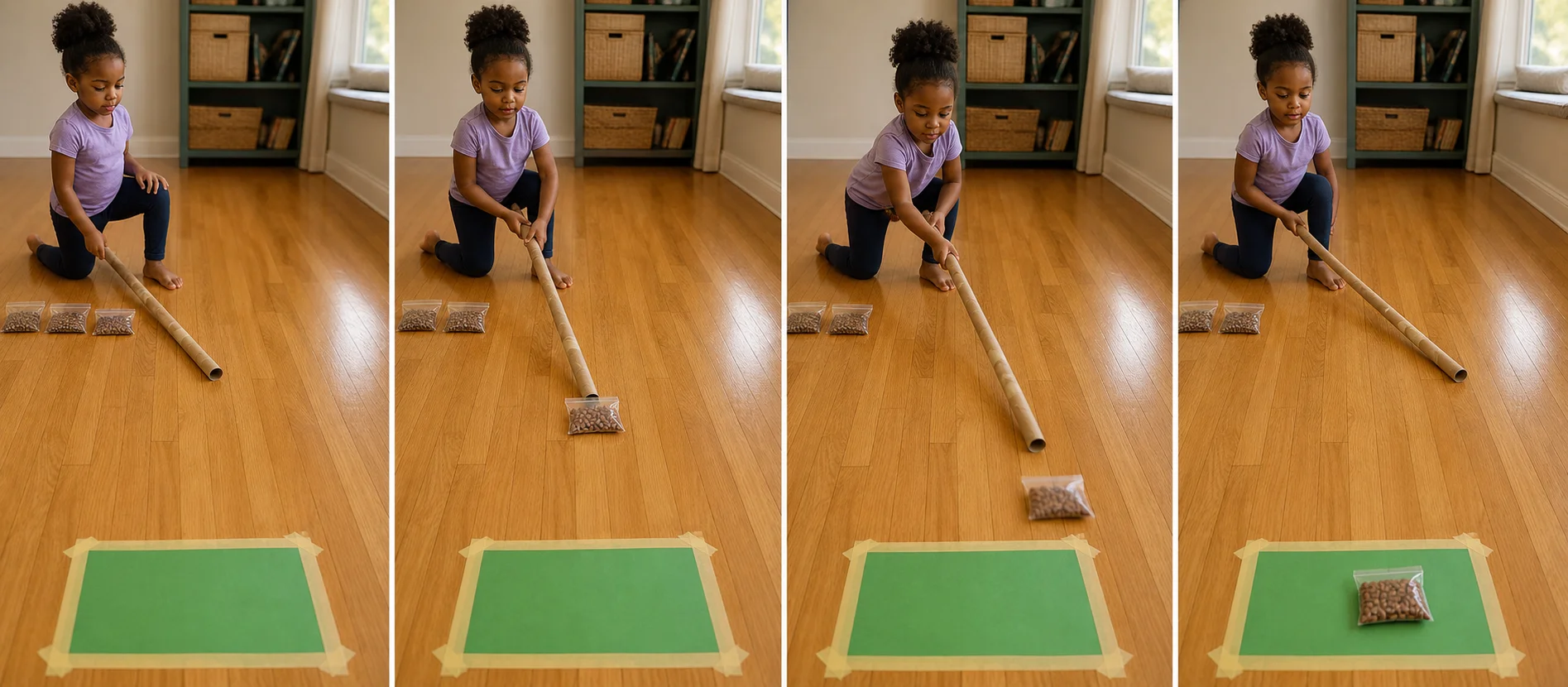
Four panels show a grown-up filling small bags with beans, taping paper rolls into one long stick, placing a paper goal on the floor, and a child pushing one puck toward the goal.
  1. 01
    Put 1 puck in front of the stick and say, "Push it to the goal."
  2. 02
    Let your child sweep the stick across the body and send the puck toward the paper target.
  3. 03
    If the puck stops short or slides off course, reset it at the starting side and try again. If it reaches the goal, bring the next puck back and keep going.
  4. 04
    When every puck has had a turn, gather them back to the starting side and play another round if your child wants more.

Safety Check

  • Clear trip hazards from the whole push lane before play starts.
  • Keep other people out of stick range while your child pushes.
  • Stay close enough to keep the stick low to the floor and stop unsafe swings.
Supporting the play

What to say in the moment

Match what you say to what you see.

Prompt ladder
Level 1 (Start)
Push one puck to the goal.
Level 2 (Keep going)
Sweep it across your body and send it forward.
Level 3 (Stretch)
Try a soft push, then a strong push.
Level 4 (Extend)
Can you rescue every puck back to the goal?
If your child seems...
What you'd see
Focused
What to do
Say
"Left side to right side."
Add
Name the goal spot while the stick is already moving.
Extend
Move the next puck slightly to the other side so your child has to sweep across again.

Make it easier

Younger end
  • -Start the puck halfway to the goal so 1 small push can succeed.
  • -Let your child stay in tall kneeling if half-kneeling is too hard to hold.
  • -Put the puck against a wall or baseboard edge for a straighter first push.

Make it harder

Older end
  • +Ask for 1 gentle push that stops near the goal before the final push.
  • +Start each puck from a different side of your child's body.
  • +Add a rule that the stick must stay touching the floor until the puck stops.

If it's not working

If you see
If child ignores it
Move the goal closer and do 1 slow push together.
If you see
If child misuses it
Rest the stick flat on the floor, say, "Stick stays low. Push the puck," and offer 1 puck at a time.
If you see
If child gets frustrated
Use just 1 puck, place it directly in front of the stick, and count any forward move as success.
Skill spotlight
Push Against Resistance

controlled pushing with force

Controlled pushing helps a child feel how much force to use, plan arm and body movement, and carry that control into toy play, cleanup, and safe sweeping or pushing tasks.

  • Pushing a weighted puck with a long stick gives your child direct practice using more or less force based on what the puck does.
  • Sweeping across the body toward a clear goal asks shoulders, trunk, and eyes to work together on one repeatable move.
  • Misses are easy to reset, so your child can keep trying the same push without learning a new rule each turn.
Real-world transfer
  • Pushing a broom, mop, toy vacuum, or rolling toy with better control
  • Using the right amount of force during rougher floor play
  • Planning a body position before moving a tool or object
  • Sticking with a task after a push misses the target