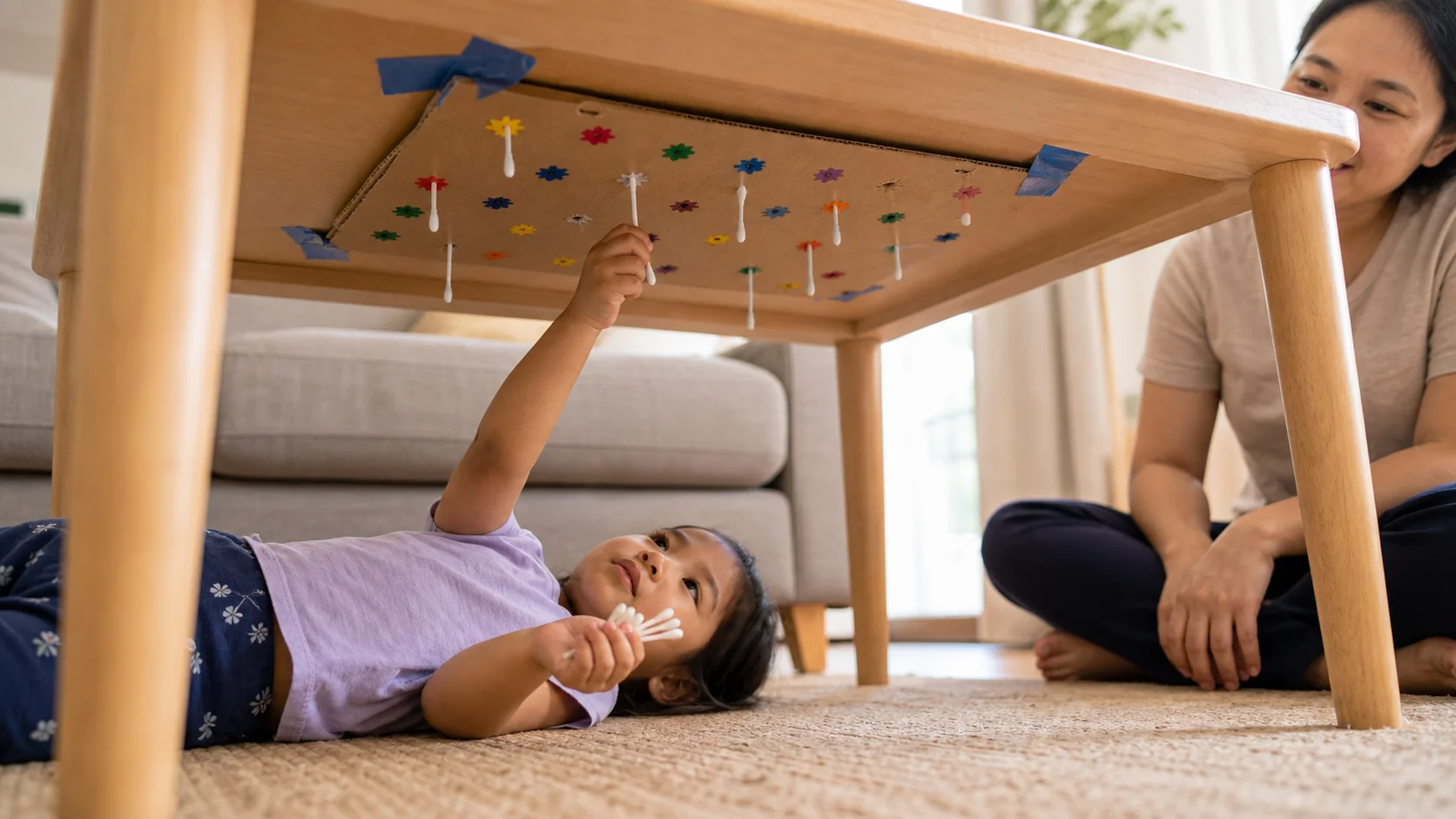
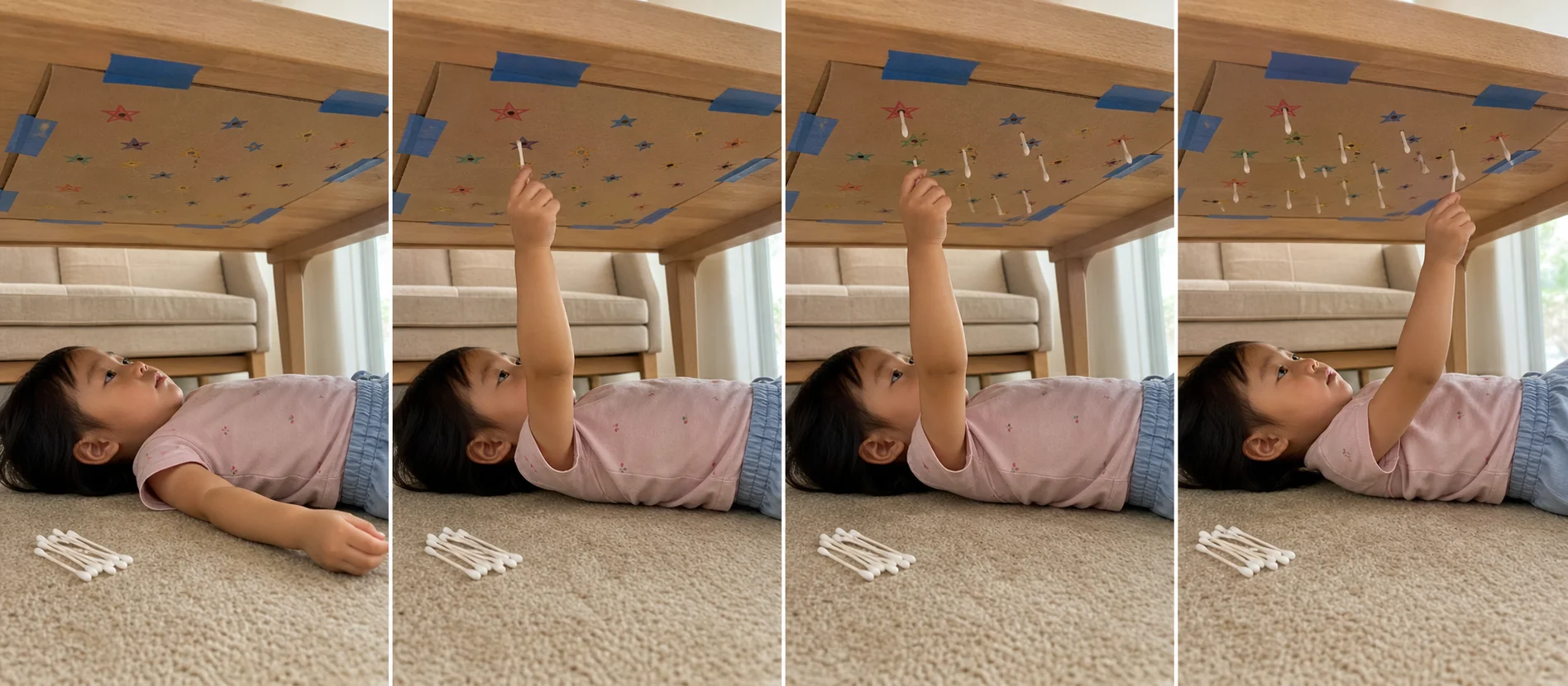
A child lies under a low table and pushes Q-tips into a cardboard star board taped overhead.
Fine motorPush Through ResistanceIndoor Floor Under A Stable Low Table

Under-Table Starry Night.

A taped-up star board turns Q-tips into a calm overhead aiming game.

Play time
5-10+ min
Age
3-5 years
Energy
Low
Mess
Low
Effort
Medium
Where
Indoor Floor Under A Stable Low Table
Start here

The recipe.

Medium parent effort
8 things

What you need

  • 1 flat piece of cardboard
  • markers
  • 1 pen
  • masking tape
  • Q-tips
  • 1 stable low table
  • 1 adult for setup and direct supervision
  • 1 child
5 min minimum

Setup

Then start the loop
Step 01
On a table or floor, make the star board by drawing many colorful dots across one flat piece of cardboard.
Step 02
On the same work surface, use the pen to poke one small hole through the center of each dot, then put the pen away.
Step 03
Under a stable low table, clear the floor so there are no hard toys or objects where your child will lie down.
Step 04
On the underside of the table, tape the cardboard flat with the marked side facing down toward your child.
Step 05
Under the table, lie down for one quick check yourself and make sure the table does not wobble, the cardboard stays flat, and several holes are easy to see overhead.
Step 06
On the floor within your child's reach under the table, place a small pile of Q-tips before the first turn.
"Look up. Pick one star."
The loop

How play unfolds.

Four panels show a grown-up drawing and poking star holes in cardboard, taping the board under a low table, a child lying underneath with Q-tips, and the child pushing Q-tips into the stars.
  1. 01
    Help your child lie on their back under the table, place a few Q-tips in the helper hand, point to one visible star, and say, "Pick one star and push your Q-tip in."
  2. 02
    Let your child line up one Q-tip with the hole and push it up into the cardboard overhead.
  3. 03
    Point to another visible star only if your child needs help finding one, then repeat until the visible holes are filled or their arms need a short break.
  4. 04
    Pull the Q-tips back out together, hand the pile back, and start another round from the same spot if your child wants more.

Safety Check

  • Use only a stable low table.
  • Clear hard objects from under the table before your child lies down.
  • Stay within arm's reach and supervise the whole time while your child is under furniture.
  • If the tape loosens or the cardboard sags, stop and retape the board before continuing.
Supporting the play

What to say in the moment

Match what you say to what you see.

Prompt ladder
Level 1 (Start)
Find one star right above you and push in one Q-tip.
Level 2 (Keep going)
Fill the next star you can see without sitting up.
Level 3 (Stretch)
Reach to a star near your shoulder and push slowly.
Level 4 (Extend)
Fill a whole row of stars before we reset.
If your child seems...
What you'd see
Focused
What to do
Say
"You found another star."
Add
Count one filled star after the Q-tip is in.
Extend
Invite one farther-but-visible star near the shoulder.

Make it easier

Younger end
  • -Work with only 3 visible holes before taking a reset break.
  • -Place the Q-tip tip into the hole opening and let the child do the final push.
  • -Let your child keep both hands free by setting 2 or 3 Q-tips on their belly.

Make it harder

Older end
  • +Ask your child to fill stars from left to right across the board.
  • +Choose one star near each shoulder before returning to the center.
  • +Have your child pull out each Q-tip with the same careful pinch used to place it.

If it's not working

If you see
If child ignores it
Push a Q-tip into the closest hole yourself and say, "Now you find the next star."
If you see
If child misuses it
If your child waves the Q-tips, drops them around the room, or crawls out to play with the tape, take back all but 2 or 3 Q-tips and point to one easy target at a time.
If you see
If child gets frustrated
Move the next turn to the closest visible holes, help steady the helper hand with the pile, and pause for a short break if their arms get tired from reaching up.
Skill spotlight
Push Through Resistance

Lining up one Q-tip and pushing it through a small overhead hole

This helps a child guide a small object into a narrow opening while the arms stay lifted, a pattern that matters for steadier reaching, simple posting tasks, and the small hand control used later for drawing and writing tools.

  • Reaching up to one small star gives your child's shoulders, eyes, and fingers a clear job at the same time.
  • Holding extra Q-tips close while pushing one through the hole builds simple two-hand coordination.
  • Repeating the same look, line up, and push loop helps your child adjust after a miss without learning a new rule.
Real-world transfer
  • Placing small objects into openings with better aim
  • Keeping one hand in a helper role while the other hand works
  • Using steadier shoulder and finger control for drawing, posting, and simple tool play