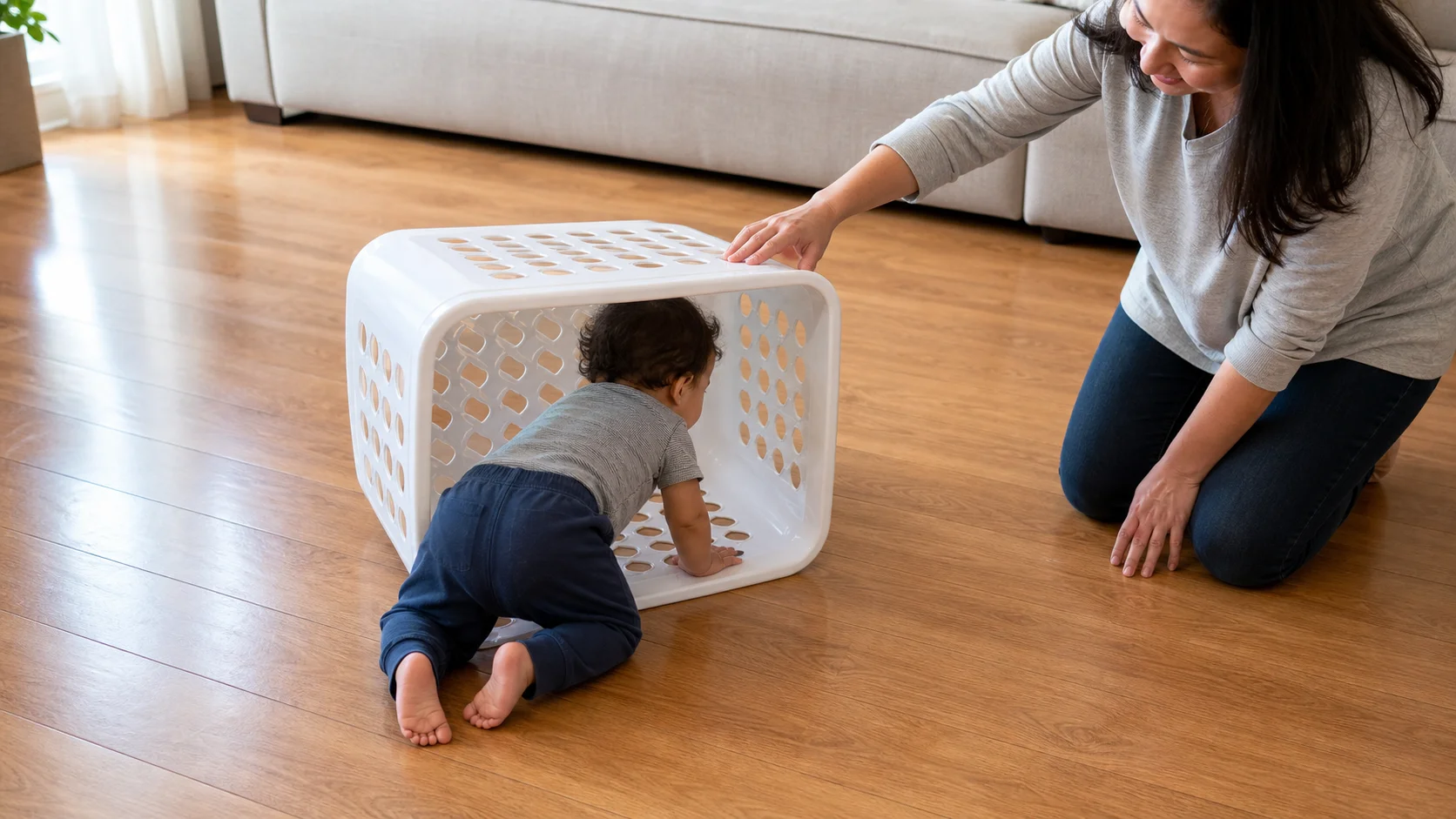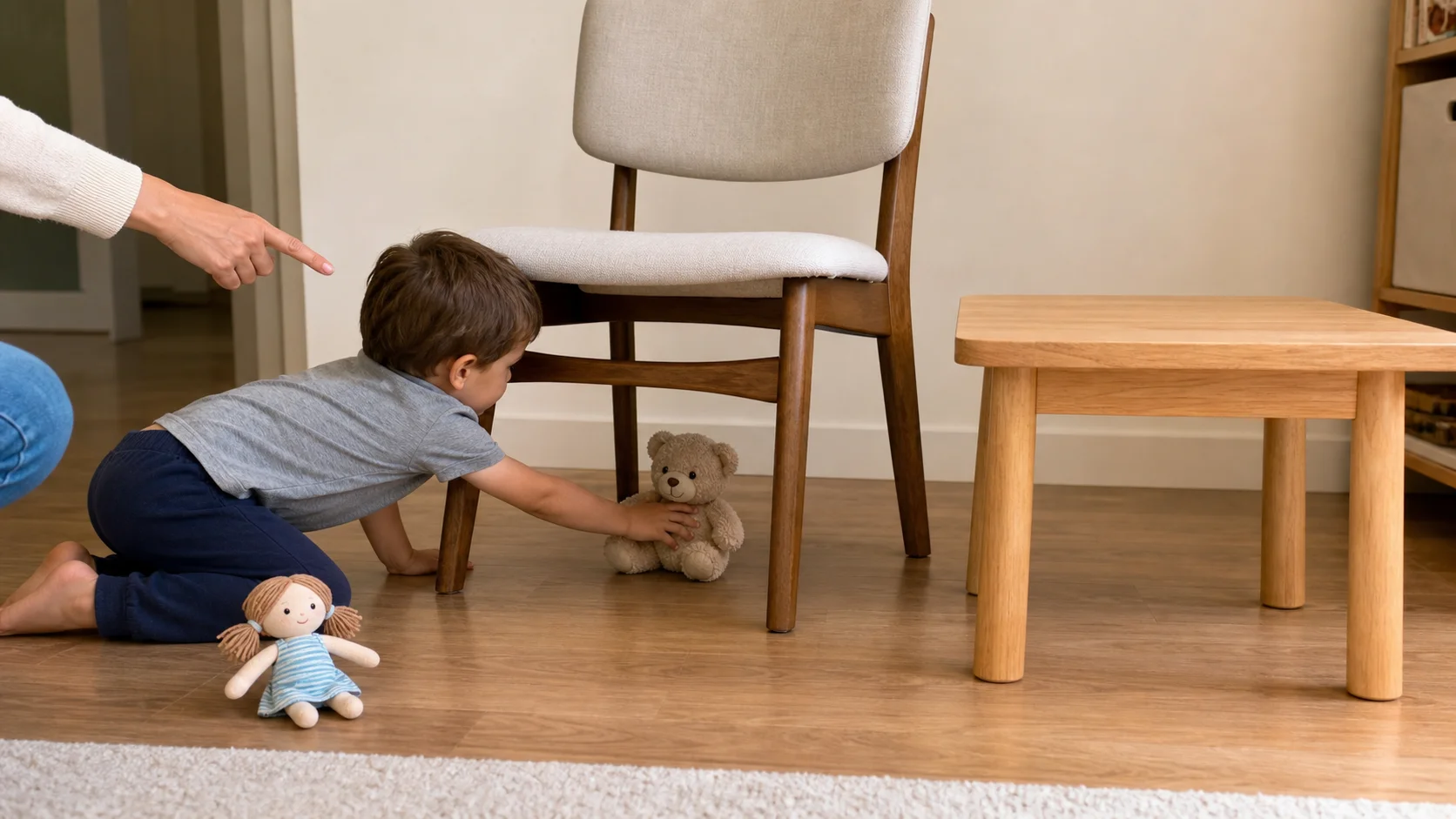
A toddler places a small teddy under a chair while a grown-up points to another toy beside a table.
LiteracySpeech delay supportFollow One StepIndoor

Toy On-Under Game.

Say one short on-or-under direction and let your child place the toy in the matching spot.

Play time
5-10+ min
Age
2-4 years
Energy
Low
Mess
No
Effort
Low
Where
Indoor
Start here

The recipe.

Low parent effort
3 things

What you need

  • 2 small toys such as a teddy and a doll
  • 2 pieces of furniture, either real or toy, such as a chair and a table
  • 1 open floor space
5 min minimum

Setup

Then start the loop
Step 01
Put the chair and table in the same open play space with room for a toy to go clearly on top of or under each one.
Step 02
Place the 2 toys side by side on the floor between you and your child.
Step 03
Sit where your child can see the toys, the chair, and the table at the same time.
"On the chair."
The loop

How play unfolds.

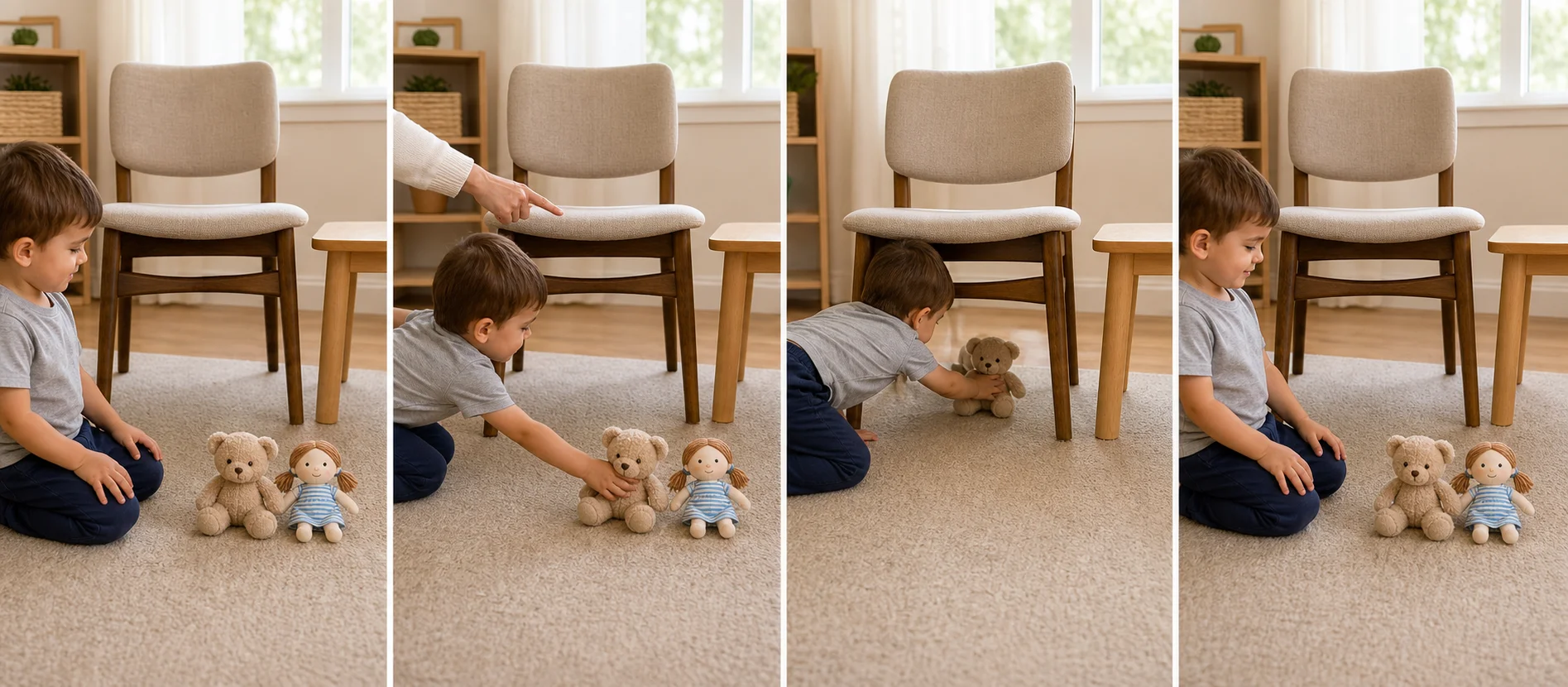
A four-panel play sequence showing two toys on the floor, a grown-up giving an on-or-under cue, the child placing the toy in the named spot, and the toy returning to the start for another turn.
  1. 01
    Show 1 quick model turn and say, "Teddy on chair."
  2. 02
    Give 1 short cue such as "Put dolly under the table."
  3. 03
    Let your child move the named toy to the named spot.
  4. 04
    Bring the toy back to the starting spot and repeat with the next cue.

Safety Check

  • Use toys that match your child's mouthing and throwing supervision needs.
  • Use stable furniture that is easy to reach around and under.
Supporting the play

What to say in the moment

Match what you say to what you see.

Prompt ladder
Level 1 (Start)
"Teddy on chair."
Level 2 (Keep going)
"Now dolly under table."
Level 3 (Stretch)
"You tell me. On or under?"
Level 4 (Extend)
"Pick the next toy for me."
If your child seems...
What you'd see
Focused
What to do
Say
"You knew where it goes."
Add
Switch the toy but keep the same furniture for the next turn.
Extend
Let your child give you the next on or under instruction.

Make it easier

Younger end
  • -Use 1 toy instead of 2.
  • -Keep only 1 piece of furniture in play.
  • -Repeat the same location word for 2 turns before switching.

Make it harder

Older end
  • +Keep 2 toys and 2 furniture targets visible.
  • +Switch both the toy and the location word on the next turn.
  • +Let your child give the full instruction for your turn.

If it's not working

If you see
If child ignores it
Do 1 more quick model turn, then hand the toy over right after the cue.
If you see
If child misuses it
Go back to 1 toy and keep only the location word changing for a few turns.
If you see
If child gets frustrated
Point to the target furniture as you say the cue and count a partly correct try as success.
Skill spotlight
Follow One Step

Following one simple spoken placement direction

This helps a child connect a spoken direction to an action, hold a simple location word in mind for a moment, and act on it in a shared play routine.

  • It gives your child practice hearing one short direction and acting on it right away.
  • The toys and furniture make on and under easy to see, not just hear.
  • The same tiny loop makes it easy to repeat without turning the game into a long lesson.
Real-world transfer
  • Following short spoken directions in daily routines
  • Understanding simple location words during books and play
  • Staying in a back-and-forth language game with another person
Back to library
Keep playing

Related activities.