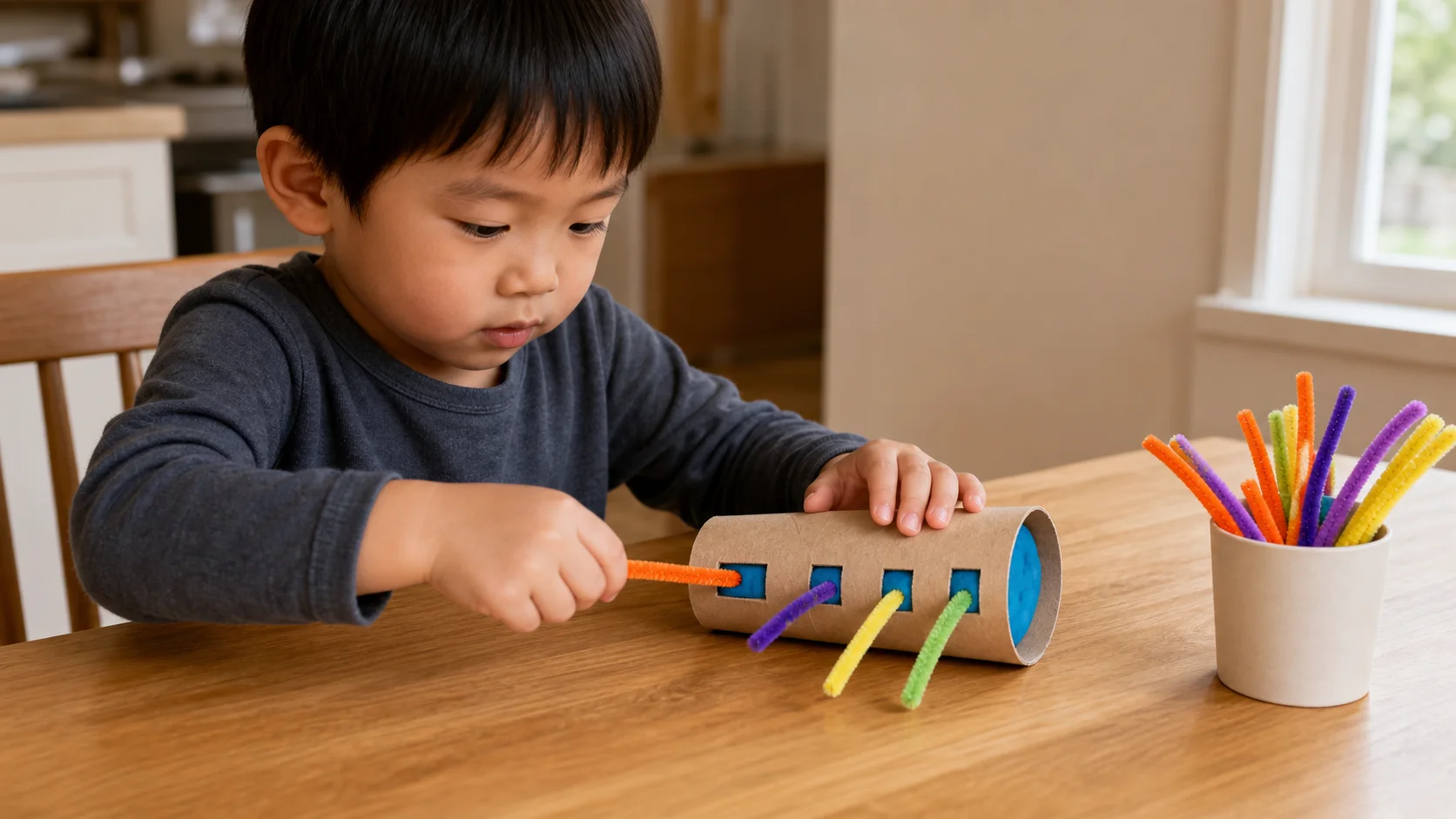
Preschool child holding a slit paper roll steady with one hand while pushing a pipe cleaner into the opening.
Fine motorPush Through ResistanceIndoor Stable Table

Tension Tube Push.

A slit paper roll and dense playdough give your child a steady push, stick, and reset loop.

Play time
5-10+ min
Age
3-5 years
Energy
Low
Mess
Low
Effort
Medium
Where
Indoor Stable Table
Start here

The recipe.

Medium parent effort
7 things

What you need

  • 1 cardboard paper roll
  • scissors for adult setup
  • 1 large piece of playdough
  • 5 to 7 pipe cleaners
  • 1 small container or cup
  • 1 stable table
  • 1 adult for setup and direct supervision
5 min minimum

Setup

Then start the loop
Step 01
On a stable table, cut 5 to 7 short slits about 1 inch long across the paper roll, then put the scissors away before play starts.
Step 02
Press the playdough firmly into the center of the roll so it sits behind the slits and feels dense.
Step 03
Set the roll horizontally with the slits facing your child.
Step 04
Place the container of pipe cleaners beside your child's working hand.
Step 05
Test 1 slit yourself so the pipe cleaner meets resistance but can still push in without tearing the roll.
"Tip to slit."
The loop

How play unfolds.

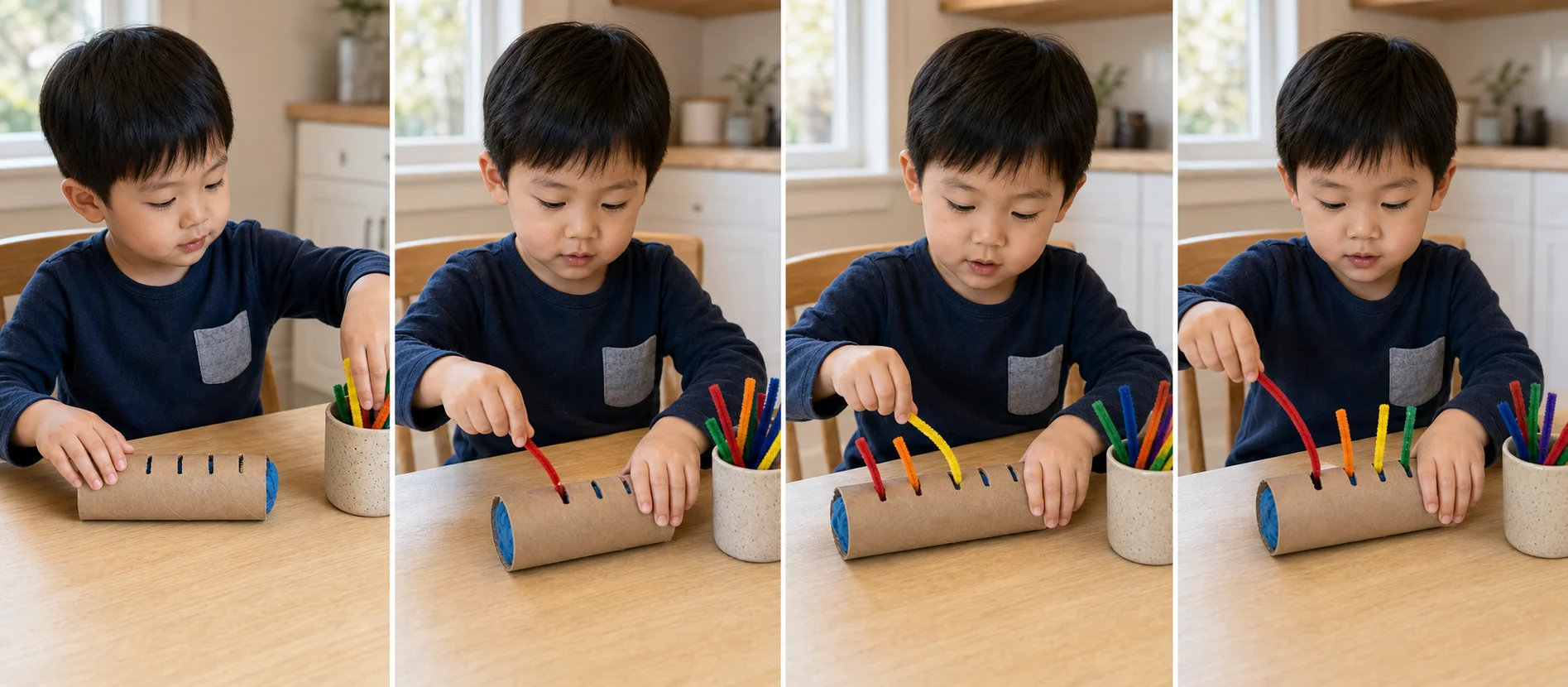
Three-step play sequence showing a child holding the tube, pushing pipe cleaners through the slits, and pulling them out to reset.
  1. 01
    Set the tube in front of your child and say, "One hand holds the tube. One hand pushes."
  2. 02
    Let your child hold the tube steady, line up a pipe cleaner with an open slit, and push until it sticks in the playdough.
  3. 03
    Repeat with the other open slits until the tube feels full.
  4. 04
    Pull the pipe cleaners back out, drop them in the container, and start another round.

Safety Check

  • Stay within arm's reach and supervise every round.
  • Pipe cleaners and loose pieces of playdough are choking hazards for children under 5.
  • Put the scissors away before play starts, and keep pipe cleaners going only into the tube.
Supporting the play

What to say in the moment

Match what you say to what you see.

Prompt ladder
Level 1 (Start)
Pick 1 pipe cleaner and touch the tip to a slit.
Level 2 (Keep going)
Park 1 hand on the tube and give it 1 strong push.
Level 3 (Stretch)
Try the next slit with the same slow push.
Level 4 (Extend)
Fill the tube, pull them out, and race your last turn.
If your child seems...
What you'd see
Focused
What to do
Say
"Your helper hand is working."
Add
Count 1 finished pipe cleaner after it sticks.
Extend
Invite 1 extra pull-out round before resetting.

Make it easier

Younger end
  • -Start with the most open slit so the first success happens quickly.
  • -Let your child use 2 hands on the pipe cleaner while you hold the tube.
  • -Stop after 2 pipe cleaners and call the tube full for this round.

Make it harder

Older end
  • +Ask your child to keep the tube from sliding without your hand on it.
  • +Use a slower push and pause when the pipe cleaner first touches the playdough.
  • +Have your child pull out only 1 chosen pipe cleaner without disturbing the others.

If it's not working

If you see
If child ignores it
Start with 1 pipe cleaner halfway in and say, "Can you finish the push?"
If you see
If child misuses it
Pause, move the pipe cleaner back to a slit, and say, "Pipe cleaners go in the tube."
If you see
If child gets frustrated
Hold the tube steady for 1 turn, widen 1 slit slightly, or switch to pulling the pipe cleaners out for the reset round.
Skill spotlight
Push Through Resistance

Strong, steady pushes into a tight slot.

This helps a child use 1 hand as a steady base while the other hand makes a firm, accurate push. That same pattern shows up when holding paper for coloring or cutting, managing simple dressing pulls, and pushing small pieces into place during play.

  • Holding the tube with one hand while pushing with the other gives each hand a clear job.
  • Tight slits and dense playdough add resistance your child can feel all the way through the push.
  • Pulling the pipe cleaners back out resets the same challenge without extra setup or cleanup.
Real-world transfer
  • Holding 1 thing still while the other hand works
  • Pushing objects into snug spaces without giving up
  • Using firm but measured pressure during coloring, cutting, and simple dressing jobs
  • Lining up a tool or piece before the hand action starts

Parent questions