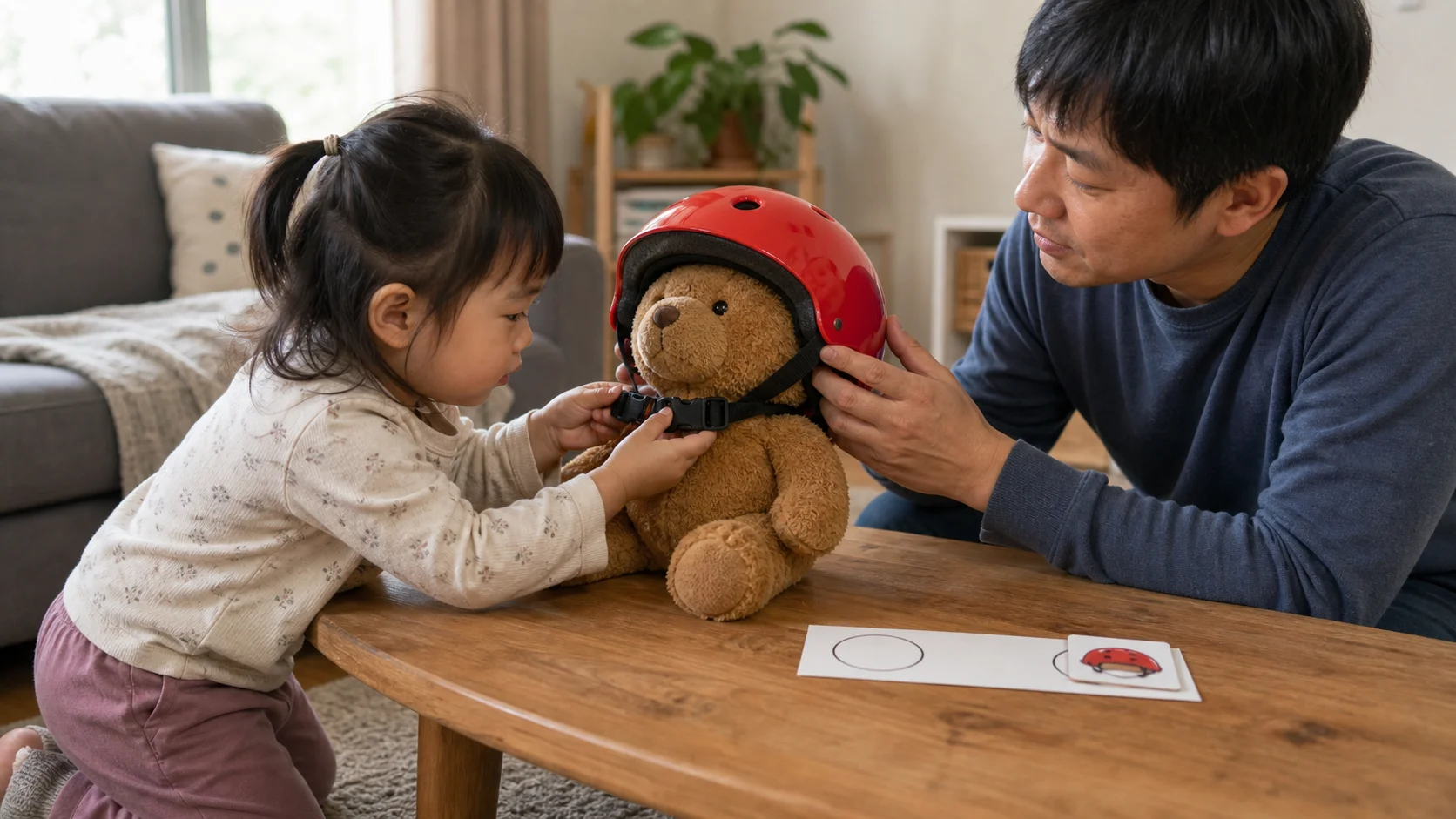
A toddler at a low table resting a bike helmet on a teddy while a grown-up steadies the strap for one calm click.
Skill builderSensory-friendly supportRepeat LoopIndoor

Teddy Helmet Click.

A teddy, a helmet, and one click turn safety gear practice into a short repeatable routine.
Play time
5+ min
Age
2-3 years
Energy
Low
Mess
Low
Effort
Low
Where
Indoor
Start here

The recipe.

Low parent effort
6 things

What you need

  • 1 stuffed animal or doll with a head large enough for a helmet to rest on
  • 1 bike helmet with a chin strap that opens easily
  • 1 paper strip with 1 start spot and 1 done spot
  • 1 small paper helmet card or marker
  • 1 child
  • 1 adult
5 min minimum

Setup

Then start the loop
Step 01
On the floor or at a low table, place the stuffed animal in front of your child and set the helmet beside it with the strap fully open and the buckle facing your child's hands.
Step 02
Place the paper strip slightly off to one side with the helmet card at `start` so it stays a small visual cue instead of taking over the game.
Step 03
Sit close enough to steady the helmet, stop pinches fast, and keep every piece within reach without standing.
`Helmet on teddy.`
The loop

How play unfolds.

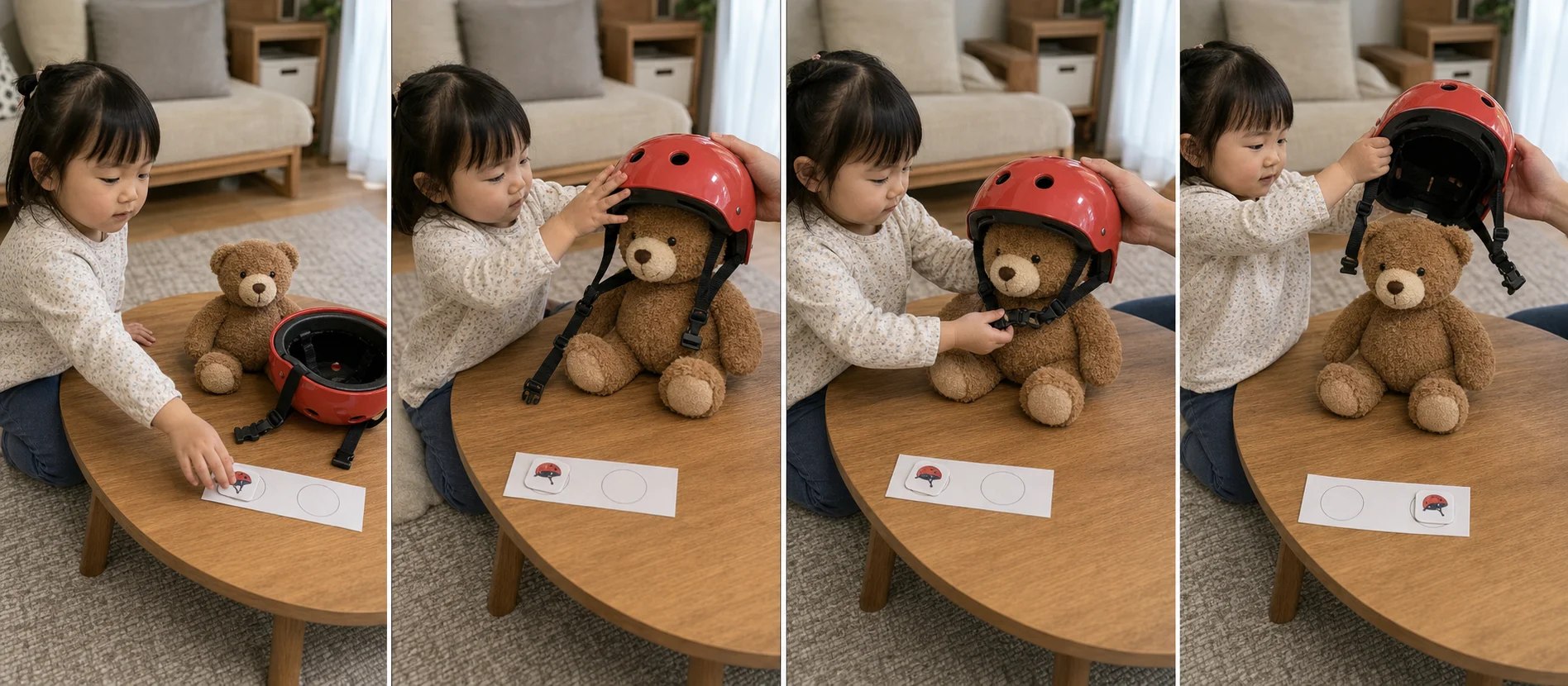
A multi-panel sequence showing a child placing a helmet on teddy, touching or clicking the strap, moving a card to done, and opening the strap again.
  1. 01
    Rest the helmet on teddy and say, `Helmet on teddy.`
  2. 02
    Let your child do one strap touch or one click. If needed, hold the helmet steady and line up the buckle.
  3. 03
    If the paper strip helps, move the helmet card to `done`.
  4. 04
    Open the strap, lift the helmet off, and reset for another short turn. Repeat for `2 to 3` calm rounds, or stop after one small success.

Safety Check

  • Keep a hand on the helmet and buckle when needed. A real helmet strap can pinch fingers or feel too close to the face.
  • Size-check the paper helmet card before play and remove it if your child mouths or throws small pieces.
  • Stop or simplify if your child pulls away from the helmet, yanks the strap, or gets upset by the face or chin area.
Supporting the play

What to say in the moment

Match what you say to what you see.

Prompt ladder
Level 1 (Start)
Helmet on teddy.
Level 2 (Keep going)
Click it once.
Level 3 (Stretch)
Card to done.
Level 4 (Extend)
Open and reset.
If your child seems...
What you'd see
Focused
What to do
Say
`Helmet on, click, done.`
Add
Name one part of the turn, like `helmet` or `open`.
Extend
Let your child do the strap-open reset before the next round starts.

Make it easier

Younger end
  • -Rest the back of the helmet against your leg or a chair so it does not wobble while your child works.
  • -Hold both buckle pieces close together so your child only has to push them the last little bit.
  • -Let your child move the card to `done` while you handle the strap-open reset.

Make it harder

Older end
  • +Let your child place the helmet and line up the buckle before the click.
  • +Ask your child to open the strap after moving the card to `done`.
  • +Do two calm rounds in a row before you give another model turn.

If it's not working

If you see
If child ignores it
Do one quick helmet-on and click demo yourself, praise it, and invite the child to do only the last push on the buckle.
If you see
If child misuses it
Hold the helmet and strap ends yourself, remove the paper strip, and give the child one simple job such as `Push` or `Touch helmet`.
If you see
If child gets frustrated
Back up to the smallest success the child will accept, such as handing you the helmet, touching the strap, or patting the helmet once, then stop after that success.
Skill spotlight
Helmet Practice

Repeating a short helmet-on and click routine while staying calm through one safety-gear step

This helps a child stay with one small safety routine, treat the buckle as a short predictable step instead of a big demand, and get used to a clear beginning and ending before real helmet practice.

  • The same `helmet on, click, open` order helps your child practice one short routine without extra surprises.
  • Keeping the helmet on teddy first lets your child meet the strap and buckle before it comes near their own head or chin.
  • The open-and-reset step gives the turn a clear ending instead of leaving the buckle as the last feeling in the round.
Real-world transfer
  • Trying one small helmet step before a real ride or balance practice
  • Handling the buckle with calmer hands instead of pulling away or forcing it
  • Moving through a short safety routine with a clearer ending

Parent questions