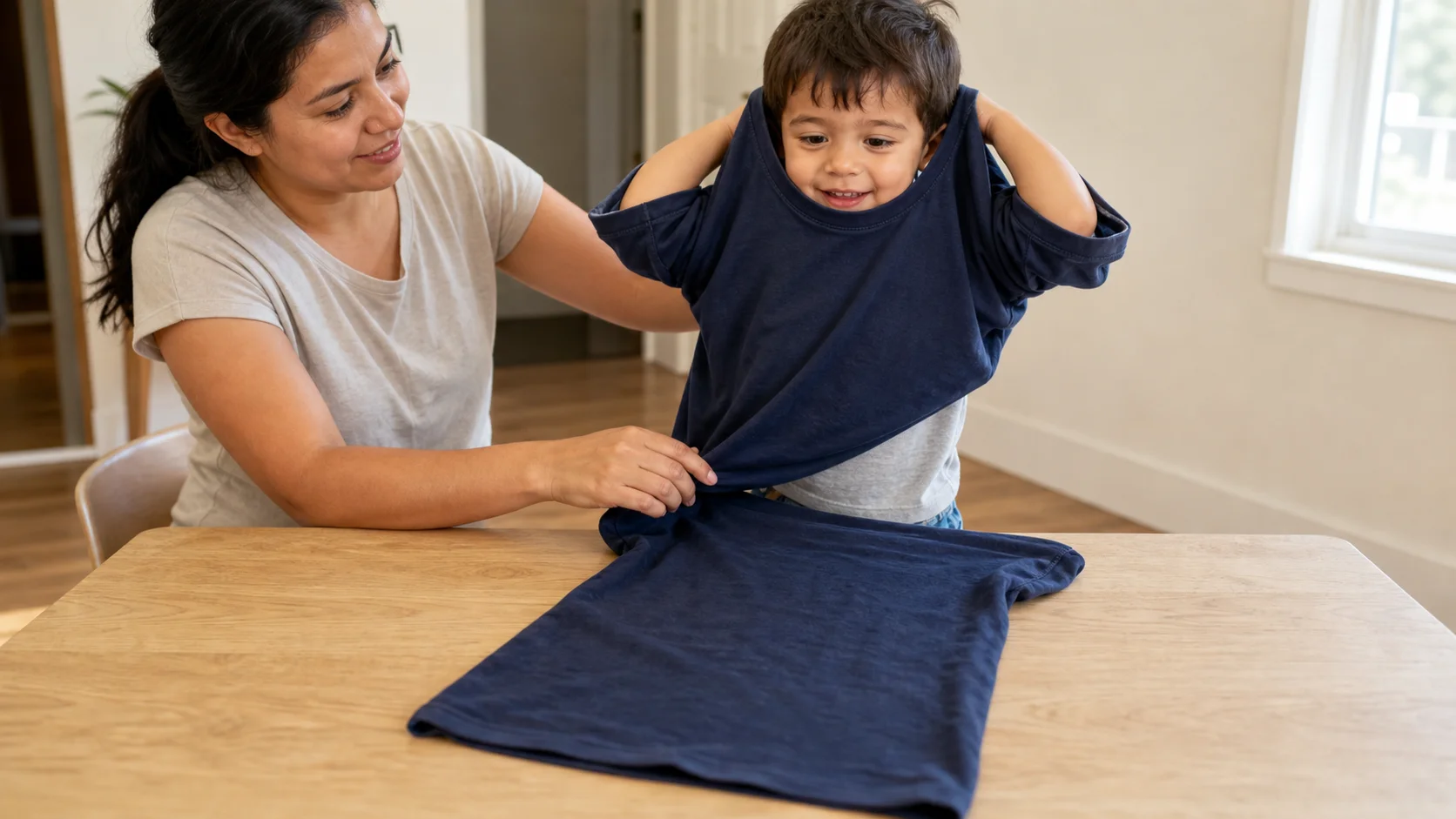
A toddler at a table pushing both arms into the sleeves of a loose T-shirt while a grown-up points to the sleeve openings.
Skill builderAutism supportPull ThroughIndoor

T-Shirt Dive.

A loose shirt on the table turns early dressing practice into one short sleeves-first game.

Play time
5+ min
Age
2-3 years
Energy
Low
Mess
Low
Effort
Low
Where
Indoor
Start here

The recipe.

Low parent effort
4 things

What you need

  • 1 loose T-shirt or light jumper large enough to slide on easily
  • 1 table or other flat raised surface
  • 1 child
  • 1 adult
5 min minimum

Setup

Then start the loop
Step 01
Lay the loose T-shirt face down on a table or other flat raised surface with the bottom edge closest to your child.
Step 02
Smooth the shirt so the neck opening and both sleeves sit on the far side and stay easy to see.
Step 03
Stay beside your child so you can point to each sleeve, straighten bunching fabric, and give light help if the shirt twists or sticks.
Sleeve, sleeve.
The loop

How play unfolds.

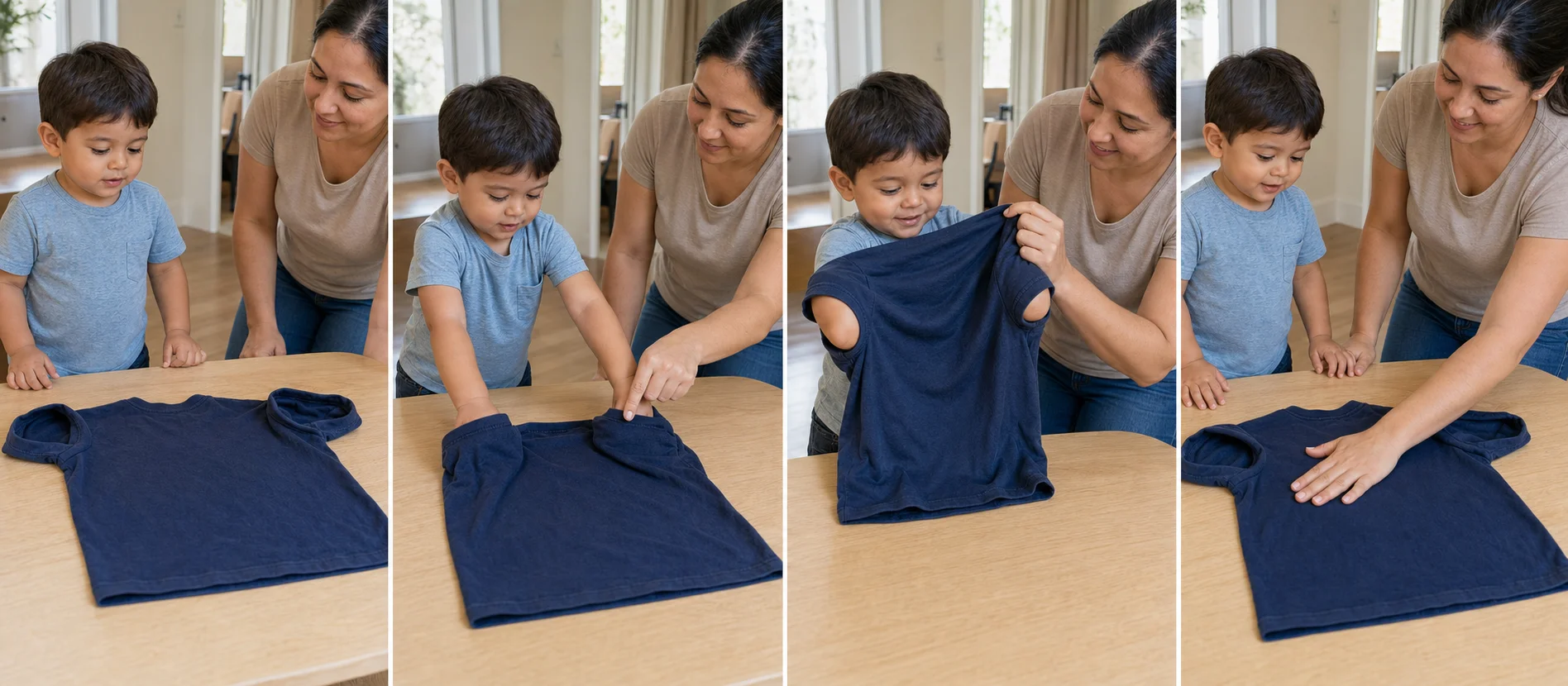
A multi-panel sequence showing a child finding both sleeves, lifting the shirt toward the head, and pulling it off for another turn.
  1. 01
    Tap one sleeve, then the other, and say, `Arms in first.`
  2. 02
    Let your child put both arms into the sleeves, then help lift the shirt toward the head with only as much help as needed.
  3. 03
    Count the turn as done when both arms are in and the neck opening reaches the top of the head or goes over.
  4. 04
    Pull the shirt back off, lay it face down again, and repeat for 2 to 4 calm turns, or stop sooner if your child is done.

Safety Check

  • Use a loose, soft, stretchy shirt or jumper that is easy to remove, and stop using it if the fabric feels tight, scratchy, or upsetting.
  • Stop before the head step turns into distress. Sleeves-only practice is enough for the round.
  • Stay close so you can smooth bunching fabric and keep the shirt from turning into a throwing or flapping game.
Supporting the play

What to say in the moment

Match what you say to what you see.

Prompt ladder
Level 1 (Start)
Find the sleeves.
Level 2 (Keep going)
Arms in first.
Level 3 (Stretch)
Lift to your head.
Level 4 (Extend)
Pull it down, then off.
If your child seems...
What you'd see
Focused
What to do
Say
Arms in first.
Add
Name one action, like sleeves or up.
Extend
Let your child pull the hem a little farther down before you help with the reset.

Make it easier

Younger end
  • -Fold each sleeve opening outward a little so both arm targets are easier to see.
  • -Slide the shirt a little closer to the table edge so the reach is shorter.
  • -Let your child keep one hand in the first sleeve while you line up the second sleeve opening.

Make it harder

Older end
  • +Pause after the sleeve tap to see whether your child reaches for both sleeves without the next cue.
  • +Let your child pull the shirt farther down the body before you help with the reset.
  • +Ask your child to smooth the shirt flat between turns before the next dive starts.

If it's not working

If you see
If child ignores it
Do one full dive turn yourself, then ask for just one job like `Find this sleeve` or `Push one arm in`.
If you see
If child misuses it
Flatten the shirt again if your child grabs the hem, throws it, or goes for the head opening first, then point back to the sleeves and restart.
If you see
If child gets frustrated
Count sleeves-only as a win for that turn, use hand-over-hand help for one calm try, or stop before the head step if the fabric near the face feels like too much today.
Skill spotlight
Simple Dressing Motions

pulling both arms and head through a loose T-shirt in order

This helps a child learn the order of getting a shirt on, feel where arms and head go in clothing, and do more of everyday dressing with less hands-on help.

  • It lets your child see both sleeve targets before the shirt goes near the face.
  • It practices the real shirt-on order in a calmer, slower setting.
  • It keeps the reset simple, so one small success is easy to repeat.
Real-world transfer
  • Getting arms and head into a shirt during everyday dressing
  • Staying calmer when clothing has to pass near the face
  • Following the same shirt-on order with less physical help