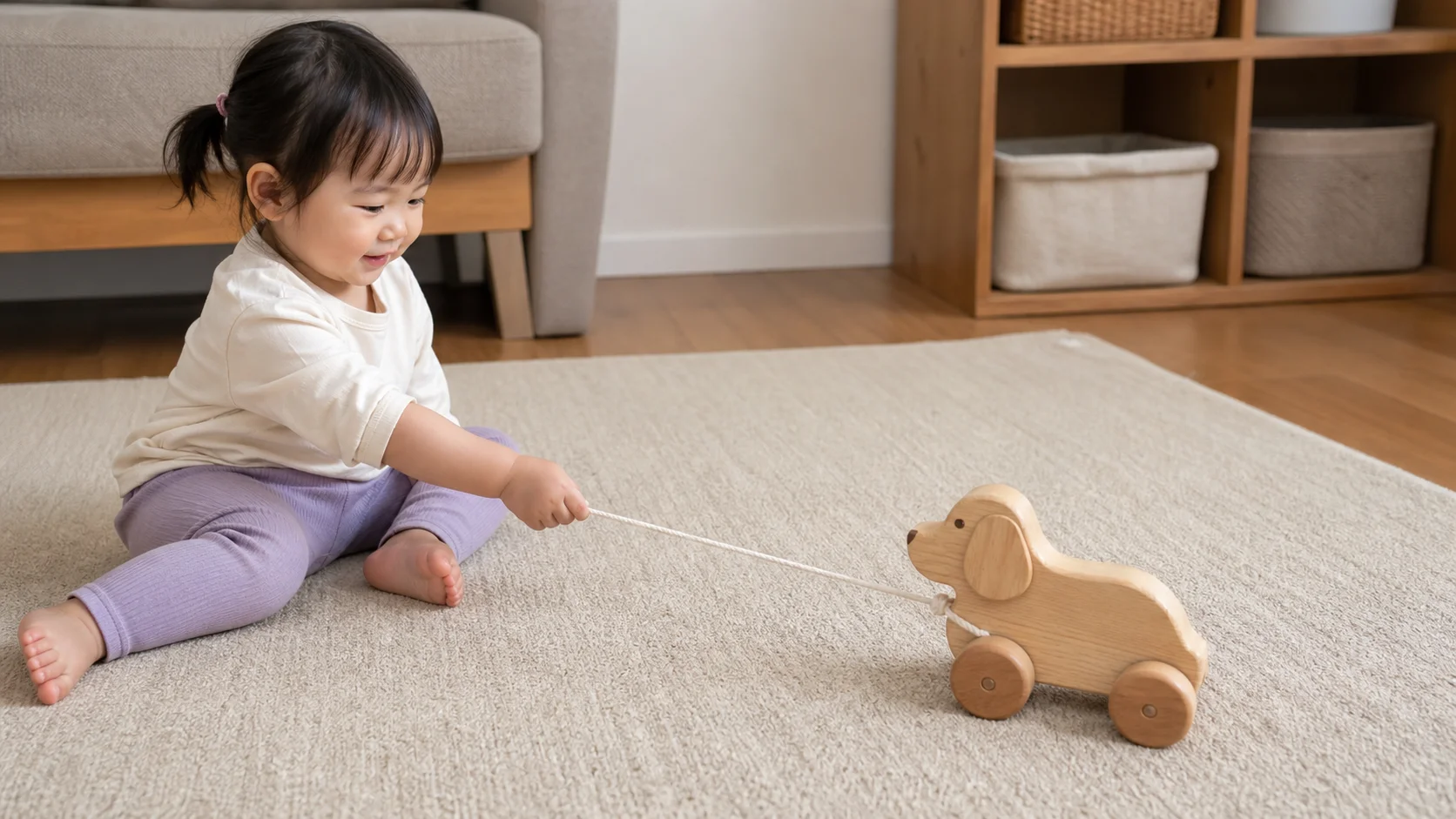
Toddler sitting on the floor pulling a large light toy back by a short string.
Gross motorDevelopmental supportPull Against ResistanceIndoor Or Outdoor

String-Tied Toy Return.

A short string and light toy create a calm push-away, pull-back, and reset game.
Play time
5+ min
Age
2-3 years
Energy
Low
Mess
Low
Effort
Low
Where
Indoor Or Outdoor
Start here

The recipe.

Low parent effort
2 things

What you need

  • 1 light toy large enough to hold safely
  • 1 short string tied securely to the toy
5 min minimum

Setup

Then start the loop
Step 01
On the floor in front of your child, clear a small open play spot so the toy can slide a short distance without snagging under furniture.
Step 02
On that floor spot, place the toy in easy reach and lay the string straight so the free end rests by your child's hand without looping around the toy, legs, or wrists.
Step 03
Beside the toy, give the string 1 gentle test pull to make sure the knot holds and the toy comes back easily.
Step 04
Beside your child, stay close enough to model 1 short return and reset the toy between turns.
`Pull it in.`
The loop

How play unfolds.

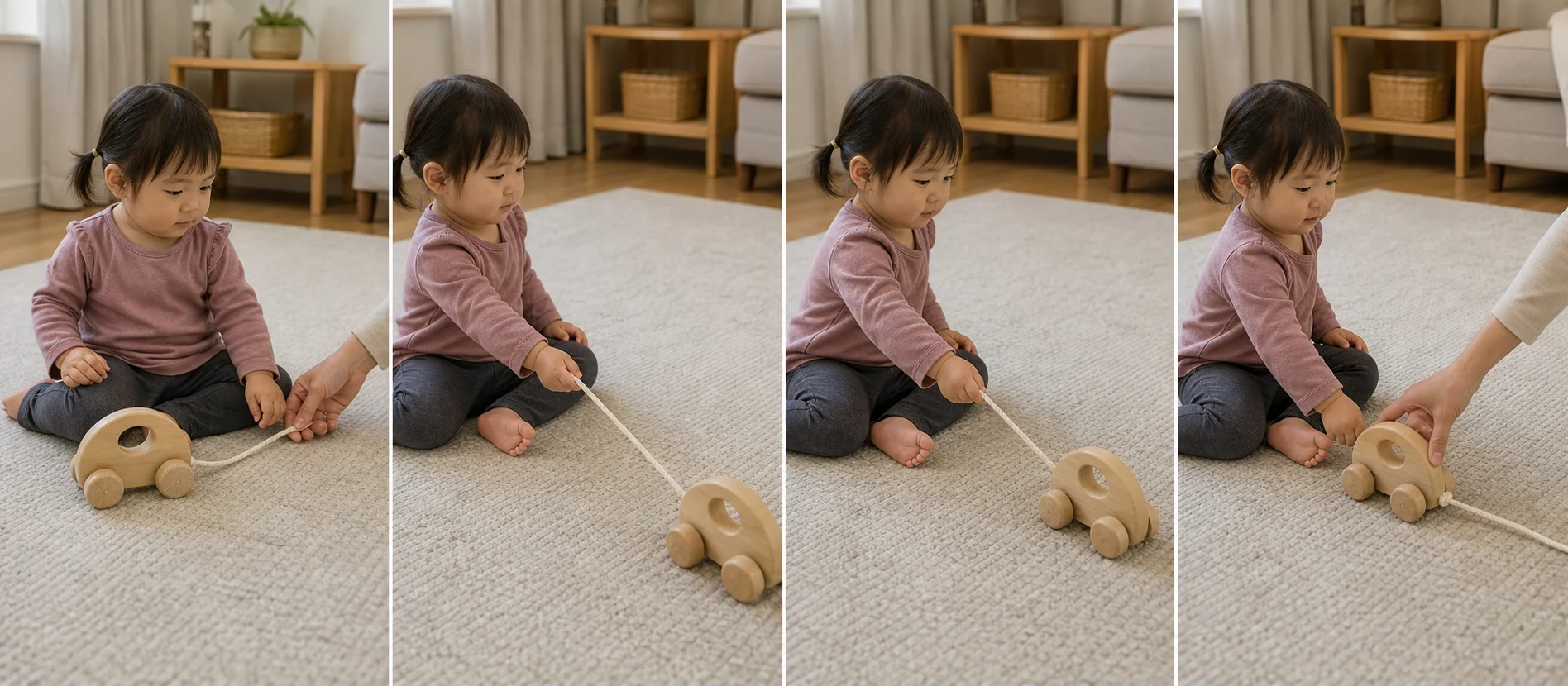
Multi-panel sequence showing a toy set a short distance away, a toddler pulling the string, the toy returning close, and the next reset.
  1. 01
    Let the toy move a short distance away while it stays in sight, then say, `Pull it back.`
  2. 02
    Let your child pull the string until the toy comes back close enough to touch.
  3. 03
    Set the toy a little way out again, or let your child nudge it forward, and repeat the same send-and-return turn.
  4. 04
    Stop after a few calm returns, or sooner if the string tangles or interest drops.

Safety Check

  • Stay close and keep the string short so it cannot wrap around your child's neck, body, or feet.
  • Stop right away if the knot loosens, the toy breaks, or any part becomes small enough to mouth or choke on.
  • Use a clean, safe toy that moves easily and does not send your child chasing across the room.
Supporting the play

What to say in the moment

Match what you say to what you see.

Prompt ladder
Level 1 (Start)
`Pull your toy back.`
Level 2 (Keep going)
`Send it out again.`
Level 3 (Stretch)
`Can it stop by your foot?`
Level 4 (Extend)
`Give it one more calm trip.`
If your child seems...
What you'd see
Focused
What to do
Say
`Your toy came right back.`
Add
`Where is your toy now?`
Extend
Let the next turn go a little farther.

Make it easier

Younger end
  • -Keep the toy starting from the same spot in front of the same hand each turn.
  • -Let the toy stop at your child's knee instead of all the way at the hand.
  • -Pause after every successful return so your child can drop the string and restart calmly.

Make it harder

Older end
  • +Let your child place the toy forward before each pull instead of waiting for you to set it.
  • +Ask for 1 slow pull and 1 quicker pull so your child feels the movement change.
  • +Ask your child to stop the toy at the same body spot each round, like the knee or foot.

If it's not working

If you see
If child ignores it
Pull the toy back once with a smile, say `Your turn to bring it back,` and offer just 1 pull instead of a full round.
If you see
If child misuses it
Put the toy back on the floor, straighten the string, and restart with `String stays down. Pull back.`
If you see
If child gets frustrated
Move the toy closer, help hand-over-hand for 1 pull, and count that single return as enough before stopping.
Skill spotlight
Pull Against Resistance

Pulling a toy back by a short string

This helps your child keep track of a toy after it drifts away, use the hand and arm to bring it back, and recover from a drop instead of losing the turn.

  • The short pull-back gives your child a clear recover-and-try-again loop instead of a toy that disappears across the room.
  • Holding the string and pulling until the toy returns adds repeat practice with grip, arm pull, and visual follow-through.
  • The same small setup makes the game predictable, which helps quick retries feel manageable.
  • One calm return already feels complete, so it is easier to stop before frustration climbs.
Real-world transfer
  • Bringing a dropped or drifted toy back instead of leaving it behind
  • Staying with short pull-and-return jobs during play and simple routines
  • Restarting after a small setback without giving up right away

Parent questions