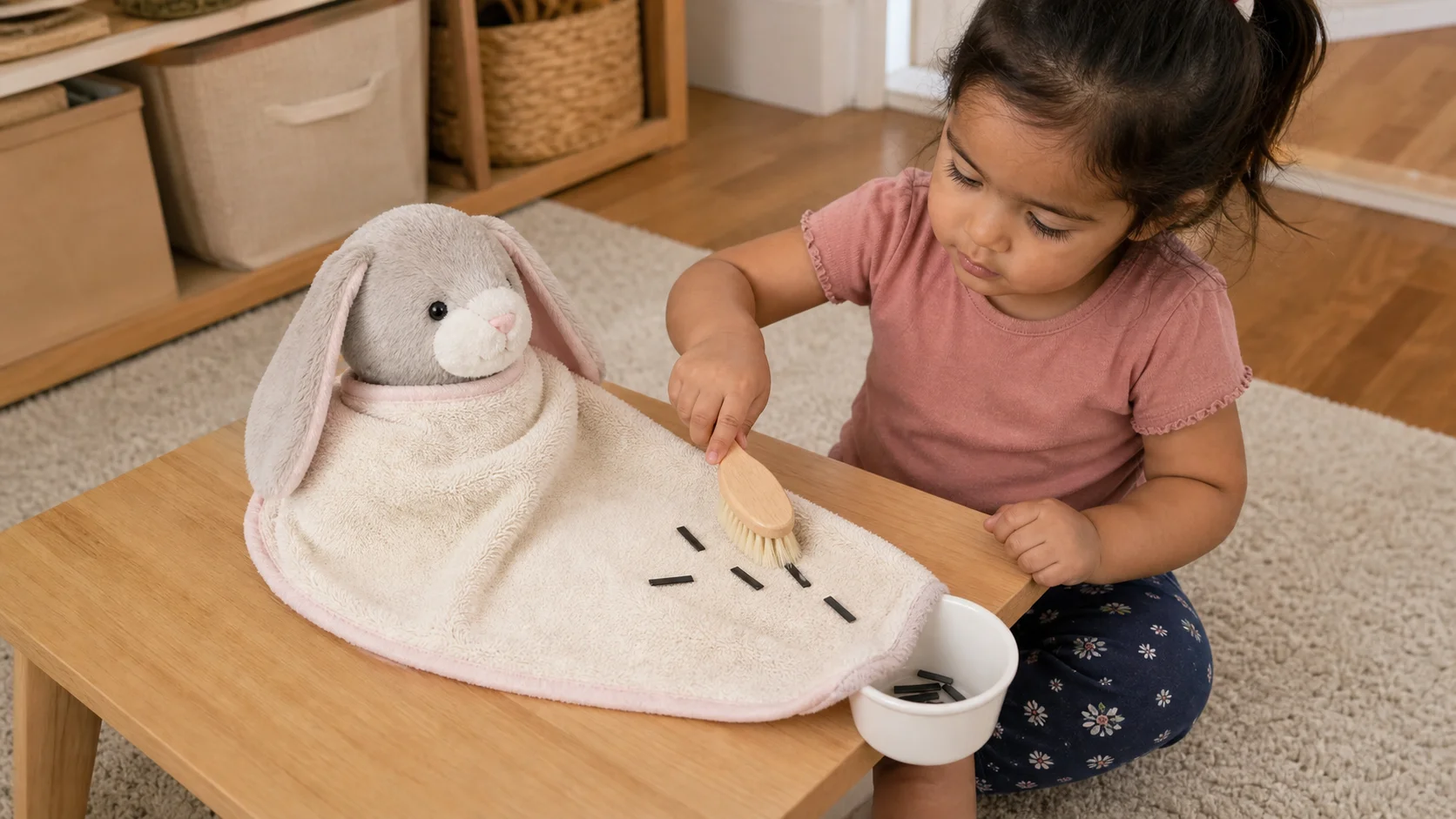
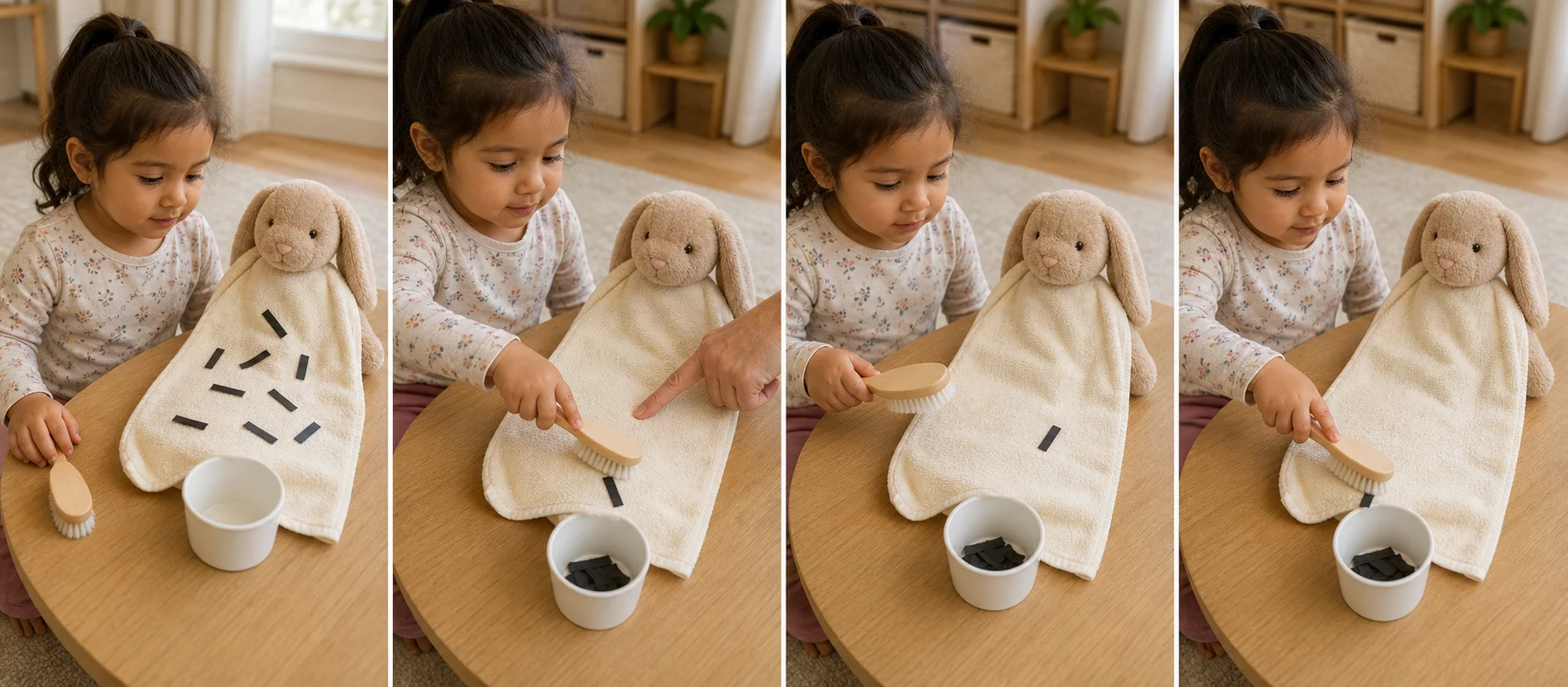
Toddler brushing paper strips off a towel draped over a stuffed toy while a done cup sits at the towel edge.
Skill builderSensory-friendly supportRepeat LoopIndoor

Stray Hair Brush-Off.

A toy, a towel, and a soft brush turn stray paper hairs into one short predictable cleanup routine.
Play time
5-10+ min
Age
2-3 years
Energy
Low
Mess
Low
Effort
Low
Where
Indoor
Start here

The recipe.

Low parent effort
5 things

What you need

  • 1 doll or stuffed toy
  • 1 small towel or doll cape
  • 6 short paper hair strips
  • 1 soft brush with an easy handle
  • 1 small done cup or bowl
5 min minimum

Setup

Then start the loop
Step 01
On a calm indoor surface in front of your child, sit the doll or stuffed toy where the towel and loose strips stay easy to see.
Step 02
Drape the towel or cape over the toy's shoulders or lap so it makes one flat catching surface.
Step 03
Scatter the paper hair strips on top of the towel, place the soft brush on your child's brushing side, and set the done cup against the lower towel edge.
Step 04
Sit close enough to model one slow brush stroke and keep the brush aimed at the towel.
`Brush it off.`
The loop

How play unfolds.

Sequence showing paper strips on a toy towel, a child brushing them toward a done cup, checking for leftovers, and resetting the toy for another round.
  1. 01
    Show one slow sweep and say `Brush the stray hairs off.`
  2. 02
    Let your child brush the paper strips off the towel toward the done cup, then pause to look for any loose ones still showing.
  3. 03
    Sweep away the last strips, say `All clean,` and reset the paper hairs on top for another short round or finish.

Safety Check

  • Stay close because small paper strips can become a mouthing or scatter hazard.
  • Keep the brush on the towel only and away from faces and eyes.
  • Stop if your child starts brushing bodies instead of the towel.
Supporting the play

What to say in the moment

Match what you say to what you see.

Prompt ladder
Level 1 (Start)
`Brush the stray hairs off.`
Level 2 (Keep going)
`Find one more hair.`
Level 3 (Stretch)
`Check if the towel is clean.`
Level 4 (Extend)
`You brush, then I check.`
If your child seems...
What you'd see
Focused
What to do
Say
`You found another stray hair.`
Add
Ask `Where is the brush?`
Extend
Let your child do the clean check before you reset the strips.

Make it easier

Younger end
  • -Hold the done cup against the towel edge for the next few rounds so the landing spot stays obvious.
  • -Reset only the lower half of the towel for a while so the brushing area stays small and easy to scan.
  • -Let your child keep holding the brush between rounds when attention is going well.

Make it harder

Older end
  • +Wait 2 seconds before pointing so your child has a chance to spot the next strip alone.
  • +Let your child brush every strip into the cup before you say `all clean.`
  • +After several easy rounds, reset the strips in 2 small groups so your child chooses where to start.

If it's not working

If you see
If child ignores it
Do 1 quick before-and-after demo yourself, then hand over the brush and invite your child to clear just the last one or two hairs.
If you see
If child misuses it
Put the brush back on the towel, say `Brush the towel, not bodies,` and reset with 1 visible strip near the edge.
If you see
If child gets frustrated
Flatten the remaining strips near the towel edge, hold the cup closer, and end after 1 easy brush-off win.
Skill spotlight
Repeat Loop

Repeating a short brush-off clean-up routine

This helps your child stay with 1 short grooming clean-up order, move a soft tool on purpose, and notice when a small care job is finished.

  • Brushing loose strips toward one finish spot gives your child a clear start and a clear end.
  • The quick check for leftovers turns the towel into an easy visual scan instead of open-ended pretend play.
  • Using a toy and towel first lets your child rehearse a grooming cleanup step without real hair or skin contact.
Real-world transfer
  • Staying calmer through a short hair or grooming clean-up step
  • Using a soft tool to clear loose bits from a surface
  • Noticing when a small routine is finished instead of brushing past the end

Parent questions