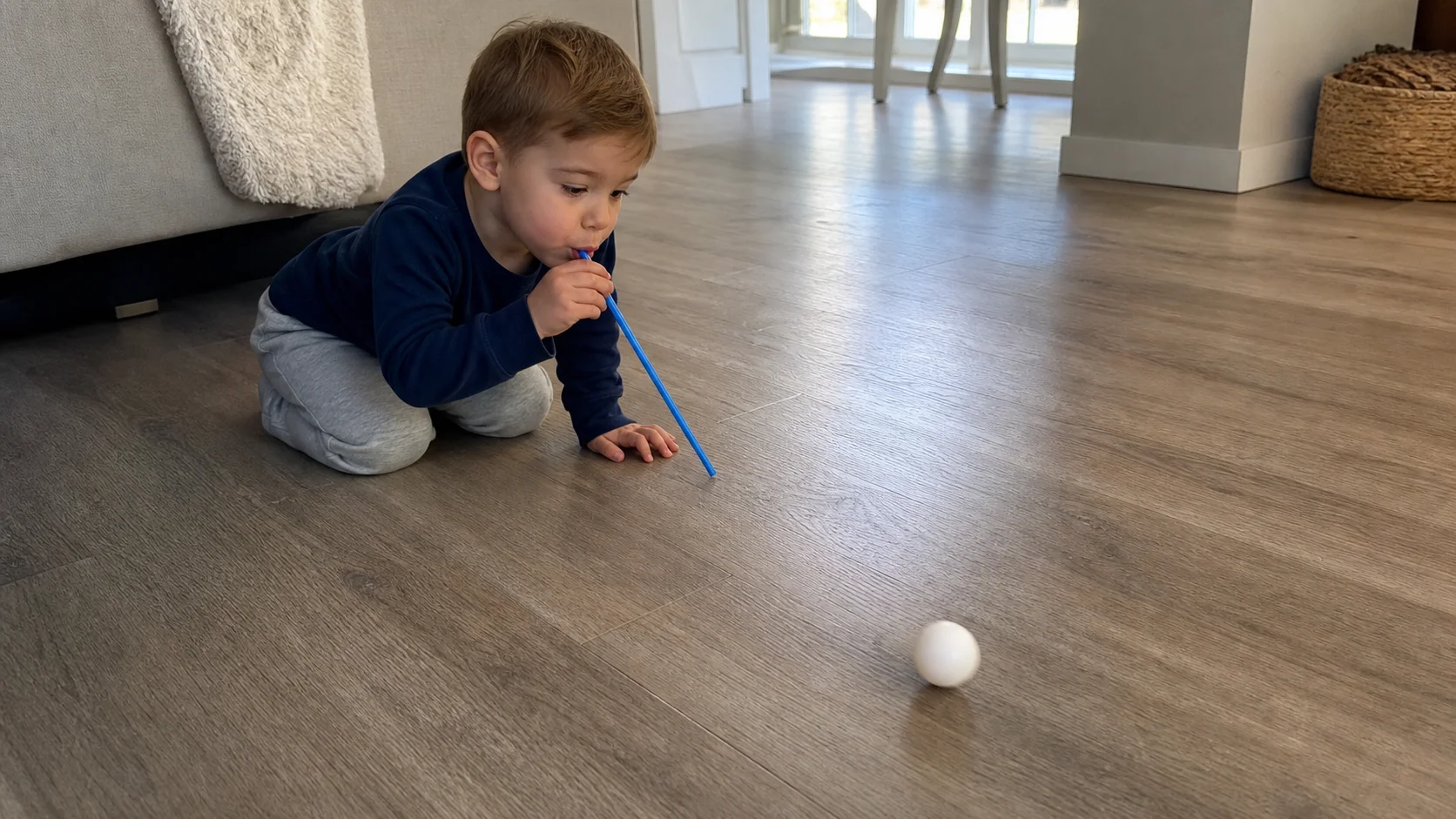
A young child leaning over a straw and blowing a lightweight ball across a short clear floor lane while a grown-up sits nearby.
ThinkingOT-adjacent supportAction ResultIndoor

Straw Ball Blow.

Turn one lightweight ball and a straw into a tiny cause-and-effect challenge. Your toddler blows through the straw to roll the ball along a clear lane and watches one body action create a visible result.

Play time
3-5+ min
Age
2-5 years
Energy
Low
Mess
Low
Effort
Low
Where
Indoor
Start here

The recipe.

Low parent effort
3 things

What you need

  • 1 child-safe straw
  • 1 lightweight ball
  • 1 smooth indoor surface, such as a table or floor
3 min minimum

Setup

Then start the loop
Step 01
Choose a smooth floor or low table and clear one short straight lane.
Step 02
Place the lightweight ball at one end of the lane and have the straw ready at the same end.
"Your blow."
The loop

How play unfolds.

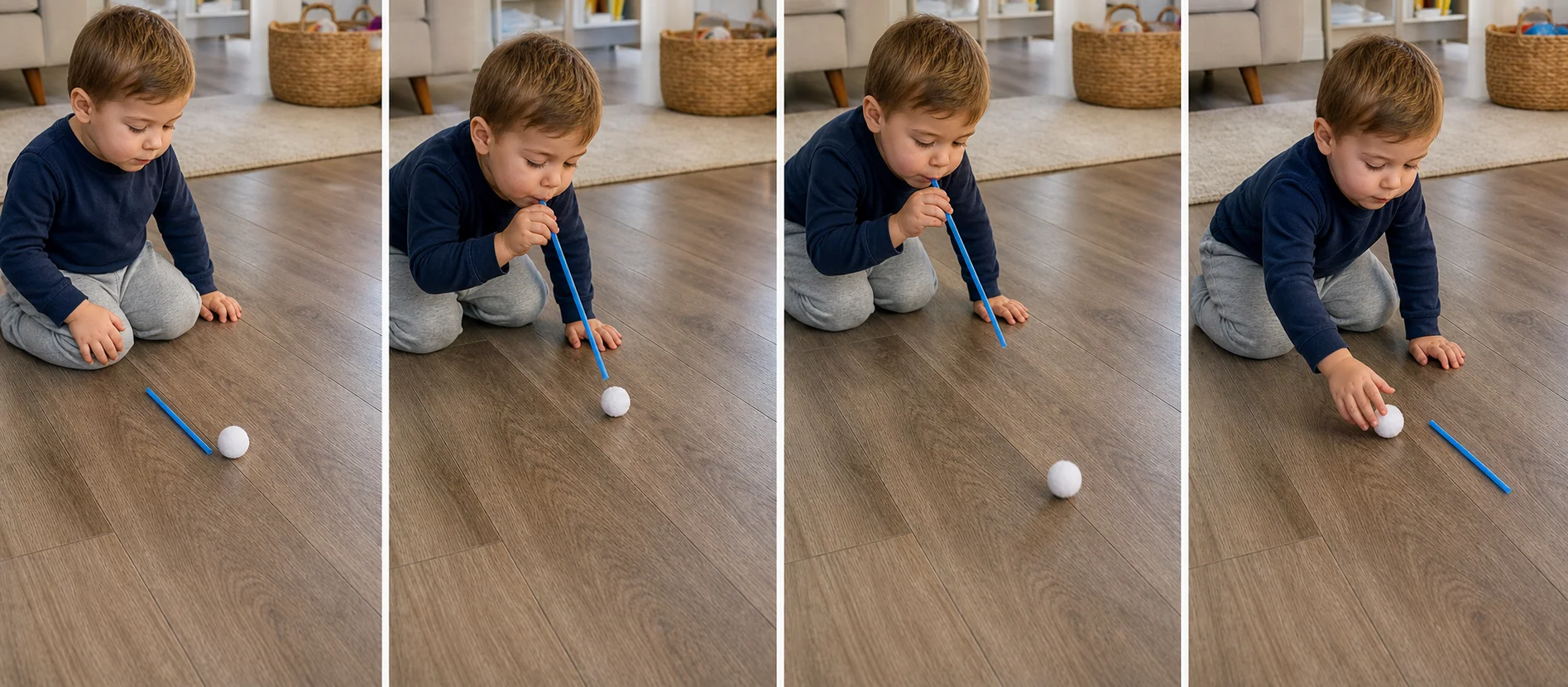
Four panels showing a grown-up setting a ball at the start line, modeling one blow through a straw, a child blowing the ball forward, and the ball being reset for another turn.
  1. 01
    Model one turn by aiming the straw opening toward the ball and blowing once to make the ball roll.
  2. 02
    Move the ball back to the start, then let your child aim the straw toward it and blow.
  3. 03
    When the ball stops, return it to the start and repeat.

Safety Check

  • Stay with your child the whole time because the straw and small ball can become mouthing hazards.
  • Use the floor instead of a table if leaning, climbing, or chasing makes the setup less safe.
  • Stop and reset if the ball keeps rolling under furniture or the straw turns into a chewing toy.
Skill spotlight
Action And Result

Making an object move with one clear action

This helps a child connect one body action to one visible result and stay with a simple retry loop when the first try is weak.

  • Early. Your child may blow once, watch the ball move a little, and need help resetting it.
  • Later. Your child starts another turn, changes breath strength on purpose, or asks to do it again.
  • Middle. Your child repeats the same lane and starts to notice when a stronger blow moves the ball farther.
Real-world transfer
  • Noticing how one action changes what happens next.
  • Repeating a short motor task without a lot of language.
  • Sticking with a retry after a small miss.
Supporting the play

What to say in the moment

Match what you say to what you see.

Prompt ladder
Level 1 (Start)
"Blow and go."
Level 2 (Keep going)
"Make it roll again."
Level 3 (Stretch)
"Can you make it go farther?"
Level 4 (Extend)
"Slow blow or strong blow?"
If your child seems...
What you'd see
Focused
What to do
Say
"You moved it with your breath."
Add
Point to the ball's new spot so the next target stays clear.
Extend
Try one slow blow and one stronger blow on the same lane.

Make it easier

Younger end
  • -Keep the ball very close to the start of the lane.
  • -Use the floor instead of a table for a steadier setup.
  • -Praise even a tiny roll before asking for another turn.

Make it harder

Older end
  • +Ask for one soft blow and one stronger blow.
  • +Let the ball start a little farther away after a few easy turns.
  • +Pause before each turn and wait for your child to get ready.

If it's not working

If you see
If child ignores it
Do one quick model turn yourself and hand the next turn back right away.
If you see
If child misuses it
Say, "Straw blows the ball," then reset the ball and show one short blow.
If you see
If child gets frustrated
Shorten the lane and count any small roll as success.