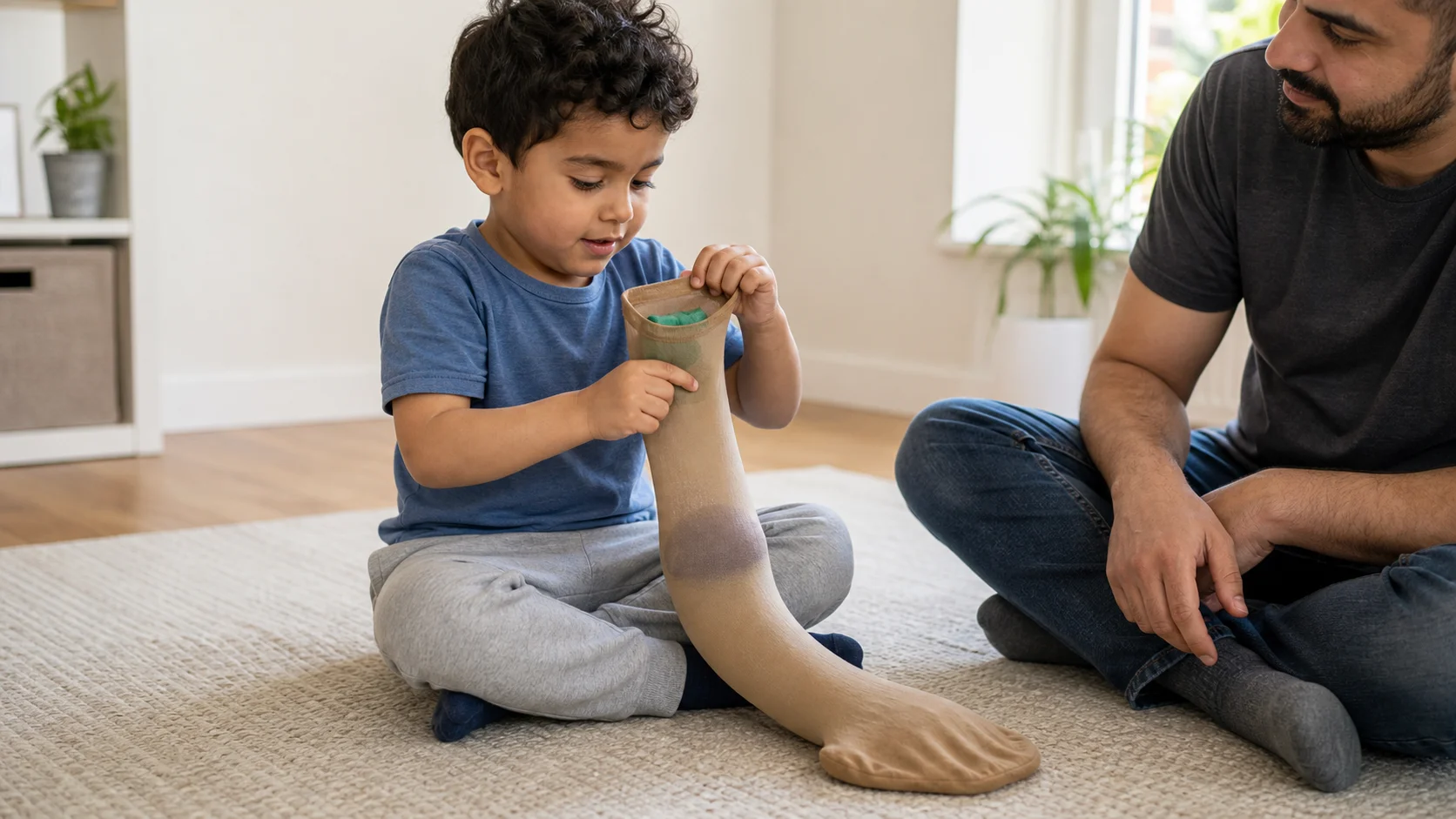
A child sits at a table, holds the top of a stocking with one hand, and pushes a hidden bean bag toward the opening with the other hand.
Fine motorTwo Hand CoordinationIndoor Seated Workspace

Stocking Bean Bag Rescue.

A bean bag hidden inside a stocking turns pinch-and-push practice into a quiet rescue game.

Play time
5-10+ min
Age
3-5 years
Energy
Low
Mess
Low
Effort
Low
Where
Indoor Seated Workspace
Start here

The recipe.

Low parent effort
4 things

What you need

  • 1 long stocking
  • 1 bean bag
  • 1 stable seated spot
  • 1 adult for setup and direct supervision
5 min minimum

Setup

Then start the loop
Step 01
At the seated spot, check the bean bag before play. Use it only if the fabric is closed and no beads are loose.
Step 02
Inside the stocking toe, push the bean bag all the way down so there is one clear lump at the closed end.
Step 03
In front of your child, place the stocking with the top opening close enough for one hand to hold.
Step 04
Beside your child, stay close enough to steady the stocking or shorten the path if the first rescue is too hard.
"Feel for the bump."
The loop

How play unfolds.

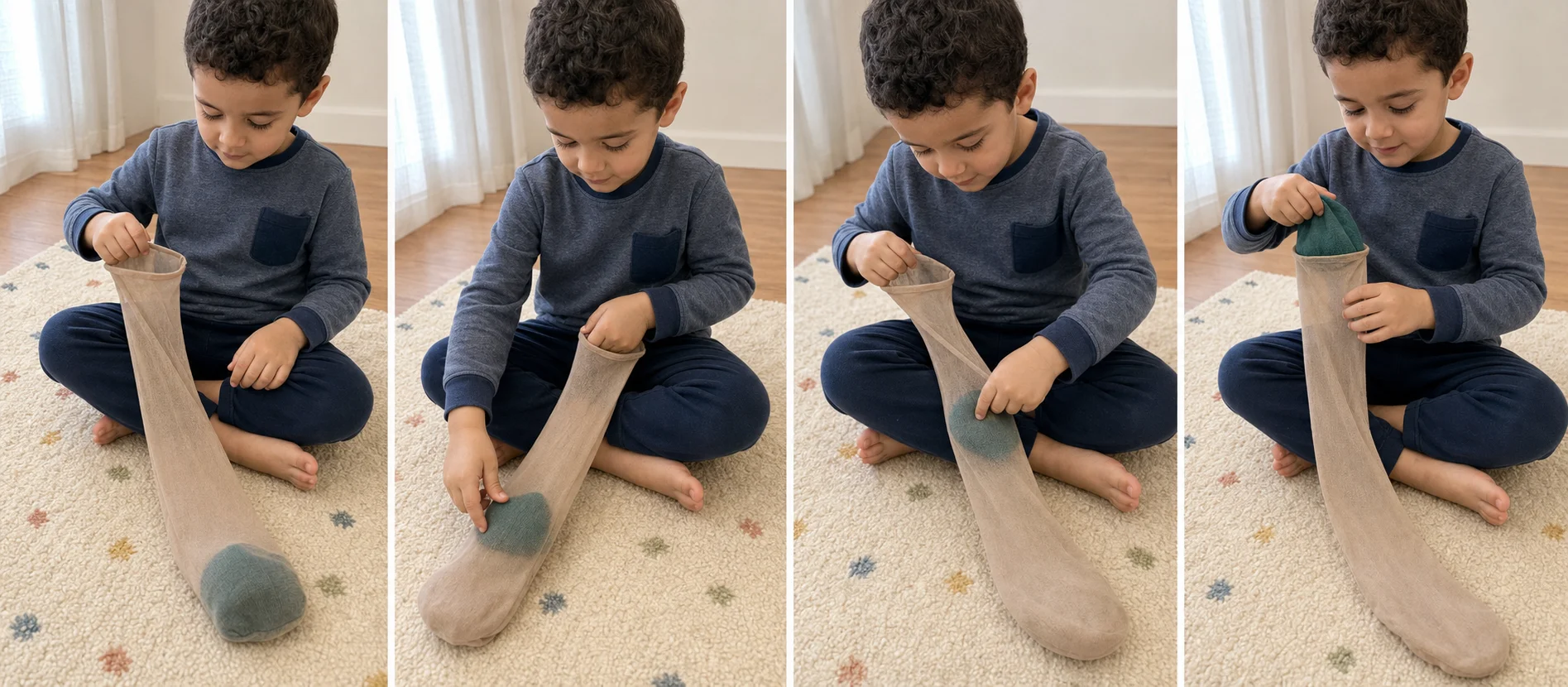
Four panels show a bean bag loaded into a stocking toe, a child holding the top, fingers pushing the hidden lump upward, and the bean bag pulled out at the opening.
  1. 01
    Show your child the bean bag lump at the toe and say, "Hold the top still. Now push the bump to the opening."
  2. 02
    Let your child hold the opening with one hand and feel for the hidden bean bag with the other hand.
  3. 03
    Have your child pinch the lump through the fabric and push it up the stocking in short moves.
  4. 04
    When the bean bag reaches the opening, let your child pull it out.
  5. 05
    Load the bean bag back into the toe, switch hands, and repeat until each hand has had a turn or your child's hands look tired.

Safety Check

  • Stay with your child during play.
  • Check the bean bag for tears or loose beads before starting.
Supporting the play

What to say in the moment

Match what you say to what you see.

Prompt ladder
Level 1 (Start)
Find the hidden bean bag.
Level 2 (Keep going)
Push it one thumb farther.
Level 3 (Stretch)
Keep the helper hand still while the pushing hand works.
Level 4 (Extend)
Try one slow rescue, then one speedy rescue.
If your child seems...
What you'd see
Focused
What to do
Say
"Keep the bump moving."
Add
Ask for one quiet rescue with slow pushes.
Extend
Let your child choose which hand rescues next.

Make it easier

Younger end
  • -Hold the stocking steady while your child uses both hands to push.
  • -Start with the bean bag close enough that only 2 or 3 pushes finish the rescue.
  • -Pause after each small push so your child can feel where the lump moved.

Make it harder

Older end
  • +Ask your child to keep the helper hand still for the whole rescue.
  • +Try a silent rescue where your child watches the lump instead of getting verbal cues.
  • +Have your child stop at the middle, then continue to the opening.

If it's not working

If you see
If child ignores it
Move the bean bag lump under their fingers and say, "Find the hidden bump."
If you see
If child misuses it
Hold the top for one round and let your child do only the pinch-and-push part.
If you see
If child gets frustrated
Move the bean bag halfway up the stocking so the rescue is shorter.
Skill spotlight
Two-Hand Coordination

Holding steady with one hand while the other hand pushes.

This helps a child keep one hand steady while the other hand does careful finger work. That same pattern shows up in dressing, opening simple packages, and holding paper or toys still while the working hand does the job.

  • The helper hand has to stay steady while the other hand does the pushing work, which matches the two-hand coordination named in the skill layer.
  • The hidden bean bag gives your child touch feedback the whole way up, so finger pressure and small push adjustments stay part of every round.
  • The short rescue-and-reset loop keeps practice predictable, which supports children who do better with quiet repetition and low language load.
Real-world transfer
  • Holding fabric, paper, or a container steady while the other hand works
  • Pushing or pulling through sleeves, socks, and other dressing steps
  • Using fingertips to manage hidden, slippery, or resistant objects