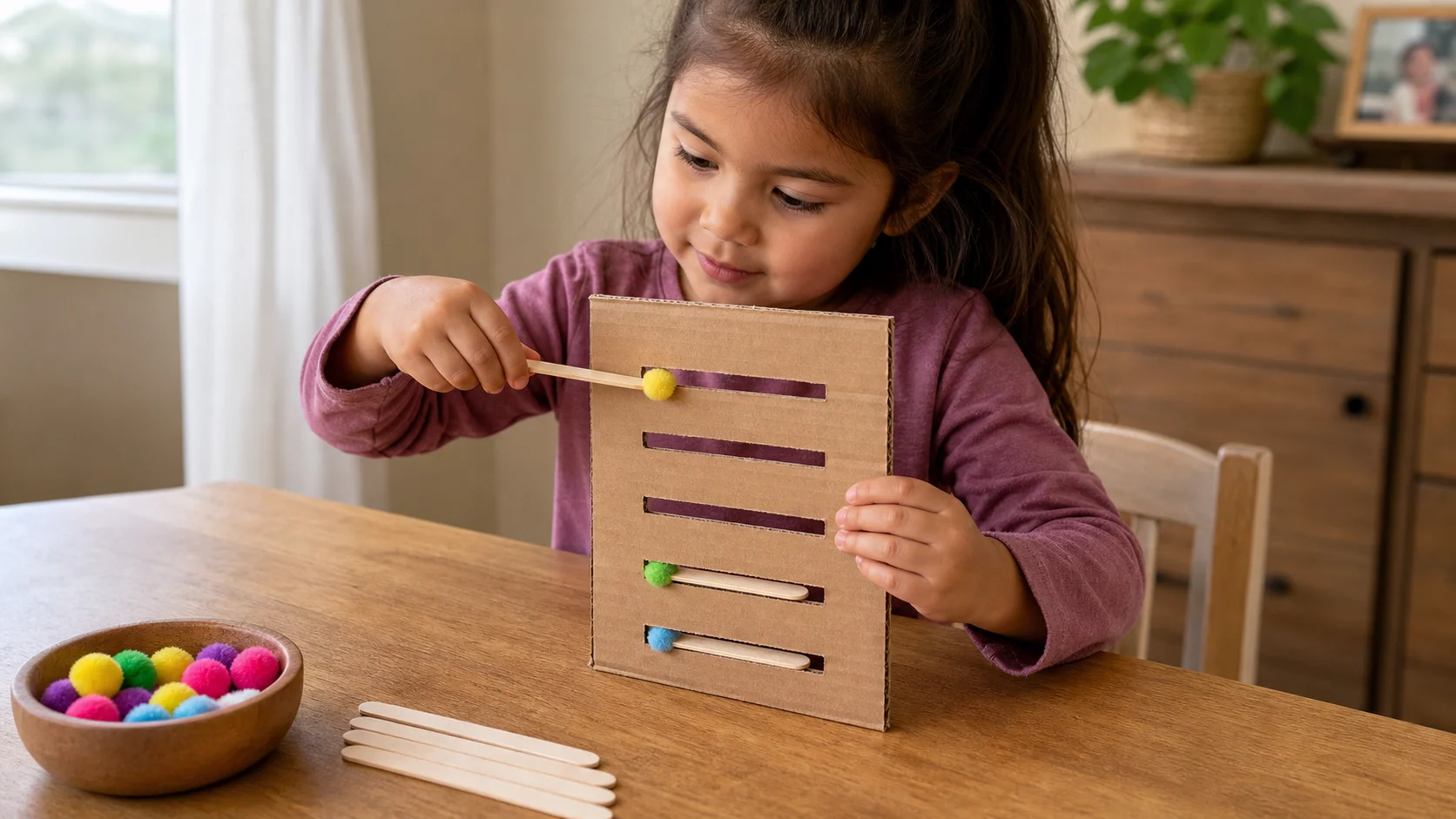
A child loads a pom-pom onto a craft stick and pushes it through a tight slit in a cardboard board while a grown-up steadies the board nearby.
Fine motorPush Through ResistanceIndoor Tabletop Or Wall Side Workspace

Stick Drop Loader.

A pom-pom, a craft stick, and a tight cardboard slot turn finger work into a satisfying push-and-drop round.

Play time
5-10+ min
Age
3-5 years
Energy
Low
Mess
Low
Effort
Medium
Where
Indoor Tabletop Or Wall Side Workspace
Start here

The recipe.

Medium parent effort
6 things

What you need

  • 1 small sturdy cardboard rectangle
  • several craft sticks
  • several pom-poms
  • 1 pair of scissors for adult setup
  • 1 table or wall-side workspace
  • 1 adult for direct supervision
5 min minimum

Setup

Then start the loop
Step 01
Away from your child, cut a small sturdy cardboard rectangle.
Step 02
In the cardboard, cut 4 to 6 tight narrow slits about 1 inch long.
Step 03
Lay the cardboard flat on the table, or lean it against a wall at your child's height.
Step 04
Beside the cardboard, place a small pile or bowl of pom-poms and set the craft sticks within easy reach.
Step 05
Test one loaded stick before you start. It should need a firm push without tearing the cardboard or sliding through loosely.
"Load, hold, push."
The loop

How play unfolds.

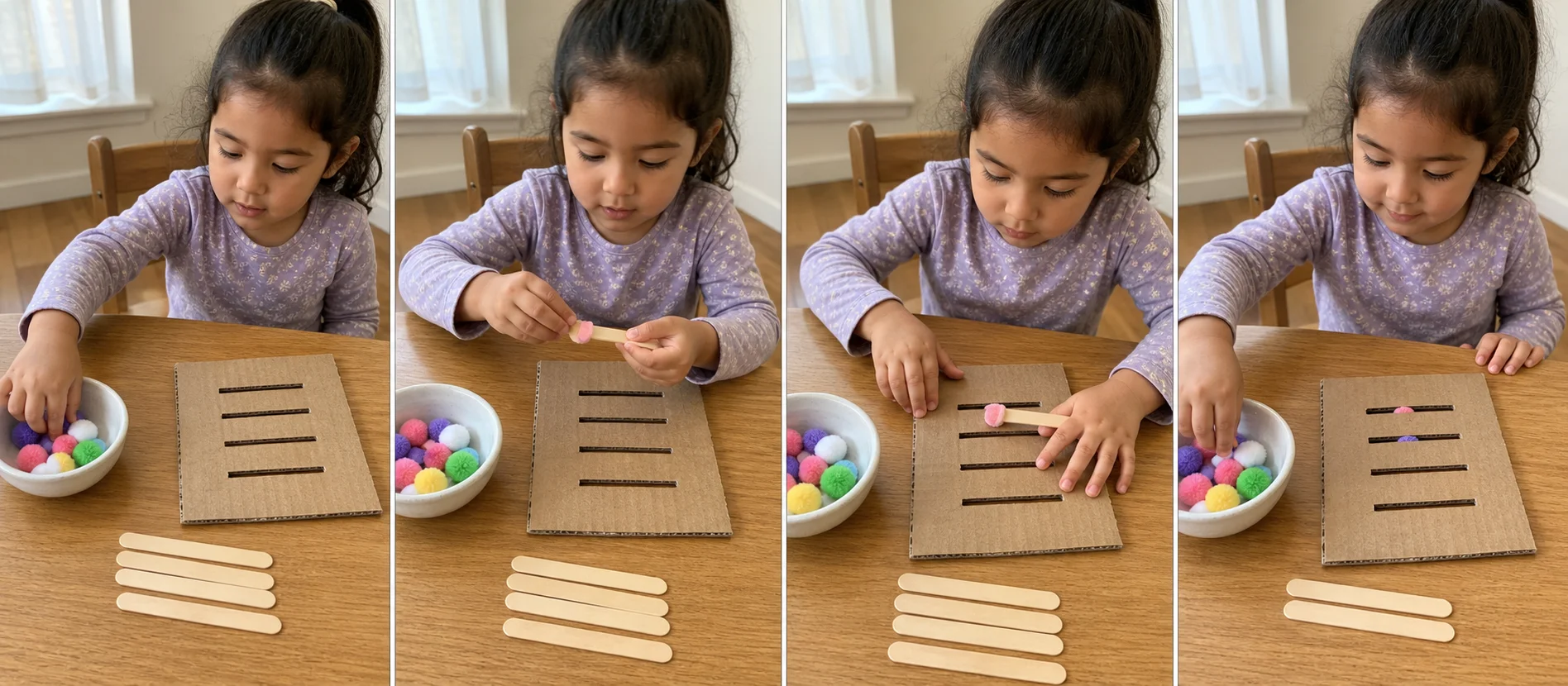
A multi-panel play sequence shows pom-poms and craft sticks beside a slit cardboard board, a child loading one pom-pom onto a stick, pushing it through a slit, and starting another turn.
  1. 01
    Model one turn and say, "Load it, hold the board, and push it through."
  2. 02
    Let your child press one pom-pom onto a craft stick, hold the cardboard steady with the helper hand, and push through a slit until the pom-pom drops through.
  3. 03
    Repeat with the next pom-pom and another slit.
  4. 04
    If the stick stalls or the board slides, switch to the easiest slit or help steady the board, then try again.
  5. 05
    Work across the slits, then circle back for another short round if your child wants more.

Safety Check

  • Craft sticks are small and pom-poms are choking hazards. Stay within reach and supervise directly the whole time.
  • Keep scissors in adult hands during setup.
  • Pause the round if a pom-pom goes in the mouth, a stick is waved, or pieces start getting thrown.
Supporting the play

What to say in the moment

Match what you say to what you see.

Prompt ladder
Level 1 (Start)
Load one pom-pom on the stick and push it through one slot.
Level 2 (Keep going)
Pick an empty slit and try another push.
Level 3 (Stretch)
Press slowly until you feel the cardboard let go.
Level 4 (Extend)
Work across the slots in any order, then start one more short round.
If your child seems...
What you'd see
Focused
What to do
Say
"Your helper hand is holding it still."
Add
Point to one unused slit.
Extend
Invite one slow push or one fast push.

Make it easier

Younger end
  • -Use the flat tabletop setup and hold the cardboard edge for your child.
  • -Pre-load the first pom-pom halfway so your child finishes the loading action.
  • -Cover unused slits with your hand so there is only one target to aim for.

Make it harder

Older end
  • +Ask your child to keep the helper hand on the cardboard for the whole push.
  • +Choose a tighter slit after one easy success.
  • +Try a quiet slow-motion push from load to drop.

If it's not working

If you see
If child ignores it
Do one slow turn yourself and make the drop obvious: "Load, hold, push, drop." Then offer 1 pom-pom and 1 stick.
If you see
If child misuses it
Move the extra pom-poms and sticks to your side, then restart with 1 loaded stick for a calm push.
If you see
If child gets frustrated
Switch to the flat tabletop setup, widen 1 slit slightly, and let your child use the easiest slit first.
Skill spotlight
Push Through Resistance

Push with control

This helps the child use small finger pressure, two hands together, and controlled force for daily hand jobs like writing, cutting, and pushing pieces through openings.

  • Loading the pom-pom onto the stick gives your child a small finger job before the bigger push.
  • The tight slit gives fast feedback about aim, helper-hand stability, and pressure.
  • Each drop is short and repeatable, so a miss becomes another try instead of a full reset.
Real-world transfer
  • Holding paper still while coloring or cutting
  • Using one hand to steady while the other hand works
  • Pressing objects into tight spaces without giving up
  • Changing hand pressure instead of pushing too hard every time