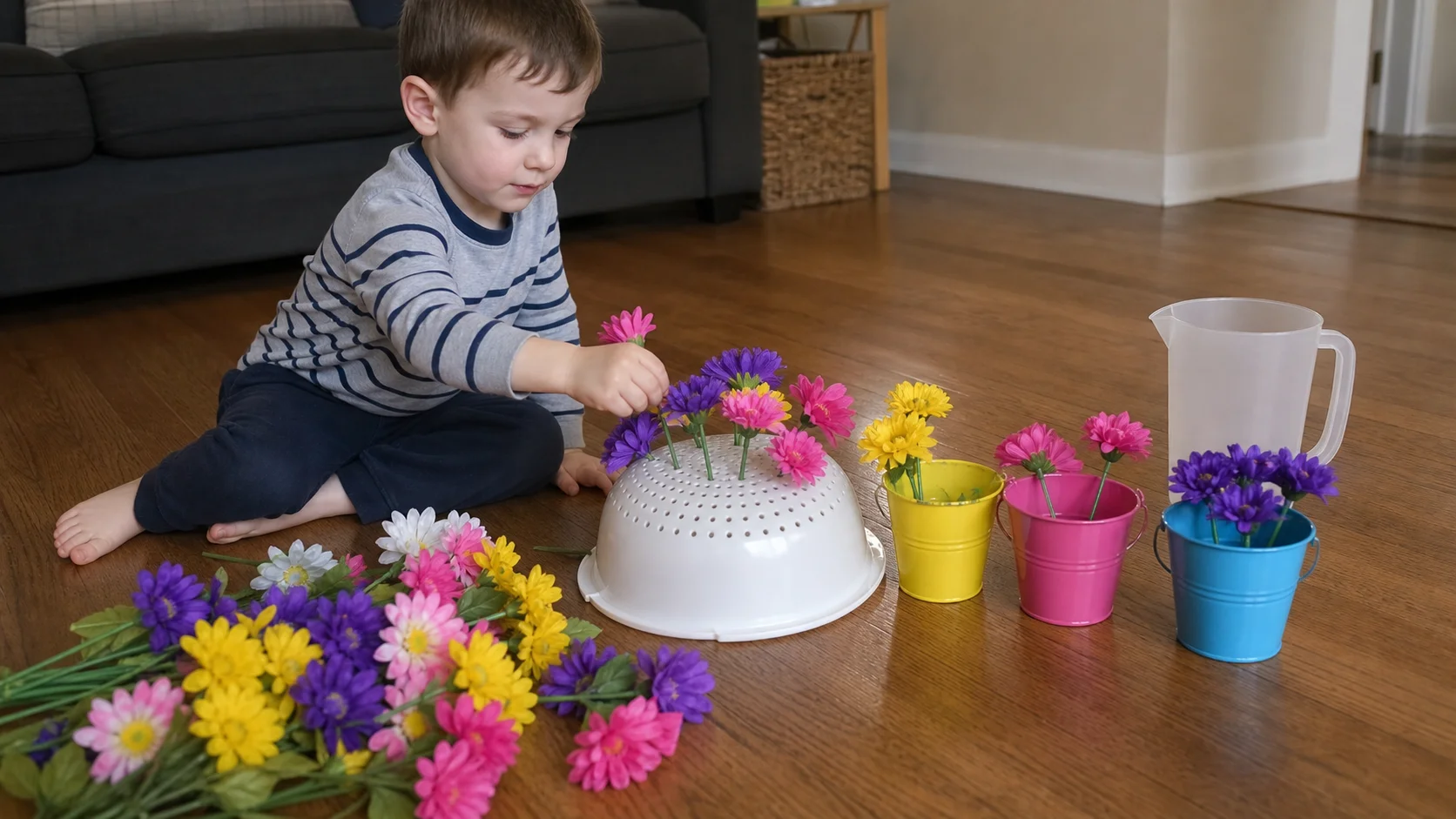
A child drops fake flowers into small buckets and a colander while a grown-up sits nearby at a low table.
ThinkingBy ColorIndoor Floor Or Table Play Space

Spring Flower Pretend Play.

Fake flowers, a few containers, and an easy dump-and-reset loop turn sorting into calm pretend garden play.

Play time
10-15+ min
Age
3-5 years
Energy
Low To Medium
Mess
Low
Effort
Low
Where
Indoor Floor Or Table Play Space
Start here

The recipe.

Low parent effort
7 things

What you need

  • A few fake flowers
  • 1 colander
  • 3 small colored buckets
  • 1 tall plastic pitcher
  • 1 indoor floor or table play space
  • 1 child
  • 1 adult
10 min minimum

Setup

Then start the loop
Step 01
Clip fake flower bunches into individual flowers if needed, then check the cut ends for anything sharp or pointy.
Step 02
On the floor or a low table, place the colander, 3 small buckets, and the tall plastic pitcher in front of your child.
Step 03
Spread the fake flowers in 1 loose pile beside the containers.
Step 04
Leave a little open space for dumping and refilling, then seat or stand your child where every container is easy to reach.
"Flower home."
The loop

How play unfolds.

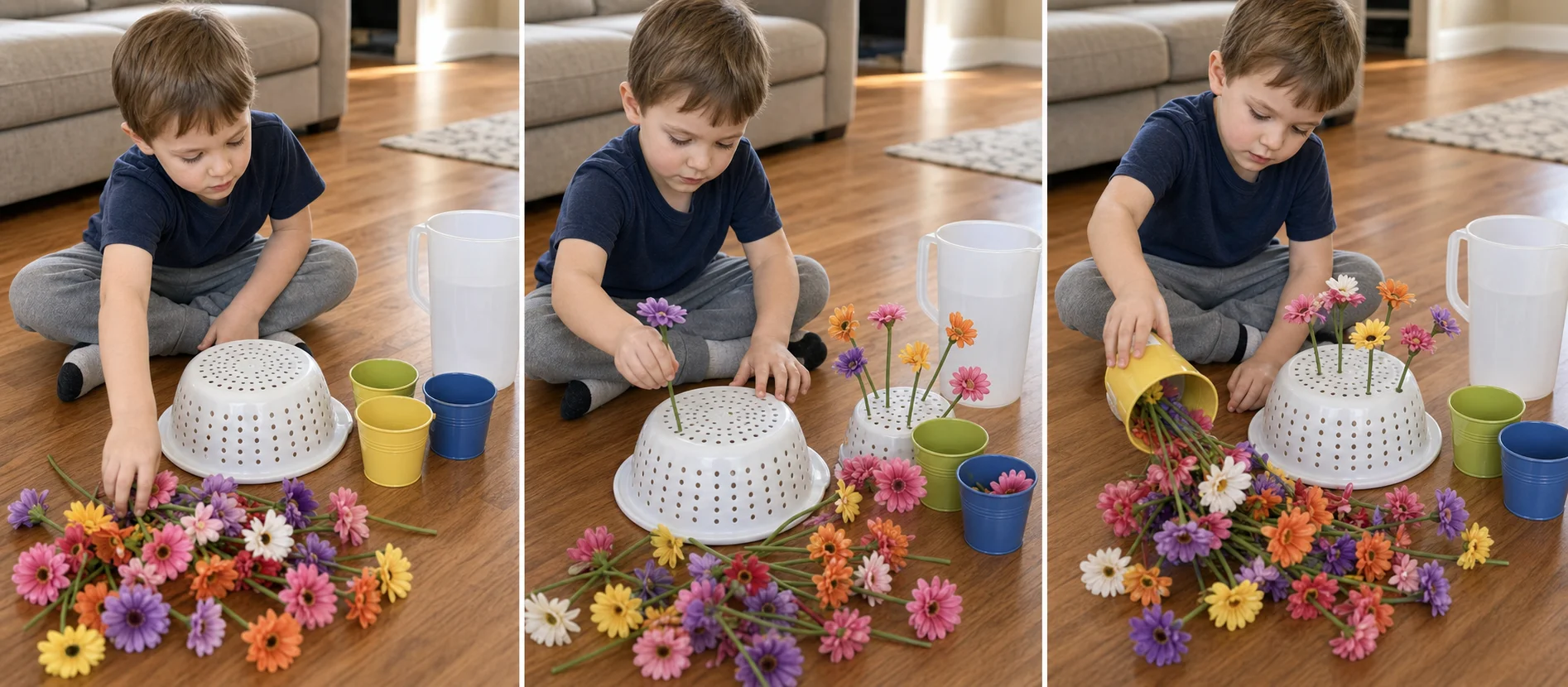
Four panels show fake flowers and containers set out, a grown-up modeling one flower drop, a child sorting flowers into buckets and a colander, and the flowers dumped back out for another round.
  1. 01
    Drop 1 flower into a container and say, "These are your flowers. You can put them wherever you want."
  2. 02
    Let your child place flowers into the colander, buckets, or pitcher one at a time.
  3. 03
    If your child starts sorting by color, size, or fit, follow that rule for the round.
  4. 04
    When a container feels full or your child wants a reset, dump the flowers back into the pile and start another bouquet.

Safety Check

  • Check clipped flower ends before play and remove any stem that feels sharp or pointy.
  • Keep real glass vases out of the main setup; use plastic containers for this age range.
  • If your child uses the toss round, keep the target close, supervise the stems, and gather scattered flowers before anyone steps through the play area.
Supporting the play

What to say in the moment

Match what you say to what you see.

Prompt ladder
Level 1 (Start)
Pick one flower and choose its home.
Level 2 (Keep going)
Fill one container, then dump it back to the pile.
Level 3 (Stretch)
Make a tiny bouquet with flowers that look alike.
Level 4 (Extend)
Toss, collect, and arrange the flowers again.
If your child seems...
What you'd see
Focused
What to do
Say
"You picked that spot."
Add
Name 1 color or size after the flower lands.
Extend
Invite 1 more flower for the same container.

Make it easier

Younger end
  • -Start with 3 flowers and 1 open container before adding the other choices.
  • -Skip the colander holes and use only open-top containers for the next round.
  • -Put 1 flower directly in your child's hand instead of asking them to choose from the pile.

Make it harder

Older end
  • +Invite your child to fill each container with a different color when they are already sorting.
  • +Ask your child to make a short, medium, or tall flower group.
  • +Let your child decide when a bouquet is finished before dumping it.

If it's not working

If you see
If child ignores it
Place 2 flowers into different containers and say, "I wonder where this one goes," then hand over the next flower.
If you see
If child misuses it
If flowers get thrown or scattered right away, offer a small handful, keep the containers close, and restart with a gather-and-drop round.
If you see
If child gets frustrated
If a flower will not fit the colander or a container tips, steady the container and say, "That one can go in the bucket."
Skill spotlight
By Color

Sorting flowers by a visible rule, Careful container placement

Sorting by a visible rule helps a child organize what they see, make a simple choice, and follow a plan while their hands place one object at a time.

  • Sorting by color or size gives your child a visible rule to notice and repeat.
  • Placing stems into different containers builds hand control without a complicated setup.
  • Dumping and starting over turns repetition into part of the game instead of extra cleanup.
Real-world transfer
  • Sorting toys or cleanup pieces by where they belong
  • Choosing matching items during dressing or pretend play
  • Placing small objects carefully into cups, bins, bags, or containers