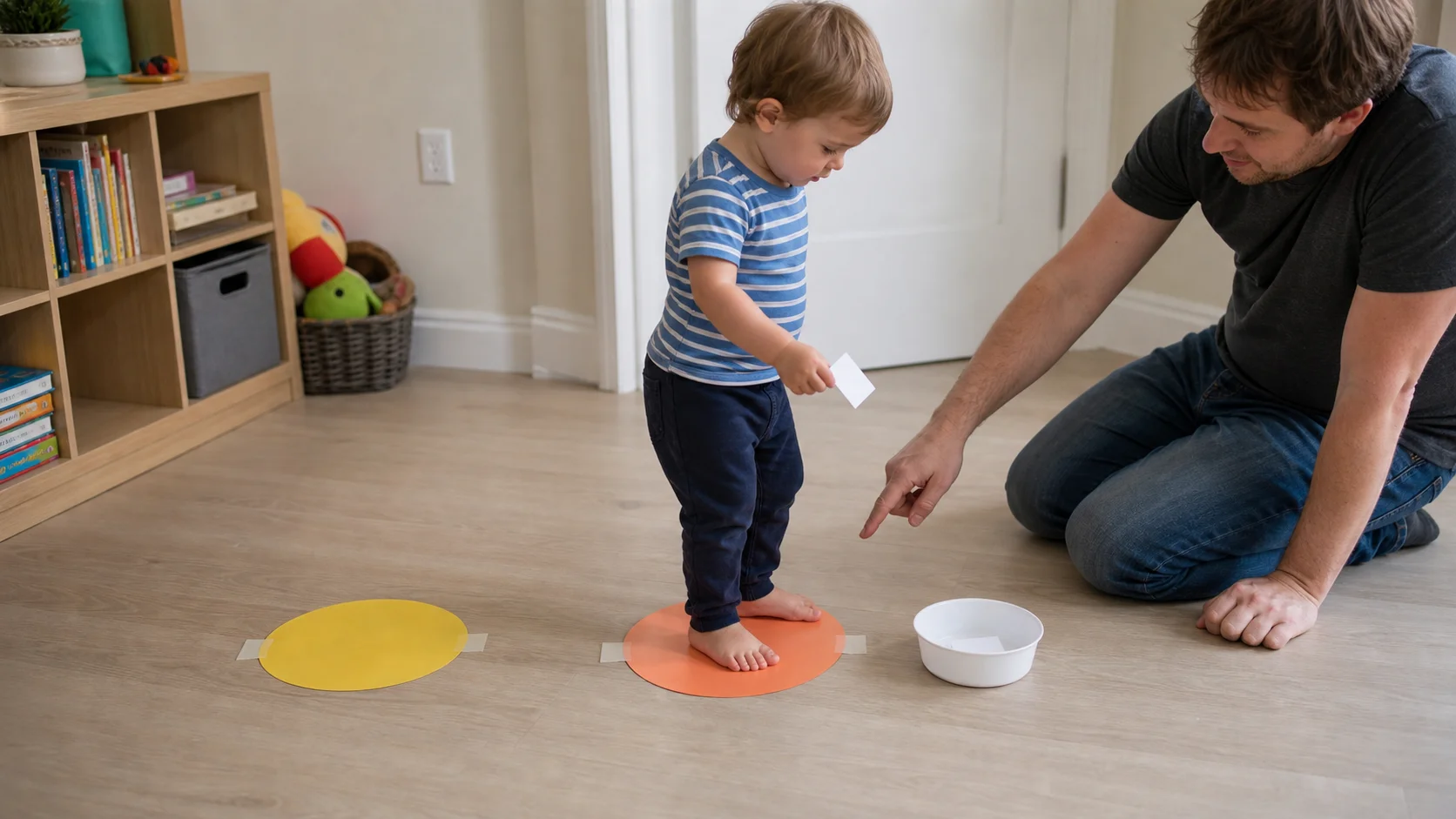
A toddler standing on one floor marker while looking at the next spot in a short indoor line, with a small finish cup nearby.
Skill builderAutism supportRepeat Loop`Indoor

Spot Line Move-Up.

Two floor spots and one short cue turn line-up practice into a calm step-and-wait game.
Play time
5+ min
Age
2-3 years
Energy
Low
Mess
Low
Effort
Low
Where
Indoor
Start here

The recipe.

Low parent effort
5 things

What you need

  • 2 floor spots made from paper plates, taped paper, or other flat markers
  • 1 small paper ticket or card
  • 1 small cup or tray for the finish
  • 1 child
  • 1 adult
5 min minimum

Setup

Then start the loop
Step 01
On the floor, place 2 flat floor spots in a short line with one small step of space between them.
Step 02
On or beside the first floor spot, place the paper ticket, and set the finish cup just past the second spot.
Step 03
Stand your child on the first spot facing the second one, and stay beside the path so you can point, praise, or guide without blocking the line.
`Stand here.`
The loop

How play unfolds.

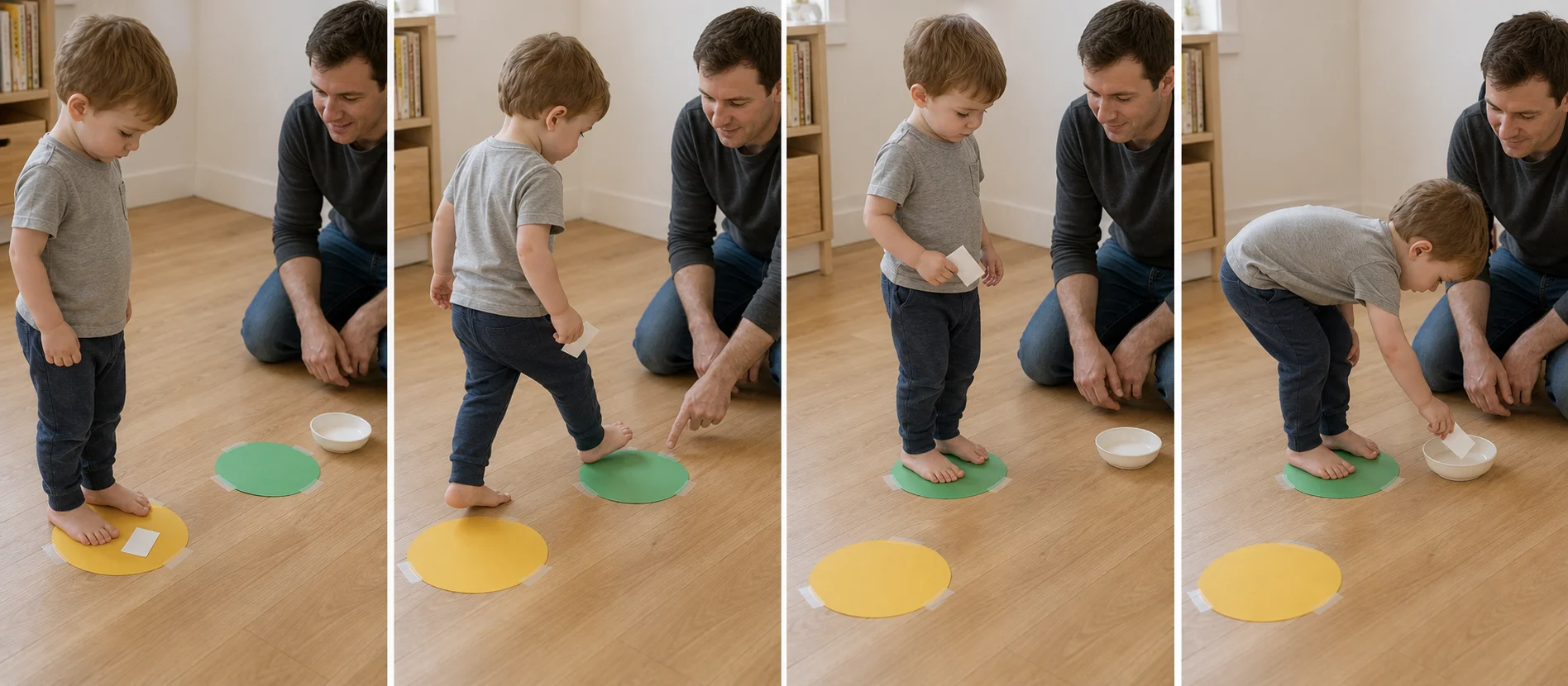
A multi-panel sequence showing a child standing on the first spot, stepping to the next marker, waiting, dropping a ticket in a cup, and returning to start.
  1. 01
    Start your child on the first spot, point to the next marker, and say `Move up` or `Stand on your spot`.
  2. 02
    Let your child step onto the next spot and wait there for one short count.
  3. 03
    If you are using the ticket, let your child drop it in the finish cup, then return to the first spot for the next turn.
  4. 04
    Repeat for a few calm practice turns, or stop after one good stand-and-wait success.

Safety Check

  • Press the floor spots flat so they do not slide or curl under your child's feet.
  • If you use the paper ticket and finish cup, keep them large enough and supervised so they do not become mouth or throw hazards.
  • Stay close if your child bolts forward, steps off early, or gets frustrated during the wait.
Supporting the play

What to say in the moment

Match what you say to what you see.

Prompt ladder
Level 1 (Start)
Stand on your spot.
Level 2 (Keep going)
Move up.
Level 3 (Stretch)
Hold your place.
Level 4 (Extend)
Find the next spot.
If your child seems...
What you'd see
Focused
What to do
Say
`Move up.`
Add
Name `spot` or `line` after your child lands with both feet.
Extend
Let your child carry the ticket to the finish and step back to start before the next cue.

Make it easier

Younger end
  • -Let the adult handle the ticket reset so your child only has to step forward, wait, and hear praise.
  • -Keep the two spots close enough that one short forward step reaches the next marker without wobbling.
  • -Rest your pointing finger on the next marker before each turn so the target never changes mid-step.

Make it harder

Older end
  • +Pause one beat before you point so your child has a chance to find the next marker alone.
  • +Let your child carry the ticket, wait on the marker, and drop it at the finish without adult touch help.
  • +Ask your child to step back to the start marker and get ready for the next turn independently.

If it's not working

If you see
If child ignores it
Start with only the second marker, point to it, model one stand-and-wait turn, and help your child copy that one spot.
If you see
If child misuses it
Remove the ticket or finish cup right away if they become throw toys or mouth toys, then go back to the marker-only version with one cue and one wait.
If you see
If child gets frustrated
Shorten the wait to one beat, guide your child onto the spot once if needed, and count one successful stand as enough for today.
Skill spotlight
Line-Up Move-Up Routine`

Repeating a short move-up line routine, Holding one new line spot for a short wait

This helps a child move through one tiny transition in order, hold place briefly, and stay with the same predictable pattern instead of rushing ahead or wandering off.

  • The floor spots show exactly where your child's feet go next, so the routine can work with less talking and less guesswork.
  • The short wait on the second spot gives your child practice holding place without turning it into a long test.
  • The reset back to the first marker keeps the pattern predictable, which can make short line-up moments easier to rehearse.
Real-world transfer
  • Lining up on a visual spot at home, daycare, or therapy
  • Moving one place forward and holding position during short transitions
  • Following a small predictable start-and-finish routine with less verbal prompting

Parent questions