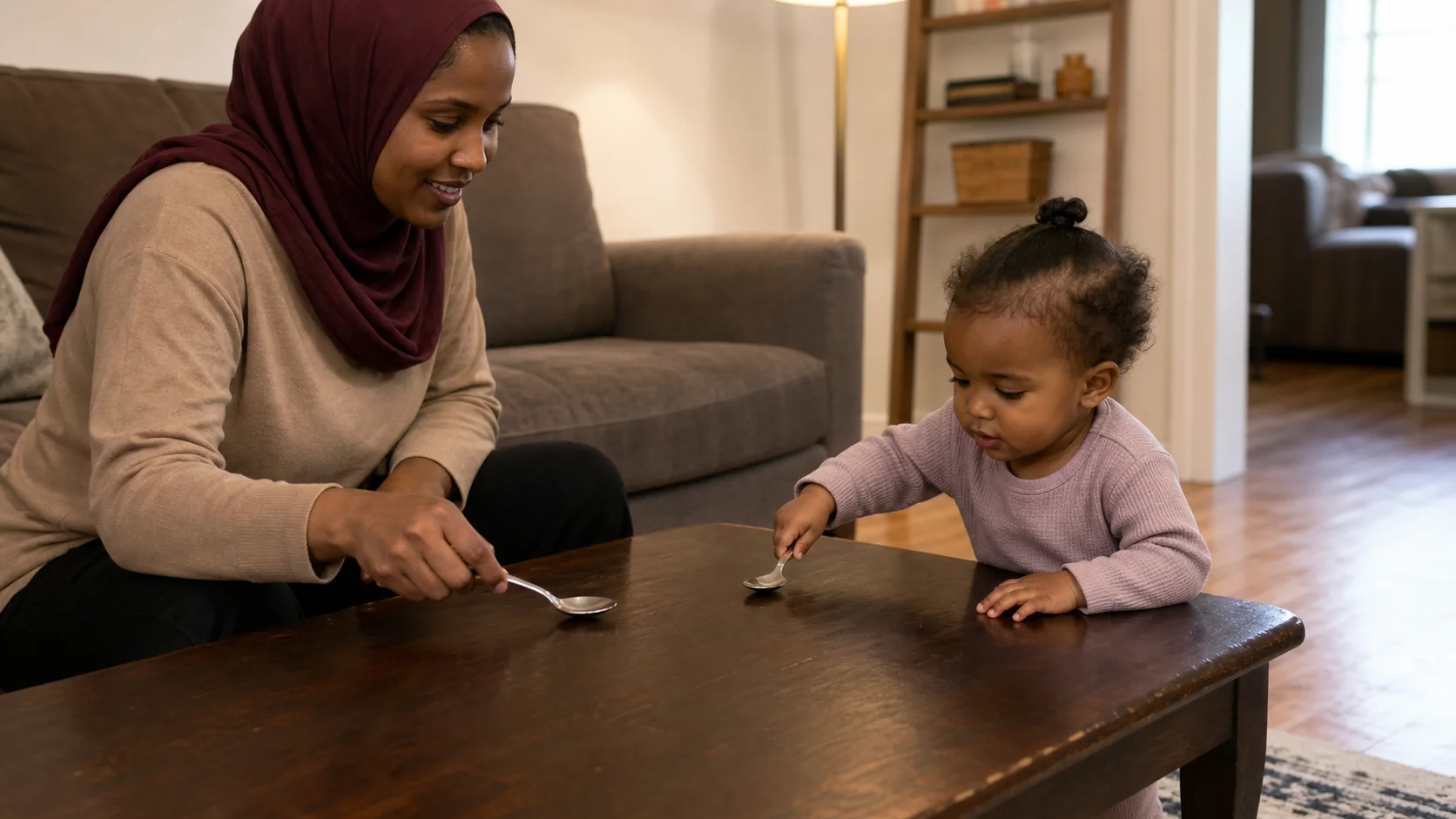
Toddler tapping a spoon on a table while a grown-up models the same one-tap turn beside them.
Skill builderAutism supportDevelopmental supportCopy Then TryIndoor

Spoon Tap Echo.

Two spoons and one calm table tap give toddlers a simple copy-my-sound language game.

Play time
5+ min
Age
1-2 years
Energy
Low
Mess
Low
Effort
Low
Where
Indoor
Start here

The recipe.

Low parent effort
2 things

What you need

  • 2 easy-to-hold spoons
  • 1 firm table
5 min minimum

Setup

Then start the loop
Step 01
On a firm table, clear away extra toys and leave 1 open tapping spot for you and 1 for your child.
Step 02
On the same table, place 1 spoon in front of you and 1 spoon in front of your child.
Step 03
At the table, sit side by side or close across from your child so your hand, spoon, and tapping spot are easy to see.
`Watch my spoon.`
The loop

How play unfolds.

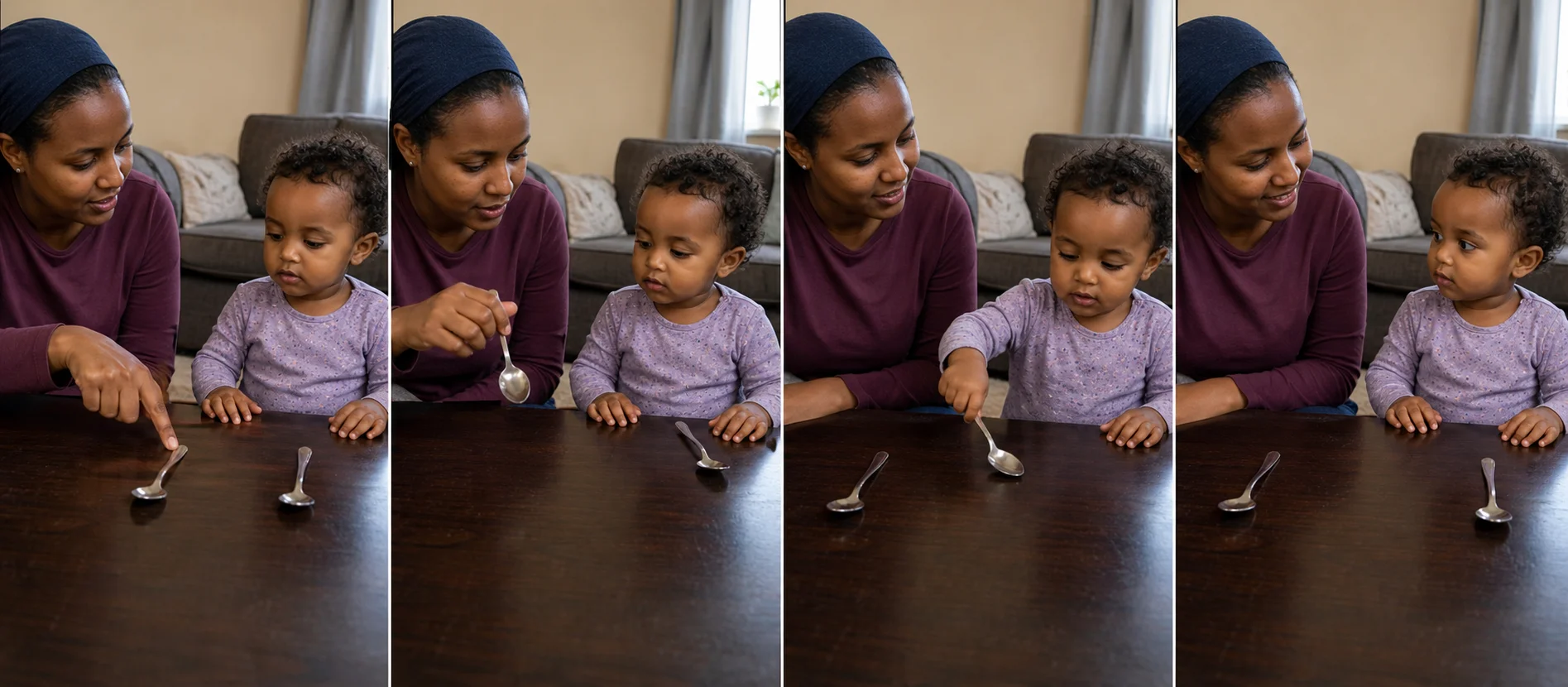
Multi-panel sequence showing a grown-up tapping one spoon, a toddler copying with a second spoon, both spoons resetting on the table, and another short echo round.
  1. 01
    Pick up your spoon, say `Do this`, and tap the table 1 time when your child is looking.
  2. 02
    Let your child answer with 1 tap of their own.
  3. 03
    If they do not copy after a short pause, place the spoon in their hand or help 1 calm tap and count that turn as success.
  4. 04
    Set both spoons back on the table and repeat for a few short rounds, or stop sooner if interest drops.

Safety Check

  • Stay close because spoons can go to the mouth, get thrown, or get swung toward hands or faces.
  • Keep the taps calm and light. Hard banging can feel too loud and can pull the activity out of the copy loop.
  • If the table sound feels too sharp for your child, stop and switch to a softer imitation activity instead of pushing through.
Supporting the play

What to say in the moment

Match what you say to what you see.

Prompt ladder
Level 1 (Start)
`Do this.`
Level 2 (Keep going)
`Tap like me.`
Level 3 (Stretch)
`Listen, then tap.`
Level 4 (Extend)
`You tap, I copy.`
If your child seems...
What you'd see
Focused
What to do
Say
`You did the same tap.`
Add
`Ask 1 quick prompt like, "Same tap?"`
Extend
`Let your child lead 1 round while you copy the same single tap back.`

Make it easier

Younger end
  • -Sit side by side so your child can copy the tap from the same direction instead of mirroring across the table.
  • -Tap the same small table spot each round so the action target stays obvious.
  • -Let your child keep holding the spoon for the next round once the first few copy turns are going smoothly.

Make it harder

Older end
  • +Wait 2 or 3 seconds after your model before helping so your child has a chance to copy independently.
  • +Let your child pick up the spoon and set it back down alone between rounds.
  • +After several easy matches, do 1 clear tap without saying `Do this` and see whether the action alone is enough.

If it's not working

If you see
If child ignores it
Move your spoon into your child's line of sight, do 1 slower tap, and offer their spoon right after the sound.
If you see
If child misuses it
Put both spoons back on the table, model 1 calm tap again, and restart only if your child can copy on the table surface.
If you see
If child gets frustrated
Help with 1 hand-over-hand tap, praise that single turn, and stop there. Try again later instead of stretching the session.
Skill spotlight
Copy After Another Person

Copying 1 simple spoon action after watching.

This helps your child notice another person's action, copy it with their own body, and stay in a short back-and-forth turn that later shows up in play, routines, and simple helping tasks.

  • One clear tap gives your child a simple action to watch and copy right away.
  • The same spoon spots and same short cue keep turn-taking easy to follow.
  • The sound lands fast, so your child gets immediate feedback without needing many words.
  • Short resets make it easy to count 1 matched tap as a real win and stop before the game gets noisy.
Real-world transfer
  • Copying 1 simple action after a grown-up shows it first
  • Joining short turn-taking games without rushing ahead
  • Using familiar objects in a new way after watching someone else do it

Parent questions