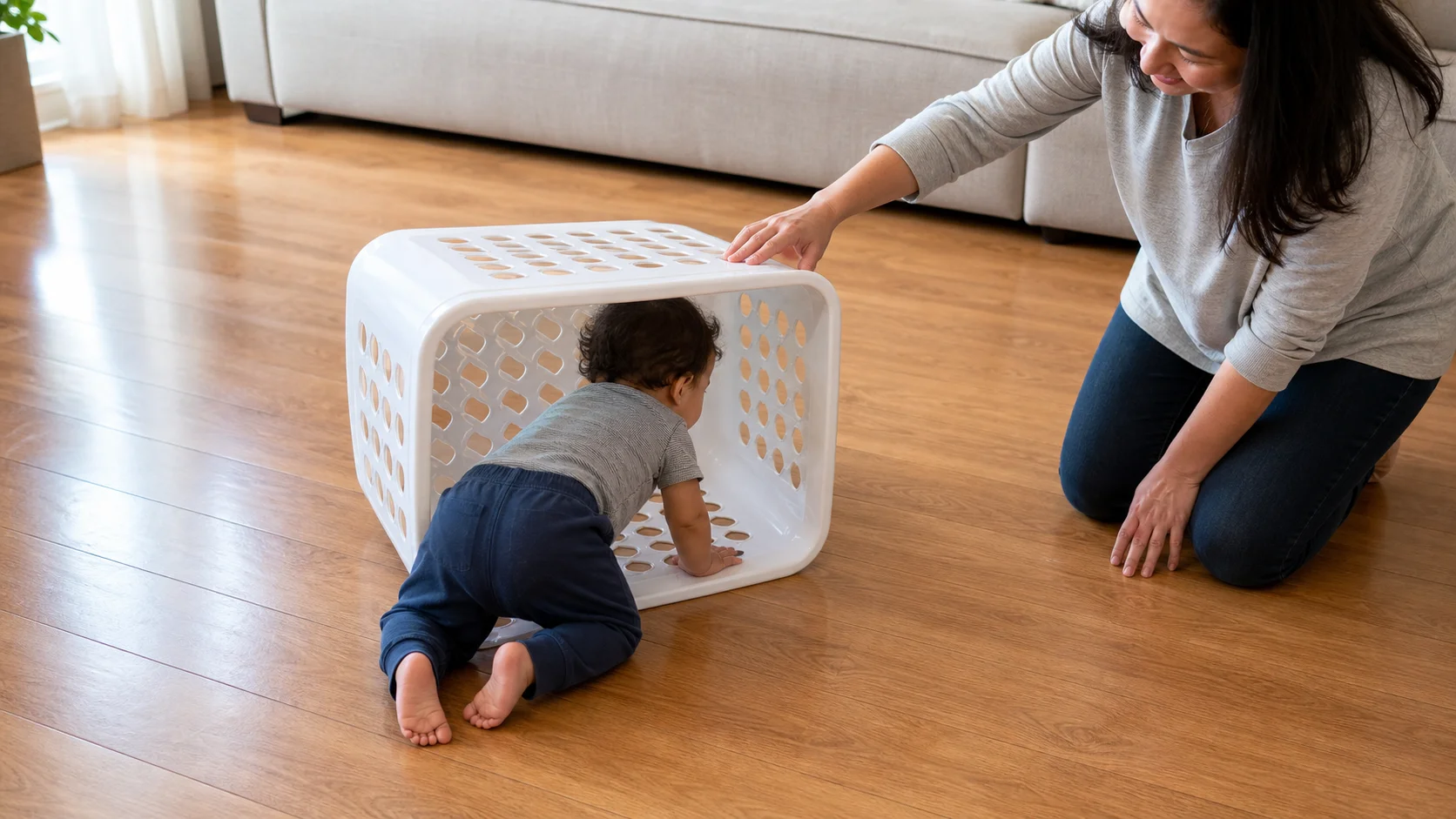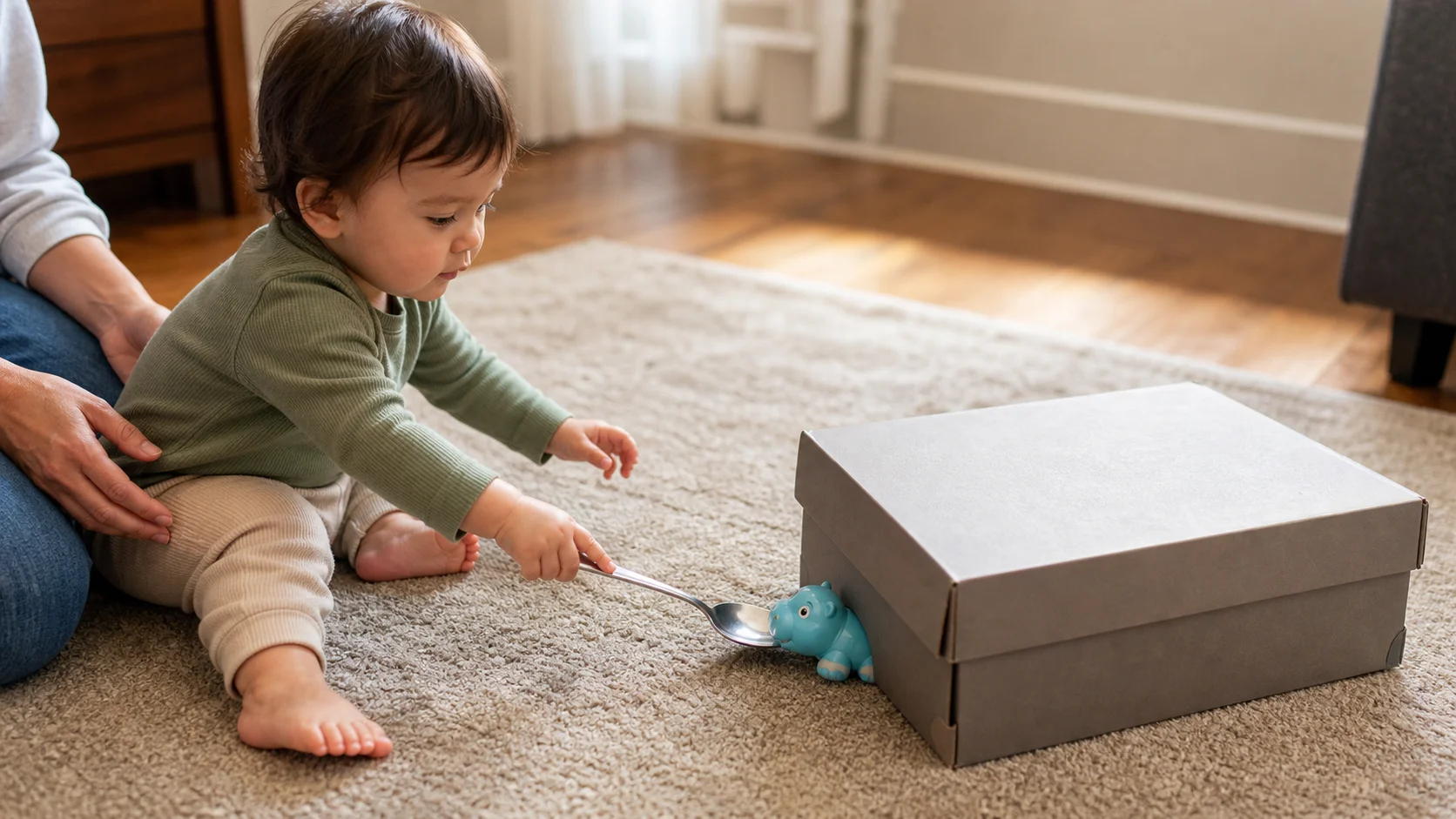
A toddler sitting on the floor beside a sturdy box and using a spoon to pull a small toy back into reach while a grown-up stays nearby.
ThinkingDevelopmental supportAction ResultIndoor

Spoon Reach Rescue.

Put one toy just out of reach, hand over a spoon, and let your child pull the toy back in one short rescue loop.

Play time
5-10+ min
Age
1-2 years
Energy
Low
Mess
No
Effort
Low
Where
Indoor
Start here

The recipe.

Low parent effort
3 things

What you need

  • 1 spoon
  • 1 small favorite toy
  • 1 stable box, chair leg, or similar safe obstacle
5 min minimum

Setup

Then start the loop
Step 01
Put 1 stable box or sturdy chair on the floor with one easy edge facing your child.
Step 02
Place 1 favorite toy just behind that edge so part of it still shows but it is not easy to grab by hand.
Step 03
Put 1 spoon in front of your child with the bowl end pointed toward the toy.
"Toy is stuck."
The loop

How play unfolds.

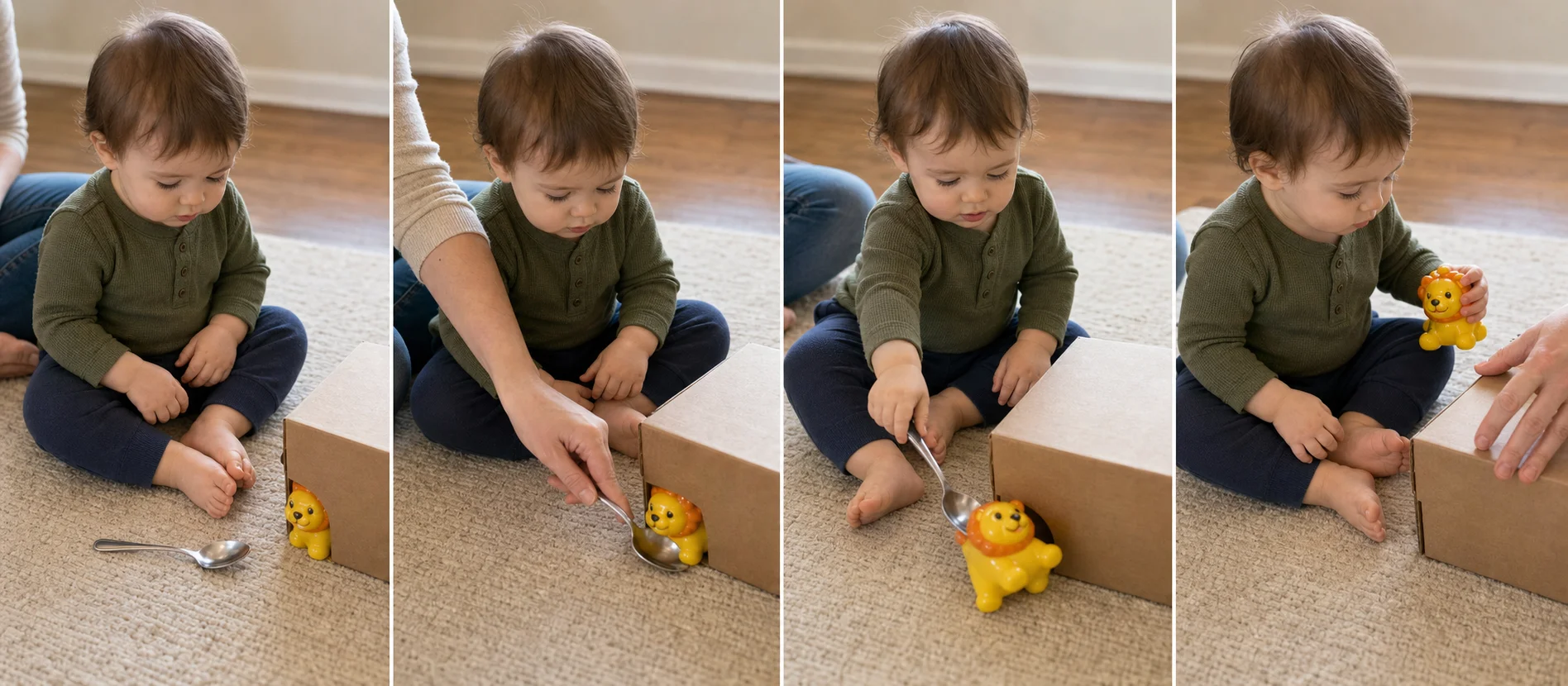
Four panels showing a toy placed just behind a box edge, a grown-up modeling one spoon rescue, a toddler pulling the toy closer with the spoon, and the toy being reset for another turn.
  1. 01
    Show one quick rescue and say, "The toy is stuck. Can you get it with the spoon?"
  2. 02
    Let your child reach the spoon toward the toy and help nudge, hook, or drag it closer.
  3. 03
    Let your child grab the toy once it comes into reach.
  4. 04
    Put the toy behind the edge again or shift it to one more easy visible spot and repeat.

Safety Check

  • Stay close enough to stop mouthing, poking, or throwing with the spoon.
  • Use a stable obstacle that does not tip or slide when the spoon touches it.
  • Use an age-safe toy that is big enough for your child.
Supporting the play

What to say in the moment

Match what you say to what you see.

Prompt ladder
Level 1 (Start)
"Get it."
Level 2 (Keep going)
"Pull it out."
Level 3 (Stretch)
"Where did it go?"
Level 4 (Extend)
"Hide it again."
If your child seems...
What you'd see
Focused
What to do
Say
"You found it."
Add
Pause before helping so your child gets a second to try the spoon first.
Extend
Shift the toy to a slightly different easy edge for the next rescue.

Make it easier

Younger end
  • -Let the toy show more clearly.
  • -Use the same hiding spot every turn.
  • -Start with a larger easy-to-hook toy.

Make it harder

Older end
  • +Shift the toy a little farther behind the edge while keeping part of it visible.
  • +Use 2 easy hiding spots and alternate between them.
  • +Wait a second longer before helping after a miss.

If it's not working

If you see
If child ignores it
Make one big rescue move yourself so the toy pops out, then hand over the spoon right away.
If you see
If child misuses it
Take back the spoon for one calm model turn, then return it with the toy in an easier spot.
If you see
If child gets frustrated
Move the toy closer to the edge, share the spoon for one pull, and let your child finish the rescue.
Skill spotlight
Action Result

using one simple tool to make a stuck object move

This helps a child notice that one tool action can change where an object ends up, stay with a short retry loop, and build more purposeful hand use during simple problem-solving play.

  • The visible stuck toy gives your child one small problem they can actually solve.
  • The spoon turns that problem into a clear action-and-result loop without needing many words.
  • You can make the game easier fast by moving the toy closer or sharing the spoon for one pull.
Real-world transfer
  • Using a simple tool to get or move something that is out of reach
  • Sticking with a short problem until the object moves
  • Coordinating hand actions around everyday items such as spoons and toys
Back to library
Keep playing

Related activities.