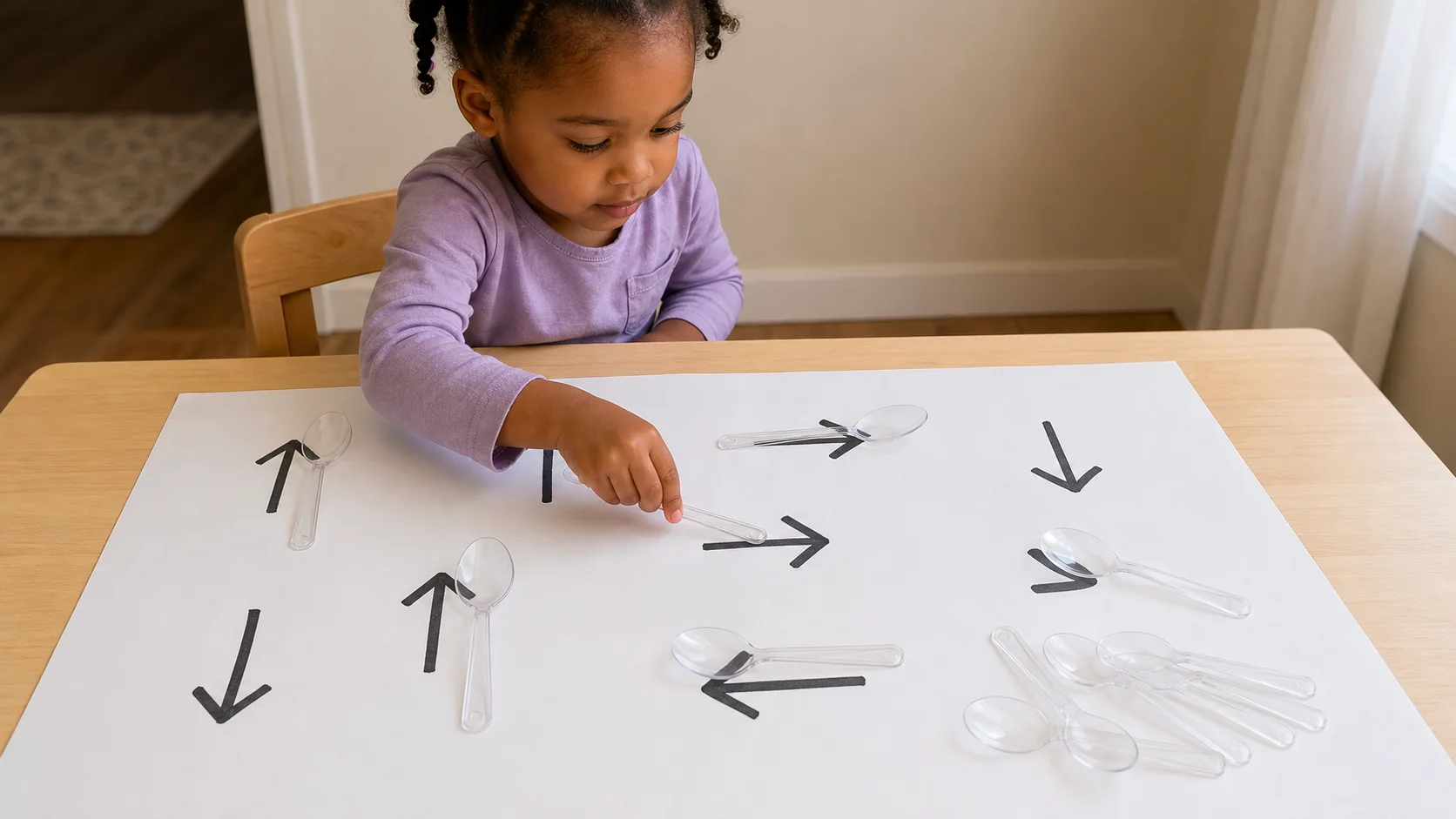
A child places plastic spoons on large drawn arrows and turns one handle to match the arrow tip while a grown-up sits nearby.
ThinkingObject To TargetIndoor Floor Or Table

Spoon Arrow Match.

Draw a few arrows, hand over some spoons, and let your child turn each one until it points the same way.

Play time
5-10+ min
Age
3-4 years
Energy
Low
Mess
Low
Effort
Low
Where
Indoor Floor Or Table
Start here

The recipe.

Low parent effort
6 things

What you need

  • 1 large sheet of paper, roll paper, or 2 to 3 taped printer pages
  • 1 marker
  • 8 to 12 plastic spoons
  • 1 flat floor or table space
  • 1 child
  • 1 adult
5 min minimum

Setup

Then start the loop
Step 01
On the floor or a low table, spread the paper where your child can reach the whole page.
Step 02
On the paper, draw 8 to 12 large arrows pointing up, down, left, and right.
Step 03
Around each arrow, leave enough open space for one spoon to sit on top without touching another arrow.
Step 04
Beside the paper, place the spoons in a loose pile with the handles easy to grab.
Step 05
Next to your child, keep one spoon ready so you can model the first match.
"Match this arrow."
The loop

How play unfolds.

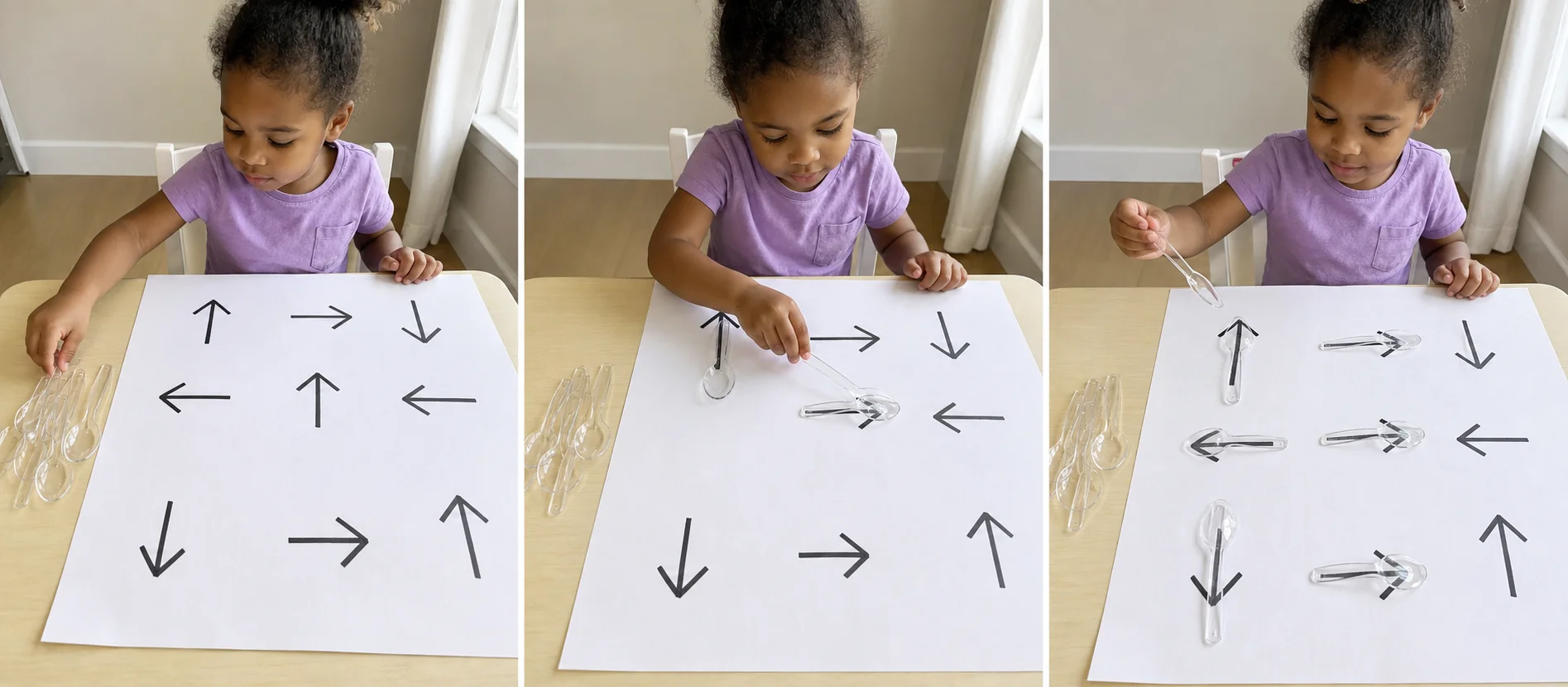
A step-by-step play sequence showing arrows drawn on paper, spoons set beside the page, one spoon turned to match an arrow, and the paper filling up one match at a time.
  1. 01
    Place one spoon on one arrow and say, "This one points to the tip. Can you make the next spoon match?"
  2. 02
    Let your child choose one open arrow, place one spoon on it, and turn the handle until it points the same way.
  3. 03
    If the spoon points the wrong way, ask, "Does the handle point to the tip?" Then let your child turn it again.
  4. 04
    Repeat with the next open arrow until the page is covered or your child is ready to stop.

Safety Check

  • Use toddler-safe plastic spoons and stay close enough to pause if a spoon goes in the mouth, gets thrown, or is swung.
Supporting the play

What to say in the moment

Match what you say to what you see.

Prompt ladder
Level 1 (Start)
Put one spoon on one arrow and make it point the same way.
Level 2 (Keep going)
Find another empty arrow and turn the spoon until it matches.
Level 3 (Stretch)
Check the handle before you let go.
Level 4 (Extend)
Turn the paper and see which arrow changed places.
If your child seems...
What you'd see
Focused
What to do
Say
"That spoon matches the arrow."
Add
Name the direction after the spoon is already placed.
Extend
Rotate the paper once and invite one more match.

Make it easier

Younger end
  • -Start with 2 arrows facing very different ways, such as up and down.
  • -Put the spoon bowl on the arrow tail first so only the handle needs turning.
  • -Let your child match beside the arrow before sliding the spoon on top.

Make it harder

Older end
  • +Ask your child to choose the next arrow before touching a spoon.
  • +Leave one mismatched spoon on the page for your child to spot and fix.
  • +Invite your child to check 2 finished spoons before starting another round.

If it's not working

If you see
If child ignores it
Match two spoons yourself and leave a third spoon halfway turned so your child can finish the fix.
If you see
If child misuses it
If spoons become drumsticks, throwing toys, or pretend food, hold the pile and offer one spoon at a time for matching.
If you see
If child gets frustrated
Use only three easy arrows, point to the arrow tip, and say, "Turn the handle to this point."
Skill spotlight
Object To Target

Matching a tool to a visual direction

This helps the child place objects with care while noticing how something sits in relation to a visual target, a skill that carries into puzzles, drawing, tool use, and simple direction-following.

  • Matching the spoon handle to the arrow tip makes "same direction" easy to see and fix.
  • The small wrist turns give fine motor practice without needing extra setup or noisy materials.
  • One spoon at a time keeps the loop predictable for children who do better with a quiet visual task.
Real-world transfer
  • Lining up puzzle pieces
  • Placing utensils and tools with care
  • Following simple direction words
  • Noticing same and different in drawings, paths, and signs