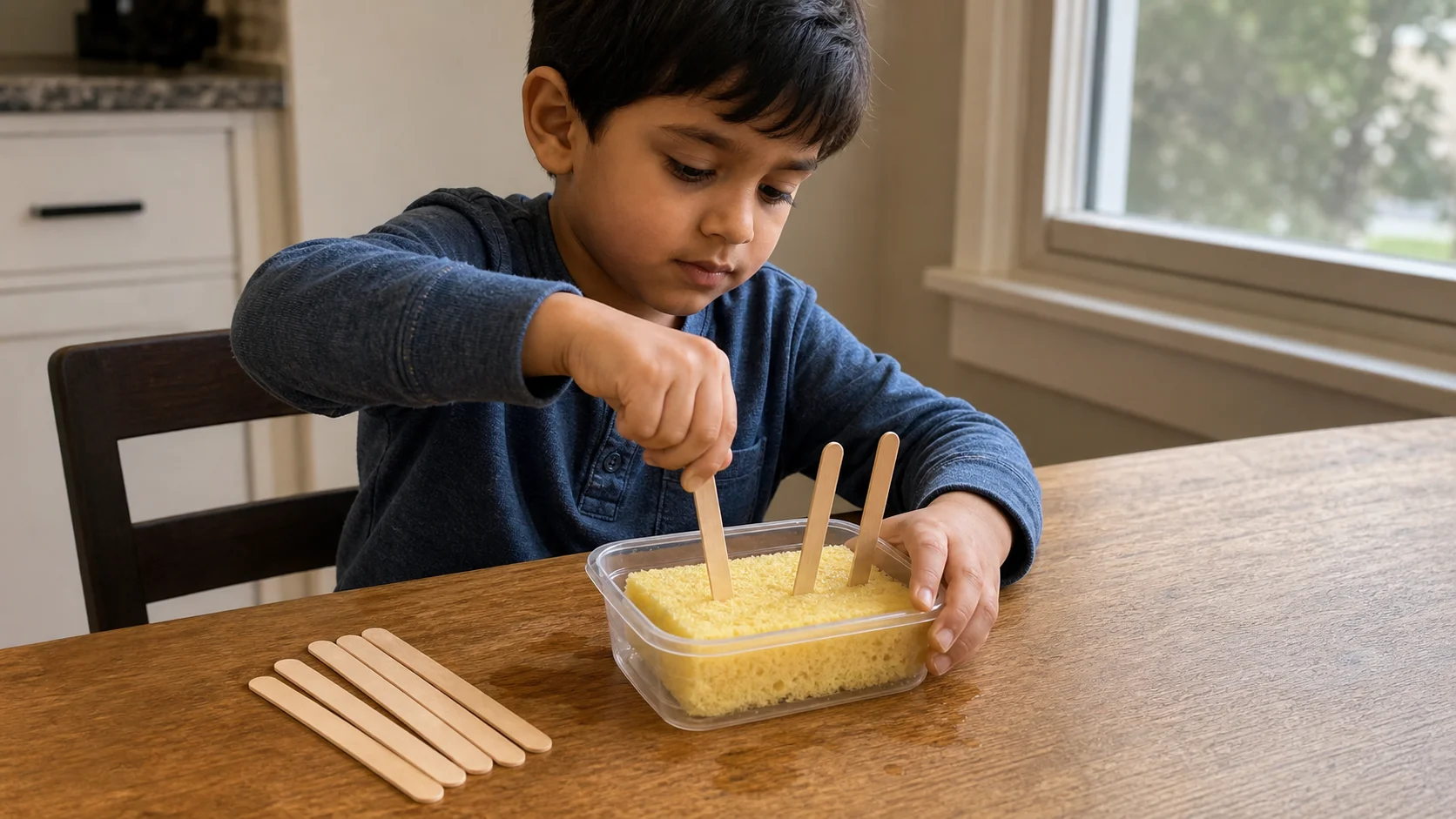
A preschool child twists a craft stick into a damp sponge in a small container while a grown-up sits nearby at the table.
Fine motorOT-adjacent supportPush Through ResistanceIndoor Seated Table Workspace

Sponge Stick Rotation.

Craft sticks and a damp sponge make a slow twist-and-stabilize fine motor challenge.

Play time
5-10+ min
Age
3-5 years
Energy
Low
Mess
Low
Effort
Low
Where
Indoor Seated Table Workspace
Start here

The recipe.

Low parent effort
7 things

What you need

  • 1 bowl
  • Water
  • 1 sponge
  • 1 plastic container that holds the sponge firmly
  • Several craft sticks
  • 1 stable table
  • 1 adult for setup and direct supervision
5 min minimum

Setup

Then start the loop
Step 01
Soak the sponge, then wring it over the bowl until it feels damp and dense instead of drippy.
Step 02
Press the damp sponge firmly into the plastic container.
Step 03
Put the container on a stable table directly in front of your child. It should stay put when you press the sponge with one finger.
Step 04
Set several craft sticks beside the container within easy reach.
Step 05
Move the bowl away, then seat your child at the table with room for both hands to reach.
"Helper hand holds."
The loop

How play unfolds.

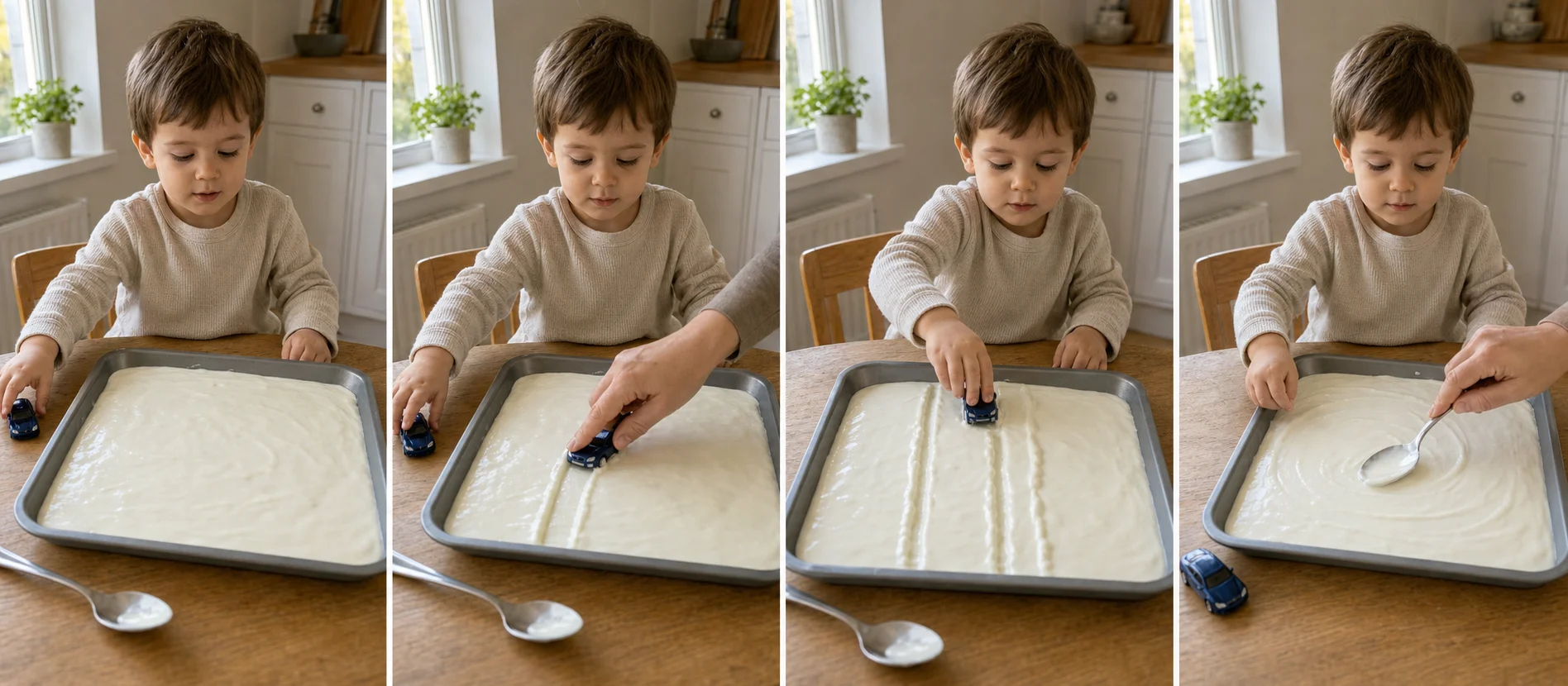
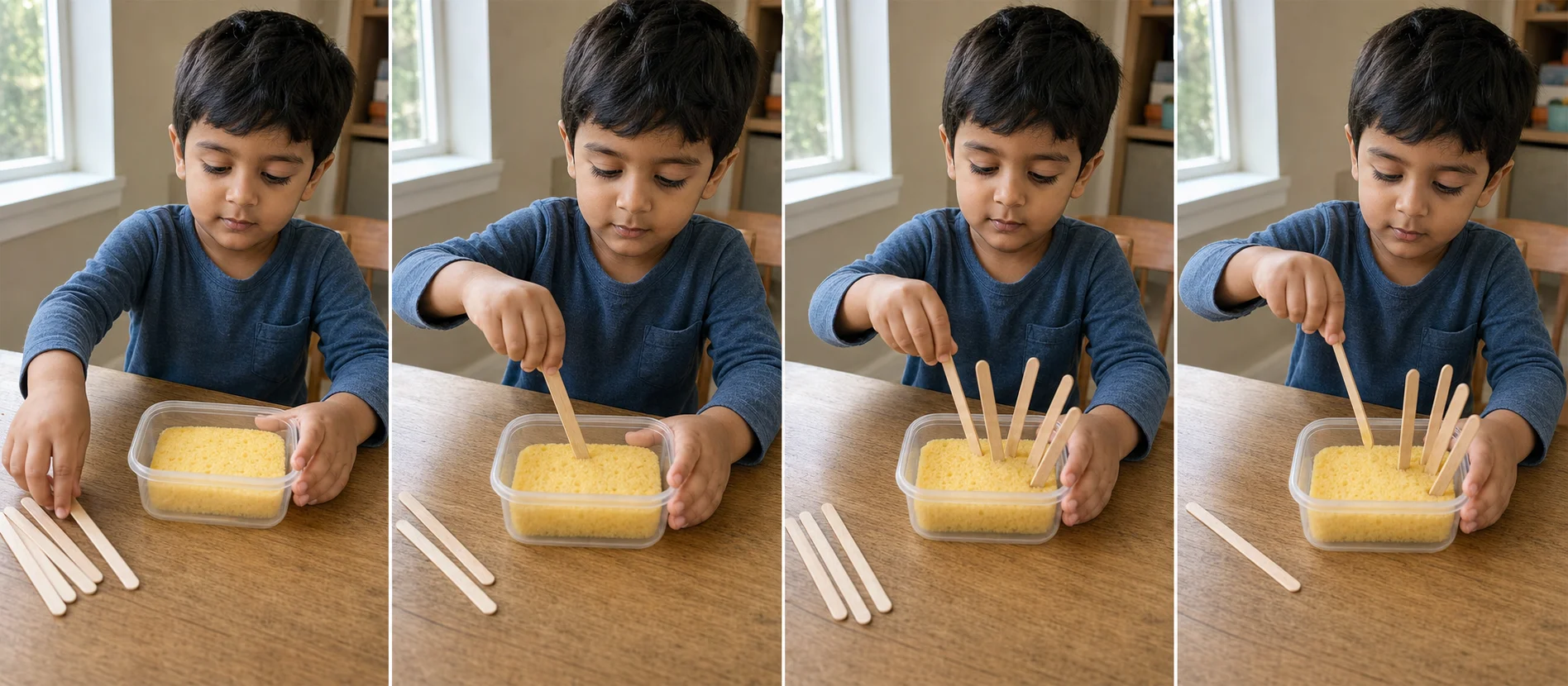
Four panels show a grown-up pressing a damp sponge into a container, a child twisting a craft stick into the sponge, the sponge filling with sticks, and the child pulling the sticks back out.
  1. 01
    Show one twist-in and twist-out turn and say, "Helper hand holds. Twist it in."
  2. 02
    Let your child hold the container steady and twist one craft stick halfway into the sponge.
  3. 03
    Keep adding sticks until the sponge looks prickly.
  4. 04
    Let your child twist and pull the sticks back out one by one.
  5. 05
    Press the sponge back down if needed, then start another round.

Safety Check

  • Stay close and supervise the whole activity.
  • Keep your child seated while working.
  • Use craft sticks only for the intended twisting action in the sponge.
  • Pause and reset if the sponge gets drippy, the container slides, or the sticks start being waved instead of twisted.
Supporting the play

What to say in the moment

Match what you say to what you see.

Prompt ladder
Level 1 (Start)
Twist 1 stick in while your child holds the container still.
Level 2 (Keep going)
Add 1 more stick and watch the sponge get prickly.
Level 3 (Stretch)
Try a slow twist out after each twist in.
Level 4 (Extend)
Switch helper hands for the next round.
If your child seems...
What you'd see
Focused
What to do
Say
"Your helper hand is working."
Add
Invite 1 quiet count as the next stick goes in.
Extend
Ask your child to choose whether the next turn is twist in or twist out.

Make it easier

Younger end
  • -Start with the stick already touching the sponge so your child only has to turn.
  • -Let your child pull out sticks before trying to twist new ones in.
  • -Keep the container close to your child's body so the helper hand can press down easily.

Make it harder

Older end
  • +Ask for 3 slow twists before your child stops pushing.
  • +Have your child remove every stick with the opposite working hand for 1 round.
  • +Let your child decide when the sponge looks prickly enough to switch to removal.

If it's not working

If you see
If child ignores it
Do 1 dramatic twist-in and twist-out yourself, then hand over just 1 stick instead of the full pile.
If you see
If child misuses it
Move the extra sticks out of reach, keep 1 stick in play, and say, "Sticks stay in the sponge."
If you see
If child gets frustrated
Start the first half-turn for your child, let them finish the twist, or switch to pulling sticks back out for 1 round.
Skill spotlight
Push Through Resistance

Twisting into resistance

Twist-and-stabilize control helps with everyday jobs where one hand holds steady while the other turns, such as opening lids, turning knobs, and controlling a pencil while coloring.

  • Twisting into the sponge gives your child clear hand and forearm feedback on every turn.
  • One hand stabilizes while the other hand turns, so both hands have different jobs in the same round.
  • Filling the sponge until it looks prickly gives a visible finish before your child reverses the motion and clears it again.
Real-world transfer
  • Turning lids, knobs, and small twist toys.
  • Holding paper or a container steady while the other hand works.
  • Using tools that need grip, rotation, and controlled pressure.
  • Staying with a small hand job until the set is finished.