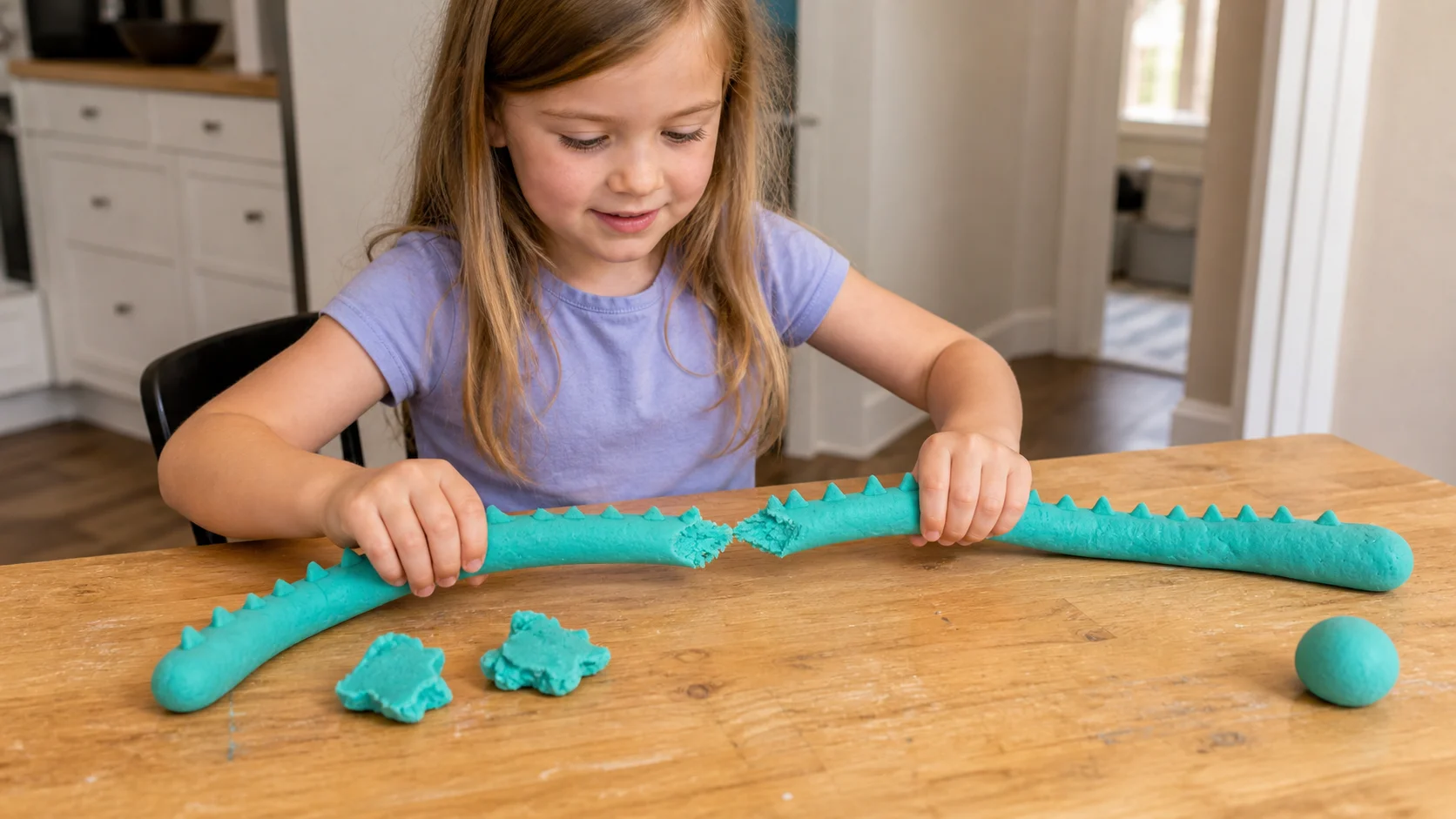
A child rolls a long play dough snake on a table and pinches spikes along the top while a grown-up stays nearby.
Fine motorOT-adjacent supportTwo Hand CoordinationIndoor

Spiky Dough Pull-Apart.

One soft lump of dough becomes a repeatable roll, pinch, pull, and rebuild game for busy hands.

Play time
5-10+ min
Age
5-11 years
Energy
Low
Mess
Low
Effort
Low
Where
Indoor
Start here

The recipe.

Low parent effort
2 things

What you need

  • 1 large lump of play dough or similar moldable material
  • 1 adult for setup and supervision
5 min minimum

Setup

Then start the loop
Step 01
Clear a low table so your child has room to roll one long dough snake.
Step 02
Put 1 large lump of dough in the middle and press it once. It should dent easily instead of cracking.
Step 03
Seat your child where both hands can stay on the table at the same time.
"Roll it long."
The loop

How play unfolds.

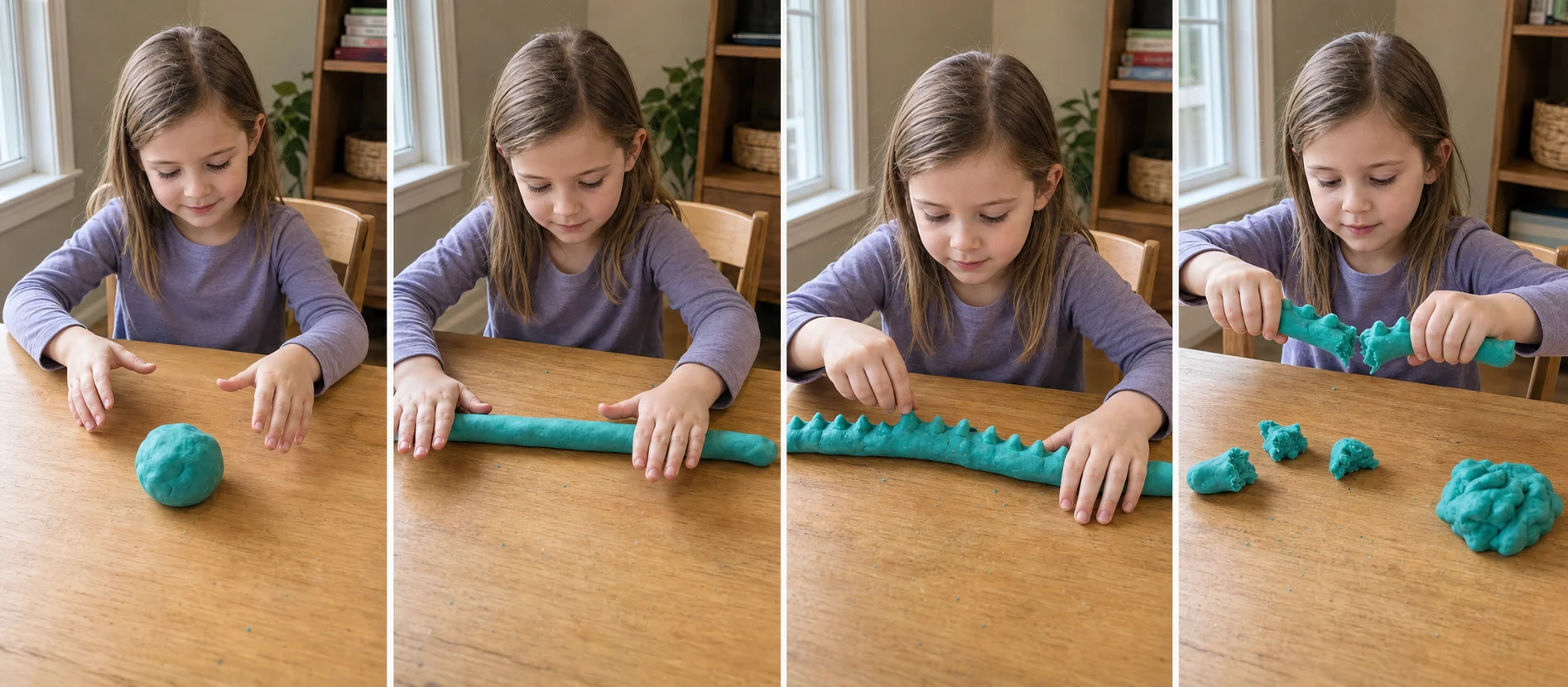
Four panels show a soft dough ball on the table, a grown-up starting a short roll, a child pinching spikes into the snake, and the dough pulled into pieces and pressed back together.
  1. 01
    Roll the dough once and say, "Let's make a spiky snake. Roll it long, pinch the top, then pull it apart."
  2. 02
    Let your child roll the dough into a long sausage and pinch spikes across the top.
  3. 03
    Have your child pull the snake into rough pieces, press them back into 1 ball, and start another round.
  4. 04
    Repeat for up to 3 rounds, or stop after 1 completed turn.

Safety Check

  • Supervise closely if your child mouths dough or loose pieces.
  • Keep the dough on the table. Pause and reset if pieces are thrown or mouthed.
  • Choose another activity if tactile dough play causes distress.
  • Soften or replace dough that is cold, sticky, crumbly, or hard to pull.
  • Keep the task short if your child is younger than the source audience or cannot comfortably use both hands at the table.
Supporting the play

What to say in the moment

Match what you say to what you see.

Prompt ladder
Level 1 (Start)
Roll the ball long with both hands.
Level 2 (Keep going)
Pinch little spikes all the way across the top.
Level 3 (Stretch)
Pull the snake into pieces with two strong hands.
Level 4 (Extend)
Squish it back into a ball and make a new spiky snake.
If your child seems...
What you'd see
Focused
What to do
Say
"Your two hands are doing different jobs."
Add
Ask for 1 slow roll before the next pinch row.
Extend
Count the pieces after the pull-apart.

Make it easier

Younger end
  • -Make a shorter sausage so your child can pinch across it quickly.
  • -Let your child pull the dough into any number of pieces.
  • -Hold one end of the sausage still while your child pinches or pulls.

Make it harder

Older end
  • +Ask for tiny spikes on one round and tall spikes on the next.
  • +Have your child pull the sausage into 6 pieces without adult help.
  • +Invite your child to rebuild the ball with both hands before starting the next round.

If it's not working

If you see
If child ignores it
Start a short snake yourself, hand it over, and say, "Your turn to make the spikes."
If you see
If child misuses it
Press everything back into 1 ball and restart with 1 slow roll. Say, "Roll first, then spikes."
If you see
If child gets frustrated
End the round after 1 roll, a few rough spikes, and any pull apart, then press it back together right away.
Skill spotlight
Two-Hand Coordination

Two-hand dough control

Two-hand control helps with small daily jobs where one hand steadies while the other works, including paper tasks, buttons, cutlery, and clothing fasteners.

  • Rolling, pinching, and pulling in one loop gives both hands a shared job instead of letting one hand do all the work.
  • Soft dough gives finger-and-thumb pinching practice without the pressure of tiny hard pieces.
  • Pressing the pieces back into 1 ball creates an easy reset, so uneven spikes or early breaks still lead into another turn.
Real-world transfer
  • Holding paper steady while drawing or cutting.
  • Managing small dressing jobs, like buttons and pulls.
  • Using two hands during snack prep, cleanup, and tool play.
  • Pinching, squeezing, and separating small materials with more control.