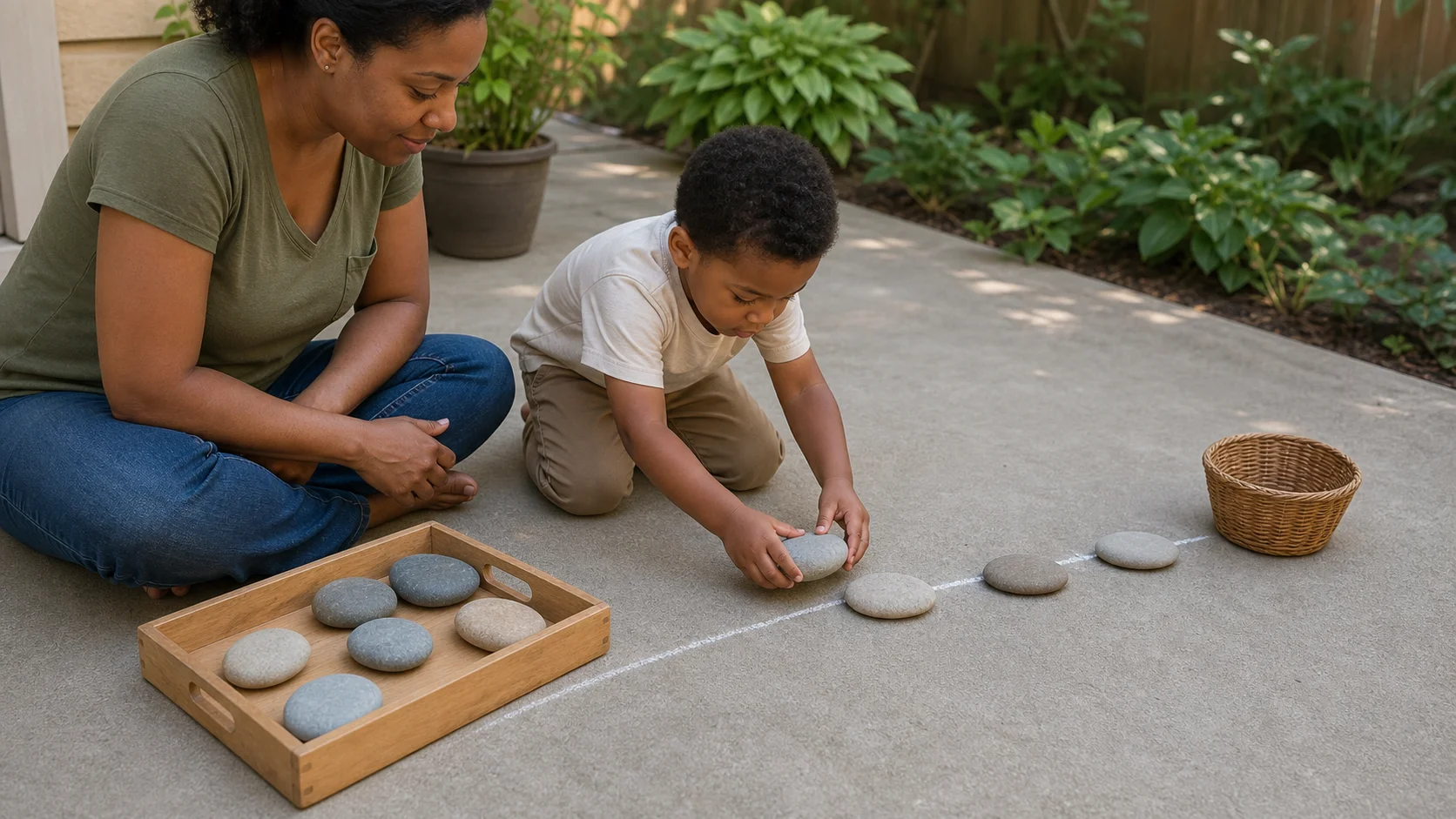
Toddler placing a large smooth stone on a short chalk trail beside a shallow tray of stones outdoors.
Fine motorSensory-friendly supportPlace With Control`Outdoor

Smooth Stone Trail.

A quiet outdoor activity where your child places large smooth stones or safe petals along a short visible trail.

Play time
3-7+ min
Age
3-4 years
Energy
Low
Mess
Low
Effort
Low
Where
Outdoor
Start here

The recipe.

Low parent effort
6 things

What you need

  • 1 shallow bin or tray
  • 6 to 10 large smooth stones or safe flower petals from one texture type
  • 1 short trail line made with chalk, string, tape, or a garden edge
  • 1 basket or clear reset spot
  • 1 adult
  • 1 child
3 min minimum

Setup

Then start the loop
Step 01
On a flat outdoor spot, check that the surface is cool, not slippery, not sharp, and not splintery.
Step 02
On that spot, make one short visible trail line with chalk, string, tape, or a garden edge.
Step 03
Beside the start of the line, put the shallow bin or tray within your child's reach.
Step 04
Inside the bin, spread either all smooth stones or all safe flower petals in one layer.
Step 05
At the end of the line, put the basket or choose a clear reset spot for finished pieces.
"One smooth piece."
The loop

How play unfolds.

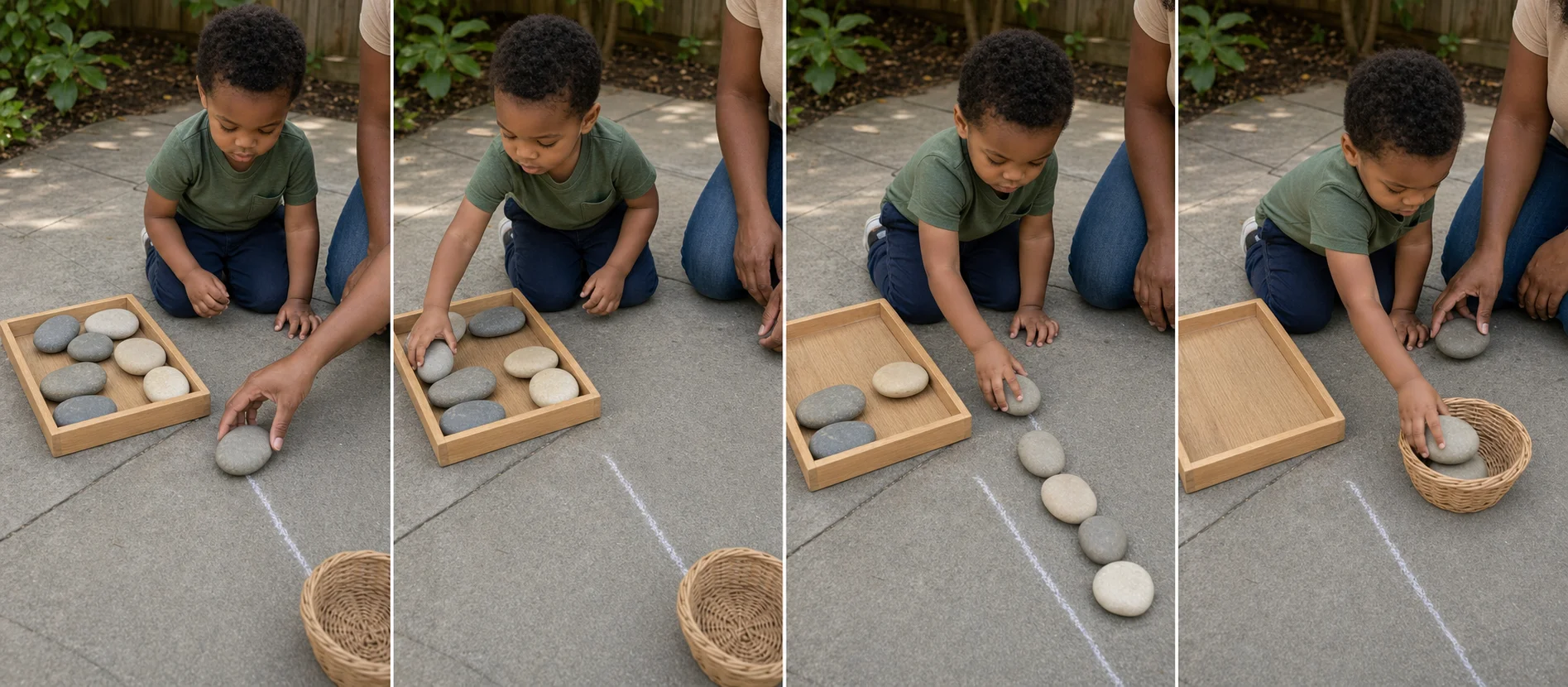
Three-panel sequence showing a stone chosen from a tray, placed beside the last stone on a trail, and returned to a basket.
  1. 01
    Place one stone or petal at the start of the line and say, "I am making a smooth trail. Want to put one here?"
  2. 02
    Let your child choose one piece from the bin, or point to one for you.
  3. 03
    Let your child place the piece near the last one, or place it where they point, then use one cue, such as "next stone" or "next petal."
  4. 04
    Keep adding pieces until the line has a small trail, or until your child is done.
  5. 05
    Move the pieces into the basket or reset spot together. Start again only if your child reaches, asks, points, or stays interested.

Safety Check

  • Use only pieces that are clean, pesticide-free, not sharp, and too large for your child to fit fully in their mouth.
  • Stay close enough to block mouthing, throwing, or stepping on loose pieces.
  • If using petals, skip any plant you cannot identify as safe.
  • Avoid hot metal, rough wood, sharp gravel, slippery paths, and splinter-prone surfaces.
  • Stop if the child keeps mouthing, throwing, or stepping on the pieces.
Supporting the play

What to say in the moment

Match what you say to what you see.

Prompt ladder
Level 1 (Start)
"Choose one smooth piece."
Level 2 (Keep going)
"Put it beside the trail."
Level 3 (Stretch)
"Leave a tiny space for the next one."
Level 4 (Extend)
"Can you make the trail reach the basket?"
If your child seems...
What you'd see
Focused
What to do
Say
"You are making a careful trail."
Add
"This one feels smooth."
Extend
Invite the child to decide whether the next piece goes close or far.

Make it easier

Younger end
  • -Let the child point to the next spot while you place the piece.
  • -Put two pieces close to the line so the child does not have to search the bin.
  • -Count the activity as finished after two careful placements.

Make it harder

Older end
  • +Ask the child to place each piece with a small gap between pieces.
  • +Invite the child to make the trail go from the basket back toward the bin.
  • +Let the child reset the whole trail independently after you start the first piece.

If it's not working

If you see
If child ignores it
Make a two-piece trail yourself and say, "One more finishes it." Hand them the easiest piece or invite them to point.
If you see
If child misuses it
Move the bin behind you and offer one piece at a time. Stop if unsafe use continues.
If you see
If child gets frustrated
Shrink the goal to one piece on the line and one piece in the basket. Let the child choose stones or petals next time if the texture was the problem.
Skill spotlight
Controlled Placement`

Careful one-piece placing, Smooth texture practice

This helps the child aim a small hand movement, let go gently, and follow a simple start-next-finish routine. The same control shows up in cleanup, table play, crayons, and small helping jobs.

  • Choosing one piece and placing it near the last one gives your child repeatable practice with careful grasp, aim, and release.
  • The visible line and reset spot make the activity easy to follow: start, add next, finish, reset.
  • One smooth texture at a time keeps the sensory demand controlled while still giving your child a real outdoor material to explore.
Real-world transfer
  • Putting small toys away without tossing them
  • Placing crayons, blocks, or snack pieces where they belong
  • Helping carry and set down small items
  • Staying calmer with one texture and one clear finish