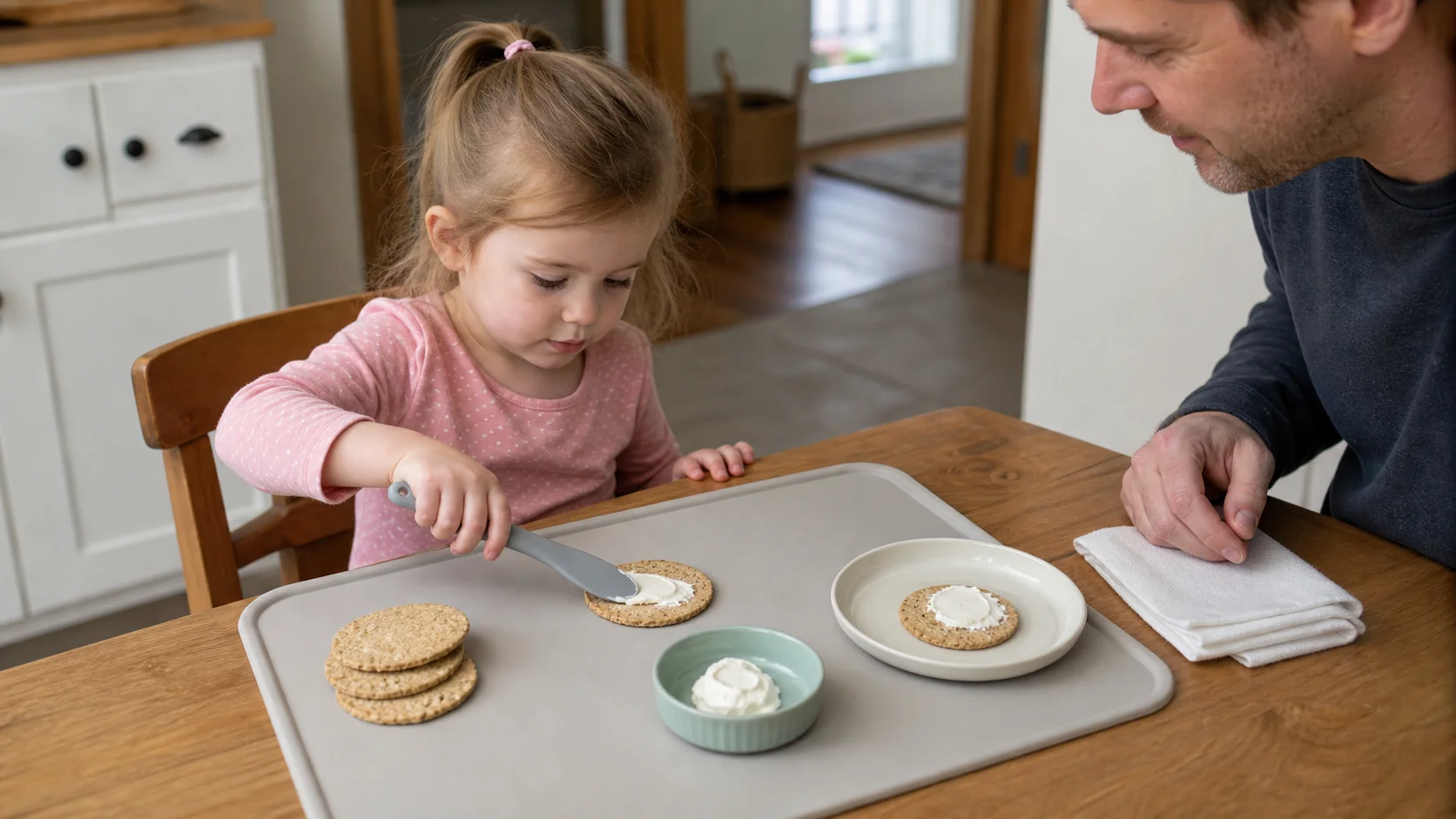
A child uses a small spoon to swipe cream cheese on a cracker on a placemat while a done plate waits nearby.
Fine motorSensory-friendly supportPush Through ResistanceIndoor

Cracker Spread Swipe.

Let your child make one tiny spread mark on a cracker, move it to a done plate, and choose whether to try again.

Play time
2-5+ min
Age
3-4 years
Energy
Low
Mess
Low
Effort
Low
Where
Indoor
Start here

The recipe.

Low parent effort
8 things

What you need

  • 2 to 4 oatcakes or crackers
  • 1 small bowl with a small amount of cream cheese
  • 1 small spoon, wooden spoon, fork, pastry brush, or child-safe spreading tool
  • 1 done plate
  • 1 wipeable placemat or tray
  • 1 napkin or towel
  • 1 adult
  • 1 child
2 min minimum

Setup

Then start the loop
Step 01
On a table, place the wipeable placemat or tray in front of the child.
Step 02
On one side of the placemat, stack the crackers.
Step 03
Near the center of the placemat, place the bowl with a shallow spoonful of cream cheese.
Step 04
Beside the bowl, place the spreading tool with the handle facing the child.
Step 05
On the opposite side of the placemat, place the done plate.
Step 06
Beside the adult, keep the napkin or towel ready for cleanup or a child-requested wipe.
"Tiny swipe."
The loop

How play unfolds.

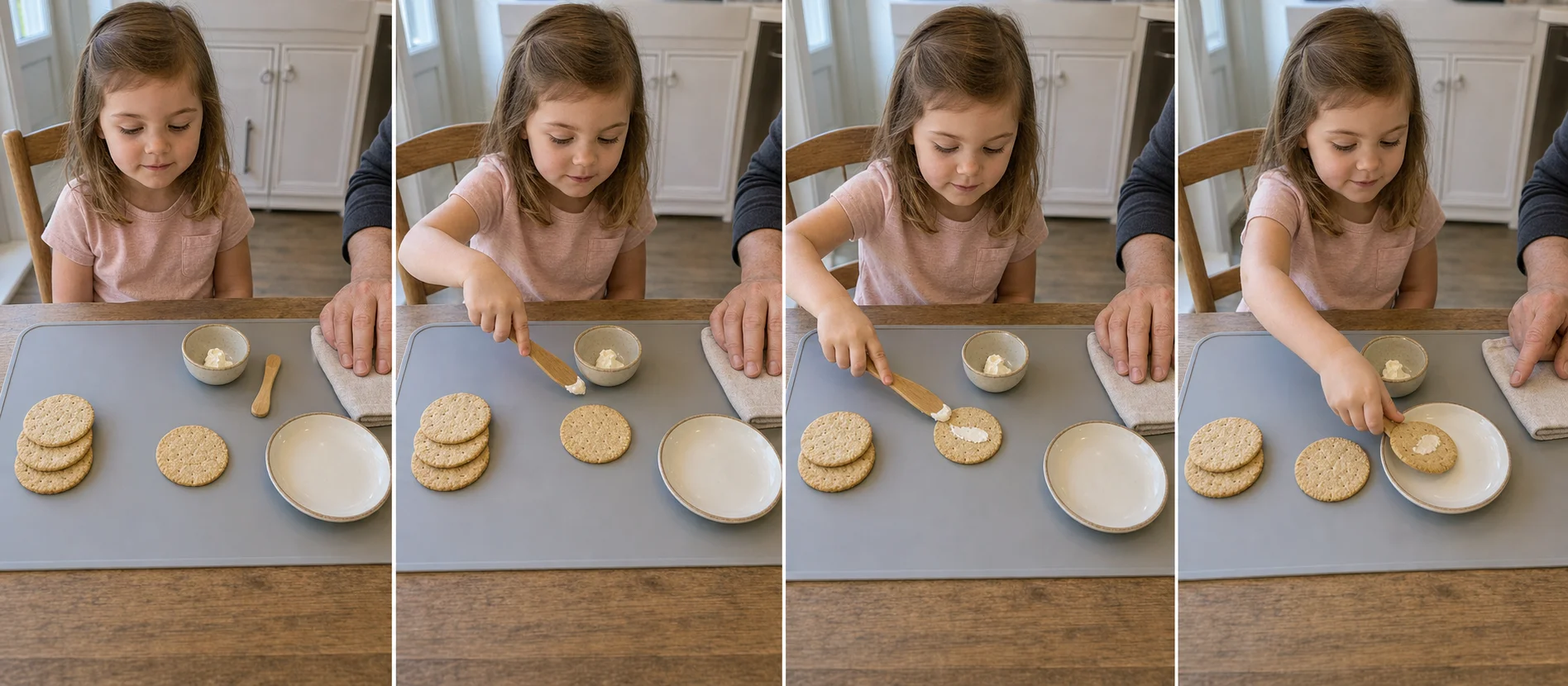
Four panels show a tool dipping into cream cheese, one swipe on a cracker, the cracker moving to a done plate, and another optional round.
  1. 01
    Touch the tool tip into the cream cheese, make one slow swipe on a cracker, and say, "You can spread a little white cheese on the cracker."
  2. 02
    Put a cracker in the open spot and let your child touch, dip, poke, pat, or swipe the cream cheese with the tool.
  3. 03
    When the cracker feels finished to your child, say, "That one goes on the done plate," and let your child move it there.
  4. 04
    Offer another cracker with the same no-pressure tone, or stop after one round.

Safety Check

  • Use only foods that fit the child's allergies, diet, chewing, and swallowing needs.
  • Skip this activity or seek appropriate professional guidance if the child has physical eating difficulties, swallow-safety concerns, or strong distress around the food.
  • Use a blunt child-safe tool, not a sharp knife.
  • Stay close because this activity uses real food and a real tool.
  • Do not pressure the child to eat.
  • Do not wipe hands or face during play if wiping is distressing for that child.
  • Stop or reset if the child gags, coughs, mouths too much cracker at once, throws food, becomes distressed, or uses the tool unsafely.
Supporting the play

What to say in the moment

Match what you say to what you see.

Prompt ladder
Level 1 (Start)
Touch the tool to the spread and make one tiny swipe.
Level 2 (Keep going)
Put that cracker on the done plate.
Level 3 (Stretch)
Try a longer swipe across the cracker.
Level 4 (Extend)
Choose whether the next cracker gets a swipe, pat, or poke.
If your child seems...
What you'd see
Focused
What to do
Say
"You made a white line."
Add
Offer the next cracker without changing the setup.
Extend
Invite one longer swipe if the child is still moving.

Make it easier

Younger end
  • -Hold one cracker steady so the child only has to move the tool.
  • -Put a tiny amount of spread on the tool tip before handing it over.
  • -Move the done plate close enough for a short reach.

Make it harder

Older end
  • +Let the child reload the tool before each cracker.
  • +Try one edge-to-edge swipe before the cracker goes to the done plate.
  • +Ask the child to decide when the cracker is finished.

If it's not working

If you see
If child ignores it
Copy the smallest action yourself, like touching the tool to the spread or tapping the cracker. Say, "You touched the tool," without asking for more.
If you see
If child misuses it
Say, "Food stays on the mat." Move the bowl closer to you, or switch to a wooden spoon, fork, or pastry brush if touching the sticky texture is the problem.
If you see
If child gets frustrated
Let them only poke the spread, hold the cracker, or watch you model one swipe. Stop early if they look distressed, gag, cough, or want to be done.
Skill spotlight
Push Through Resistance

Controlled spreading with a small tool

This helps the child use a small tool with enough pressure and control for everyday food routines.

  • The tiny swipe lets your child practice pressing a tool through a sticky texture without turning it into a tasting demand.
  • The done plate gives the round a clear finish, so one small mark can be enough.
  • Poking, patting, swiping, or watching all keep the sensory load small while preserving the same spread-and-finish loop.
Real-world transfer
  • Spreading, scooping, and serving with safe tools
  • Staying in charge around new food textures
  • Finishing one small table task before moving on