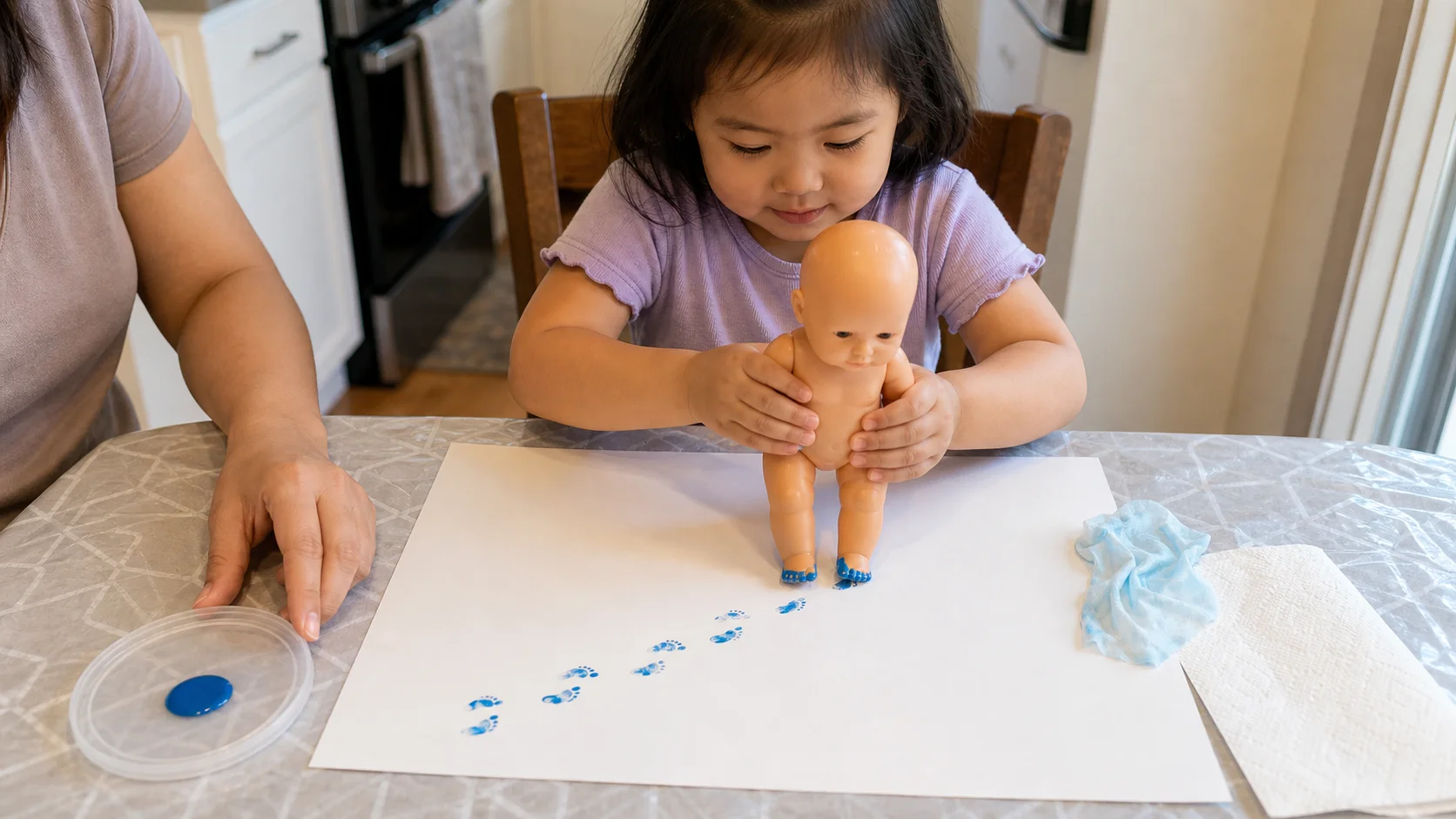
A toddler at a covered table walking a washable doll with painted feet across paper while a tiny paint dish and damp wipe sit nearby.
Skill builderSensory-friendly supportOT-adjacent supportFinish And ResetIndoor

Doll Footprint Trail.

Walk a washable doll through a tiny paint spot, make a footprint trail, and wipe the feet before the next turn.

Play time
3-5+ min
Age
2-4 years
Energy
Low
Mess
Low
Effort
Medium
Where
Indoor
Start here

The recipe.

Medium parent effort
9 things

What you need

  • 1 washable doll or plastic figure with feet
  • 1 sheet of paper
  • 1 tiny spot of washable paint
  • 1 shallow paint dish, plastic lid, or tray
  • 1 damp wipe or cloth
  • 1 dry paper towel
  • 1 washable table cover, tray, or placemat
  • 1 adult
  • 1 child
3 min minimum

Setup

Then start the loop
Step 01
On the table or tray, lay down the washable cover, tray, or placemat.
Step 02
On the covered spot, place the paper flat in front of your child.
Step 03
Beside one short edge of the paper, put a coin-size spot of washable paint in the shallow dish or on the plastic lid.
Step 04
On the other side of the paper, place the damp wipe and dry paper towel.
Step 05
Beside the paint, place the doll with its feet facing the paint spot.
"Doll feet in."
The loop

How play unfolds.

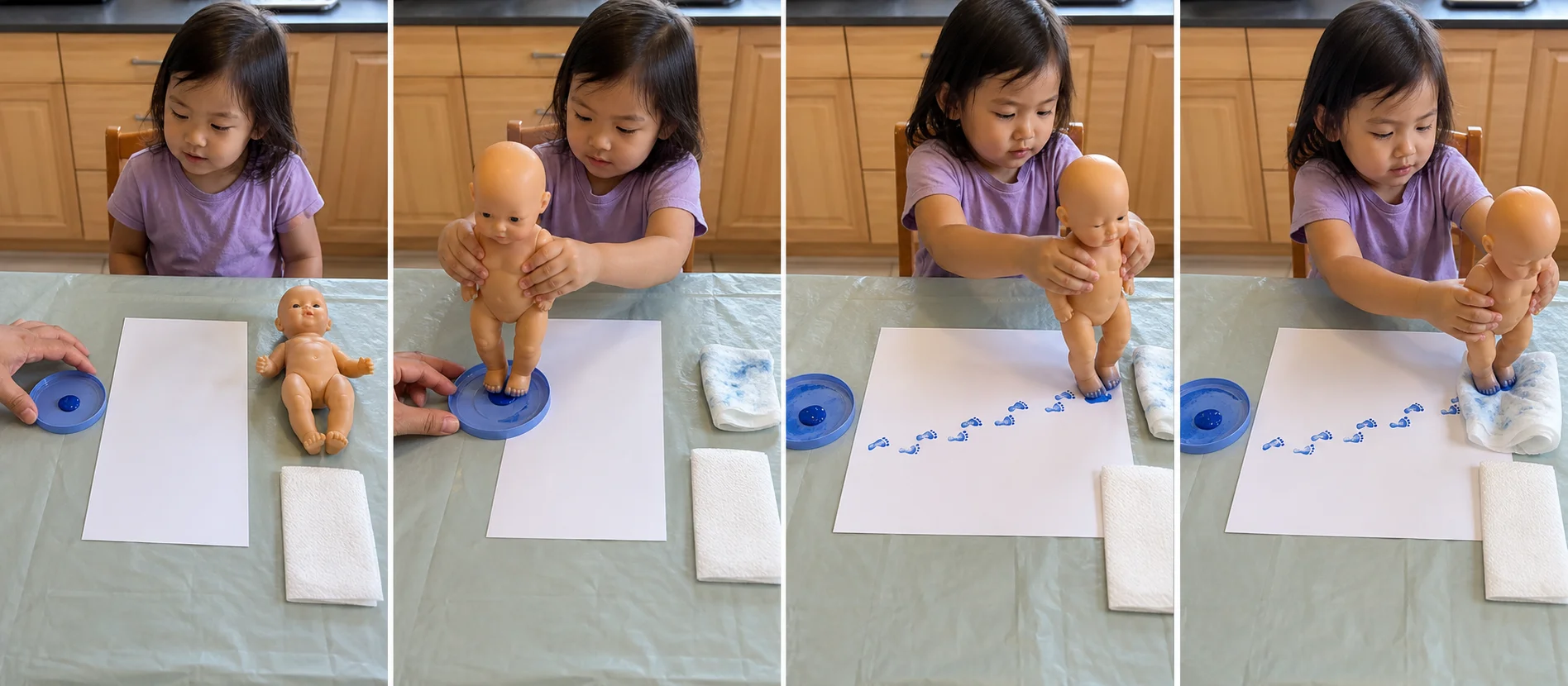
Four panels showing a doll's feet touching paint, the doll walking across paper, tiny footprints appearing, and the feet being wiped clean.
  1. 01
    Model one turn: tap the doll's feet in the paint, walk the doll across the paper, and wipe the feet clean. Say, "Doll feet in. Walk, walk, walk. Look, footprints. Wipe feet."
  2. 02
    Offer the doll and ask, "Your turn or watch?"
  3. 03
    If your child joins, let them run the same dip, walk, look, and wipe loop with short cues.
  4. 04
    After the feet are wiped, turn the paper or point to a clean space for another trail.
  5. 05
    Stop after one trail if your child hesitates, backs away, or says no.

Safety Check

  • Stay close enough to take the doll if paint moves toward your child's mouth, eyes, clothing, furniture, or floor.
  • Use washable paint and a washable, child-safe doll or figure with no small detachable parts.
  • Keep the activity no-pressure. Your child can watch, stop, or use the toy as the only paint-contact surface.
Supporting the play

What to say in the moment

Match what you say to what you see.

Prompt ladder
Level 1 (Start)
Invite your child to make the doll take one slow painted step.
Level 2 (Keep going)
Point to the trail and ask the doll to walk to the wipe.
Level 3 (Stretch)
Offer tiny steps or big steps for the next trail.
Level 4 (Extend)
Let your child choose where the doll walks next on the clean paper.
If your child seems...
What you'd see
Focused
What to do
Say
"Keep the doll walking."
Add
Name one thing only, such as "feet" or "trail."
Extend
Try tiny steps across one clean strip.

Make it easier

Younger end
  • -Count one clear footprint as a complete turn.
  • -Let your child point to the walking spot while you hold the doll.
  • -Use only one cue at a time, such as "walk" or "wipe."

Make it harder

Older end
  • +Ask your child to stop the doll on an empty space before wiping.
  • +Invite a tiny-step trail first and a big-step trail next.
  • +Pause before the wipe and ask what comes next.

If it's not working

If you see
If child ignores it
Make one footprint trail yourself, hold it up for a quick look, and ask, "Should the doll walk again or be all done?"
If you see
If child misuses it
Say, "Paint stays on paper," wipe the doll's feet, and either restart with one adult-led step or end the activity.
If you see
If child gets frustrated
Remove the paint dish, keep the paper and clean doll, and let your child practice just walking the doll across the page.
Skill spotlight
Finish And Reset

Finish and reset a messy turn

This helps the child stay with a small messy routine, see that paint can be controlled, and finish one turn before starting another.

  • The doll-first paint contact lets your child join messy art without putting paint on their own hands.
  • The footprint trail gives immediate proof that the walk worked.
  • Wiping the doll's feet makes cleanup part of every turn, not a surprise at the end.
  • Finding a clean paper space helps your child finish one small messy routine before starting again.
Real-world transfer
  • Finishing a messy art turn before starting another.
  • Trusting that sticky or wet play can be cleaned up.
  • Following a short cleanup routine after play.
  • Moving from watch-only participation to safe hands-on participation.

Parent questions