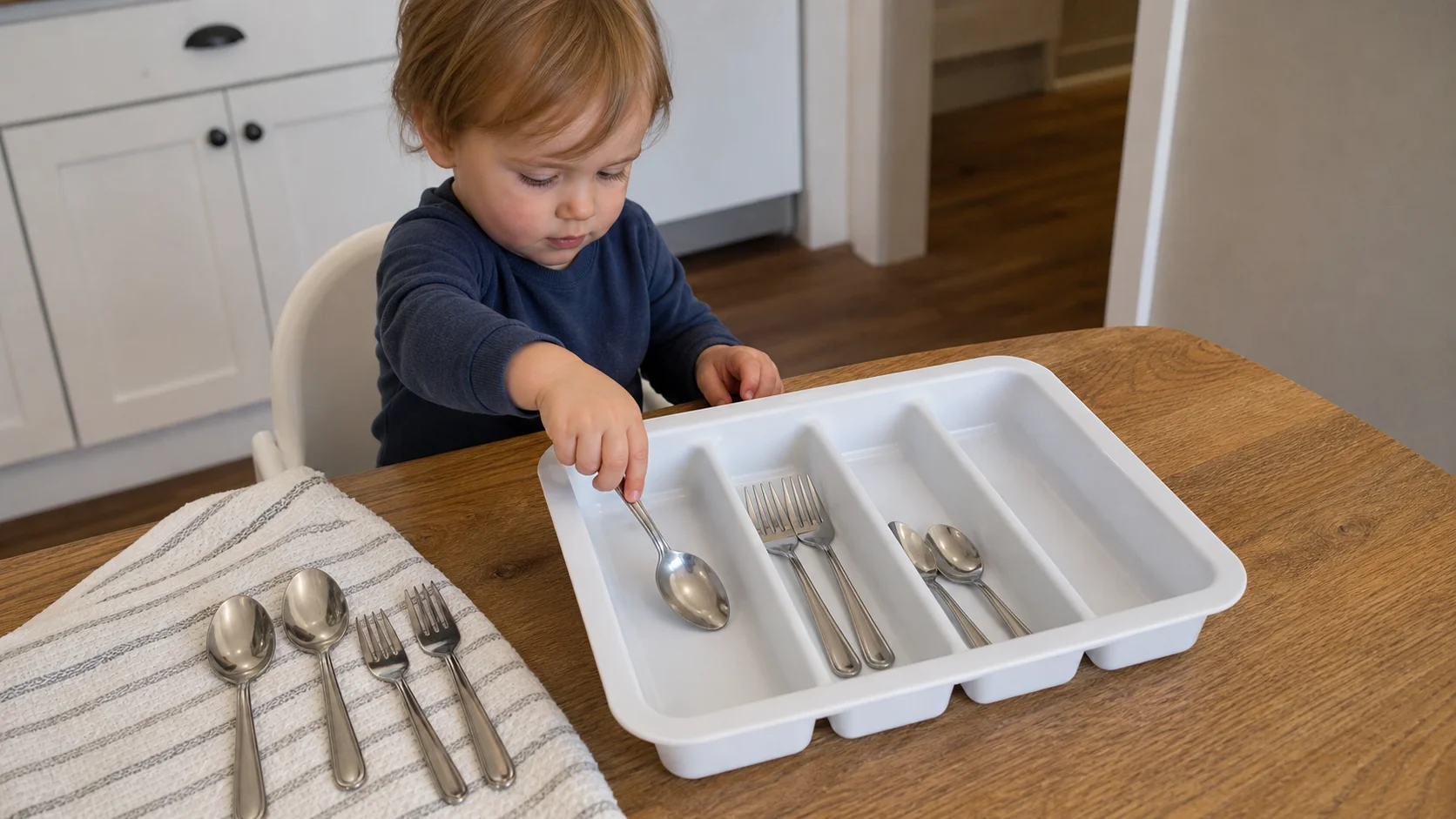
A toddler seated at a table placing a clean spoon into a silverware tray while a grown-up keeps a few forks and spoons nearby.
ThinkingAutism supportDevelopmental supportBy TypeIndoor

Silverware Tray Sort.

Set out a few clean spoons and forks and let your child sort each one into the right tray section.

Play time
5-10+ min
Age
2-3 years
Energy
Low
Mess
No
Effort
Low
Where
Indoor
Start here

The recipe.

Low parent effort
3 things

What you need

  • 1 silverware tray
  • 2 or 3 clean spoons
  • 2 or 3 clean forks
5 min minimum

Setup

Then start the loop
Step 01
Seat your child at the table or in the high chair and clear the surface so the tray and utensils are the only things in reach.
Step 02
Put the silverware tray directly in front of your child with the sections easy to see.
Step 03
Set 2 or 3 clean spoons and 2 or 3 clean forks beside the tray and move the rest of the silverware out of reach.
"This one."
The loop

How play unfolds.

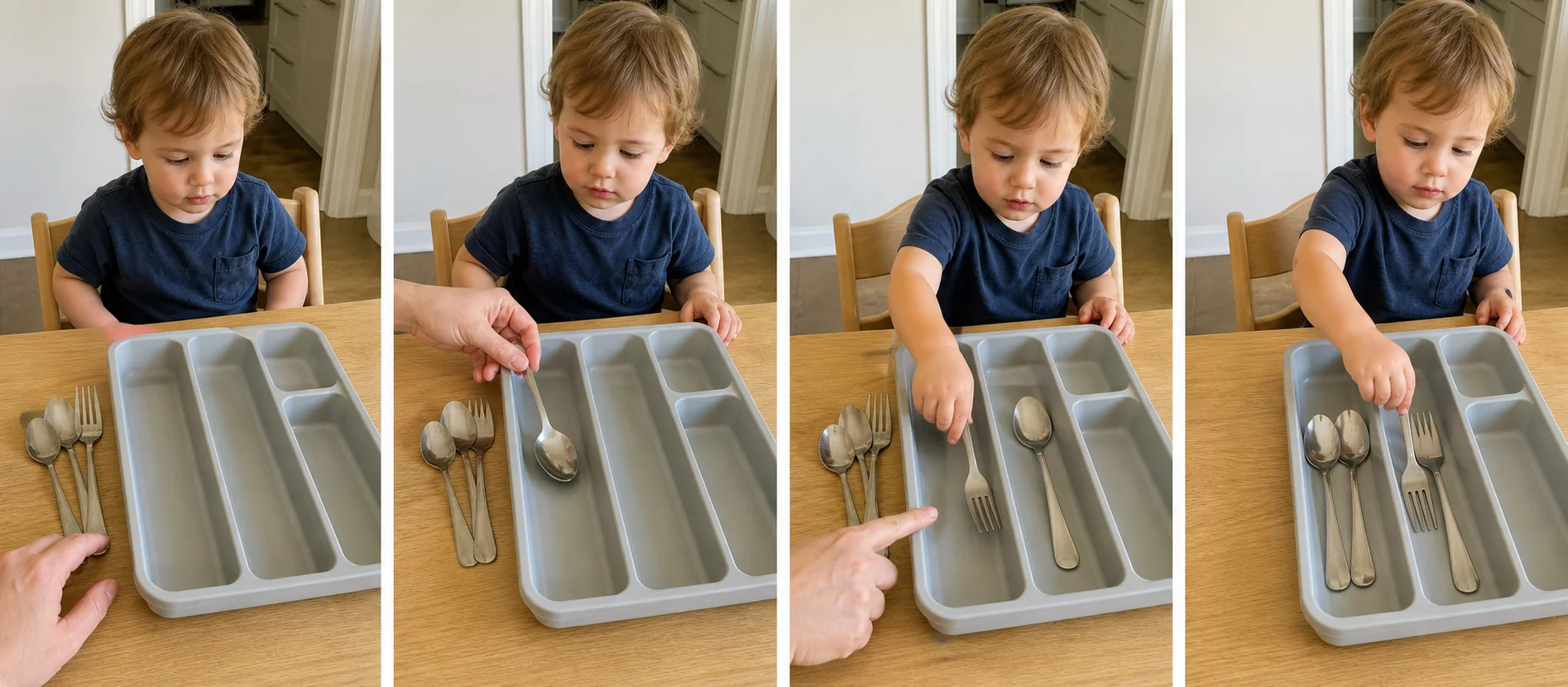
Four panels showing a silverware tray on the table, a grown-up modeling a spoon and fork, a toddler sorting one utensil at a time, and the last piece landing in the tray.
  1. 01
    Show where 1 spoon goes and where 1 fork goes, then say, "Your turn."
  2. 02
    Hand or point to 1 utensil at a time and let your child place it in the matching tray section.
  3. 03
    If a piece lands in the wrong spot, hold it over the 2 sections and try again together.
  4. 04
    Finish the small batch, then stop or bring out 1 more short round.

Safety Check

  • Skip knives and any sharp serving pieces.
  • Stay within arm's reach when forks are in play.
  • End the round if your child starts waving, poking, mouthing, or throwing utensils.
Supporting the play

What to say in the moment

Match what you say to what you see.

Prompt ladder
Level 1 (Start)
"Fork or spoon?"
Level 2 (Keep going)
"Find its spot."
Level 3 (Stretch)
"Check before you drop."
Level 4 (Extend)
"Let's finish this little batch."
If your child seems...
What you'd see
Focused
What to do
Say
"You knew where it went."
Add
Name 1 utensil word after the piece lands, such as fork or spoon.
Extend
Pause before helping so your child scans the tray first.

Make it easier

Younger end
  • -Use only spoons for the first short round.
  • -Keep the tray very close to your child's hands.
  • -Start with 2 pieces total.

Make it harder

Older end
  • +Add 1 or 2 more utensils to the batch.
  • +Mix the spoons and forks closer together before each turn.
  • +Let your child pick the next utensil instead of waiting for you to hand it over.

If it's not working

If you see
If child ignores it
Start with 1 spoon and 1 fork only, sort 1 yourself, and offer the other right away.
If you see
If child misuses it
Keep the extra utensils in your hand and give only 1 piece at a time.
If you see
If child gets frustrated
Use only spoons for 1 short round, then bring the forks back after a success.
Skill spotlight
By Type

sorting everyday objects by type

This helps your child notice how everyday objects belong in groups, place items with more control, and join a simple household helping job from start to finish.

  • Matching each utensil to the right tray section gives your child repeated sort-by-type practice with a real visible target.
  • Placing one piece at a time builds controlled hand use without needing extra craft supplies or setup.
  • Finishing a tiny kitchen job helps your child join a household routine that has a clear start and stop.
Real-world transfer
  • Putting clean utensils away during kitchen routines
  • Noticing how similar objects belong together
  • Staying with a small helping job until it is done
Back to library
Keep playing

Related activities.