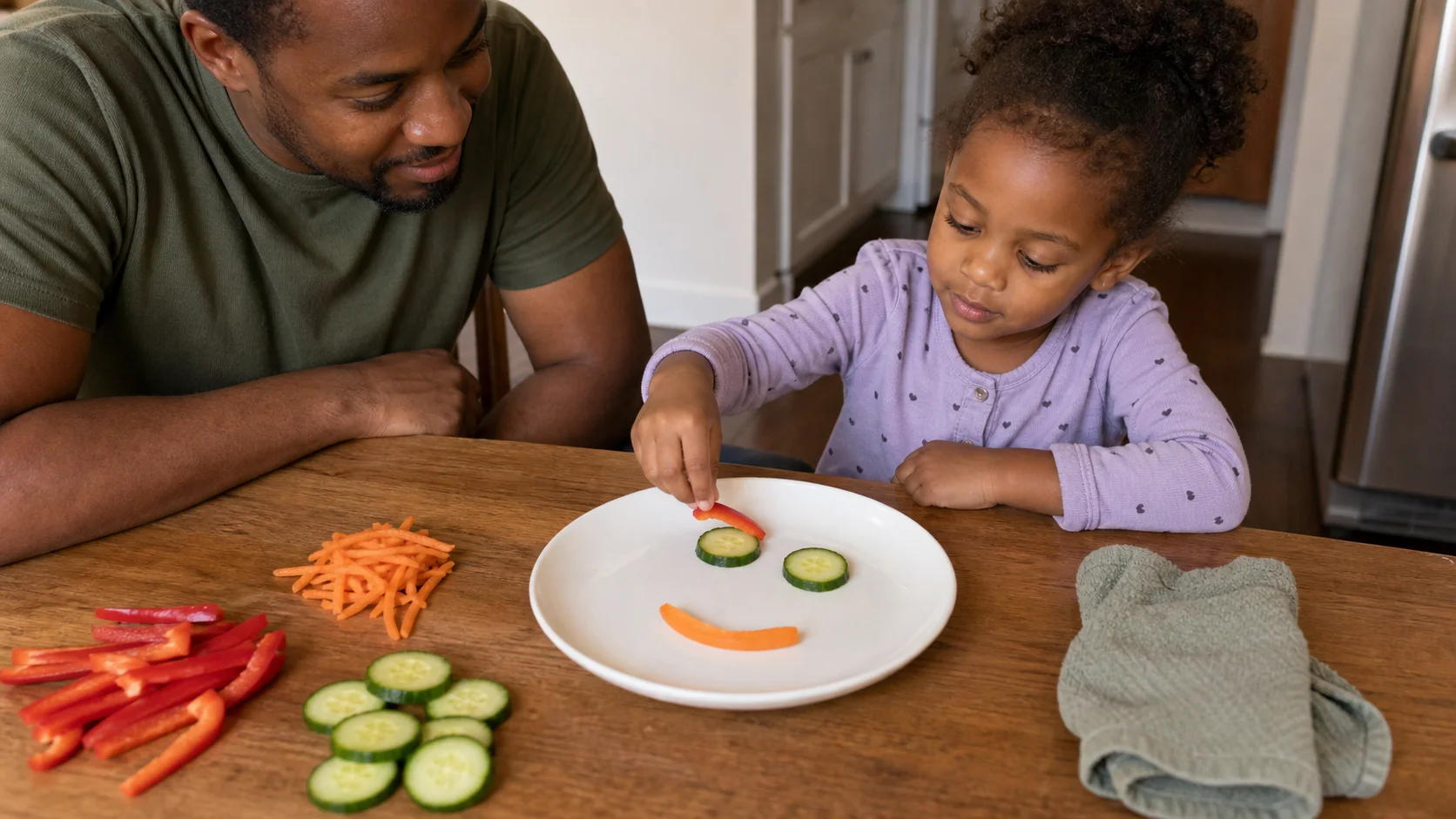
A child places cucumber and pepper pieces onto a plate to make a silly face while a grown-up sits nearby.
Fine motorSensory-friendly supportPlace With ControlIndoor

Silly Veggie Face.

Safe veggie pieces become a silly-face game that lets toddlers explore food without tasting pressure.

Play time
5-10+ min
Age
2-5 years
Energy
Low
Mess
Low To Medium
Effort
Low
Where
Indoor
Start here

The recipe.

Low parent effort
5 things

What you need

  • 1 plate
  • A few soft fruit or vegetable pieces, such as cucumber slices, carrot pieces, or pepper strips
  • 1 small towel
  • 1 adult for close supervision
  • 1 child
5 min minimum

Setup

Then start the loop
Step 01
On the table, set the plate directly in front of your child and leave the middle empty for the face.
Step 02
Around the plate edge, place a few safe food pieces where your child can reach them.
Step 03
Near one side of the plate, make one starter feature, such as a cucumber eye or pepper eyebrow.
Step 04
At the table, seat your child facing the plate.
"One silly eye."
The loop

How play unfolds.

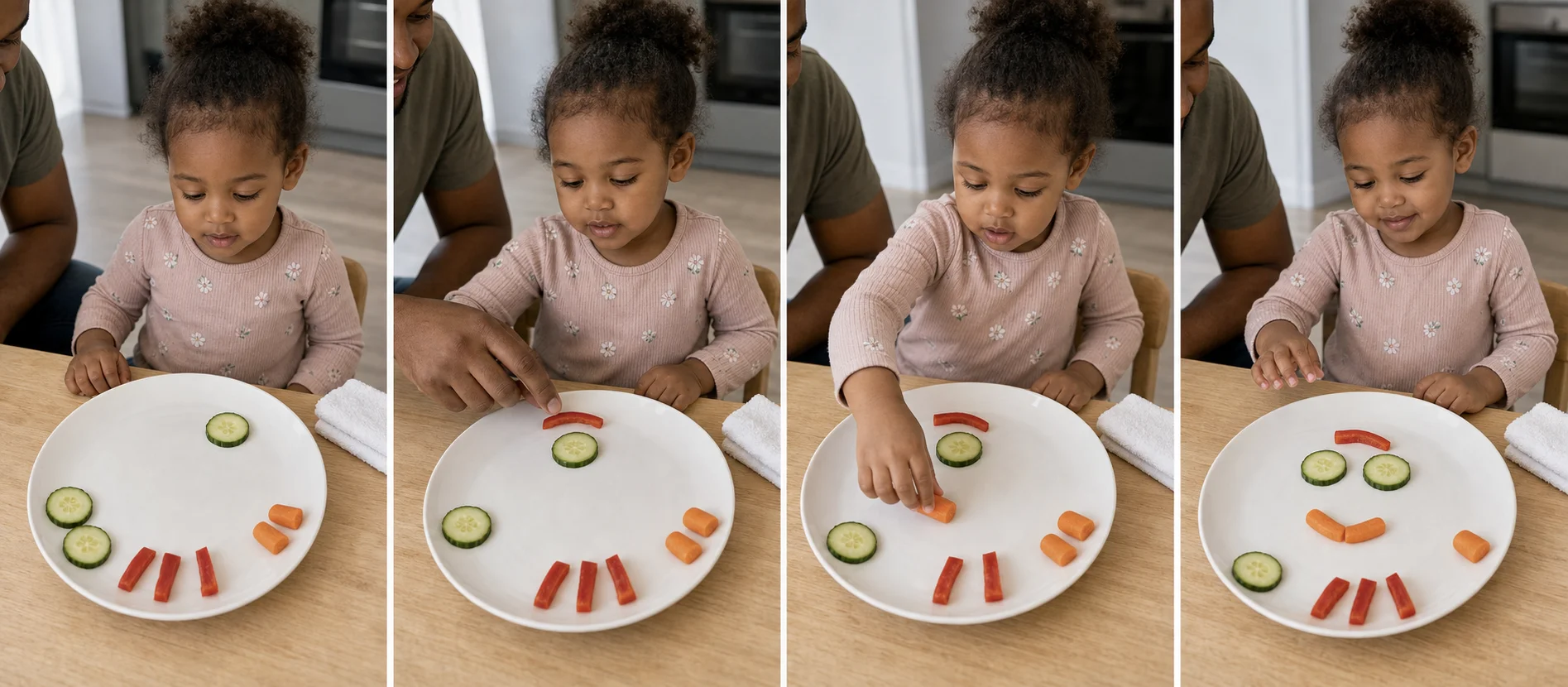
Four panels show vegetable pieces set around a plate, a grown-up making one starter feature, a child adding face parts, and the plate being cleared for another round.
  1. 01
    Point to the starter feature and say, "Let's make the silliest face. This cucumber can be an eye."
  2. 02
    Let your child choose one food piece and place it somewhere on the face.
  3. 03
    Name the picture, not the eating, and keep going one piece at a time until the face feels done.
  4. 04
    Slide the pieces back to the plate edge for a new silly face, or stop when your child is ready to be done.

Safety Check

  • Stay close because the food pieces may be mouthed or eaten.
  • Use pieces that are safe for your child's chewing and handling skills.
  • Pause if any piece goes toward the mouth unsafely.
  • Choose another activity if food contact already feels overwhelming before the plate is offered.
Supporting the play

What to say in the moment

Match what you say to what you see.

Prompt ladder
Level 1 (Start)
Put one piece down and say what silly part it could be.
Level 2 (Keep going)
Invite your child to add one more face part anywhere on the plate.
Level 3 (Stretch)
Ask your child to choose whether the face looks happy, surprised, or wiggly.
Level 4 (Extend)
Clear only one feature and rebuild that part a new way.
If your child seems...
What you'd see
Focused
What to do
Say
"That pepper eyebrow is tall."
Add
Name one color, shape, or face part while your child keeps placing pieces.
Extend
Invite one small change, such as moving the smile higher or lower.

Make it easier

Younger end
  • -Offer only two pieces at a time so choosing stays simple.
  • -Let your child point to the spot while you place the food piece.
  • -Call the face finished after one child-placed piece and one parent-made feature.

Make it harder

Older end
  • +Ask your child to make two matching parts, such as two eyes.
  • +Invite a new expression using the same pieces, such as surprised or sleepy.
  • +Have your child rebuild one feature after you move it slightly.

If it's not working

If you see
If child ignores it
Build one exaggerated feature yourself, such as a pepper eyebrow, and say, "This face looks surprised."
If you see
If child misuses it
Remove any thrown or unsafe piece, move the plate closer, and offer one calm choice: "Carrot smile or cucumber eye?"
If you see
If child gets frustrated
Stop the build at one or two features and call it done. A finished face is not required.
Skill spotlight
Placement Control

Placing small food pieces onto a chosen spot with control

This helps a child control where a small object lands, notice how separate parts make one picture, and stay with a short table routine without pressure to eat.

  • Placing one piece at a time gives your child repeated practice aiming and releasing a small object onto a chosen spot.
  • The face grows in a visible way, which helps your child notice how separate parts make one whole picture.
  • Keeping tasting optional lets the play stay focused on choosing, placing, and exploring food without pressure.
Real-world transfer
  • Placing small items where they belong during crafts, snacks, and table play
  • Noticing how parts fit together in pictures and simple matching games
  • Exploring food without pressure, which can make mealtime routines feel calmer