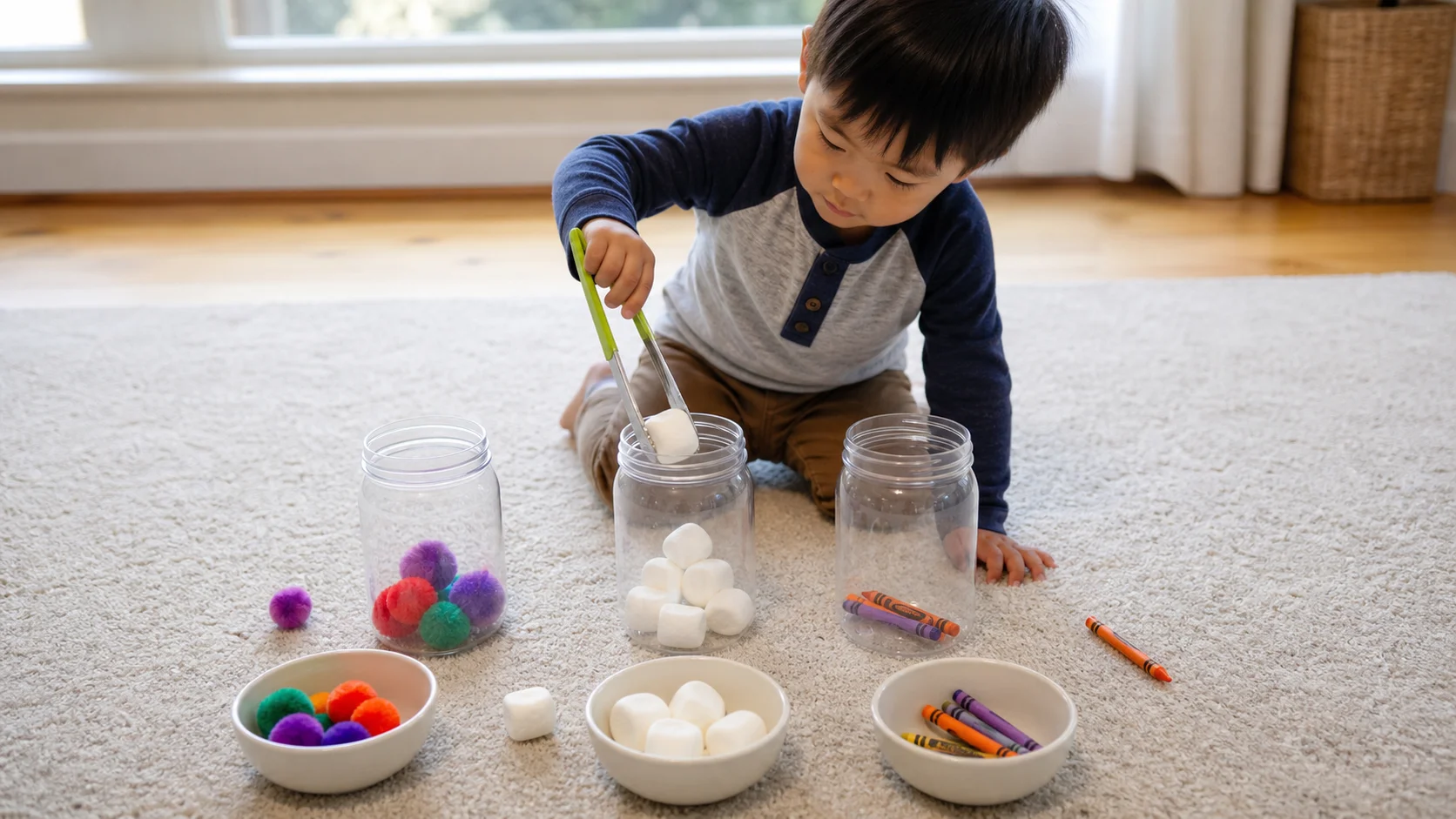
A child uses tongs to carry small items from bowls to matching jars while a grown-up sits nearby.
Fine motorSqueeze And ReleaseIndoor

Shoving Station.

Set out a few bowls, matching jars, and tongs for a simple sort-and-shove game toddlers can repeat.

Play time
5-10+ min
Age
2-3 years
Energy
Low
Mess
Low
Effort
Low
Where
Indoor
Start here

The recipe.

Low parent effort
6 things

What you need

  • 3 non-breakable jars
  • Pom-poms
  • Marshmallows
  • Crayons
  • 3 bowls
  • 1 child-safe pair of tongs
5 min minimum

Setup

Then start the loop
Step 01
Set the 3 empty jars in a row on the floor or a low table where your child can reach each opening easily.
Step 02
Place 1 bowl of pom-poms, 1 bowl of marshmallows, and 1 bowl of crayons beside the jars, leaving a little space between bowls.
Step 03
Put 1 sample item beside each jar so your child can see which jar matches which bowl.
Step 04
Place the tongs in front of the bowls and keep the jars steady enough that they will not tip during the shove.
"One in."
The loop

How play unfolds.

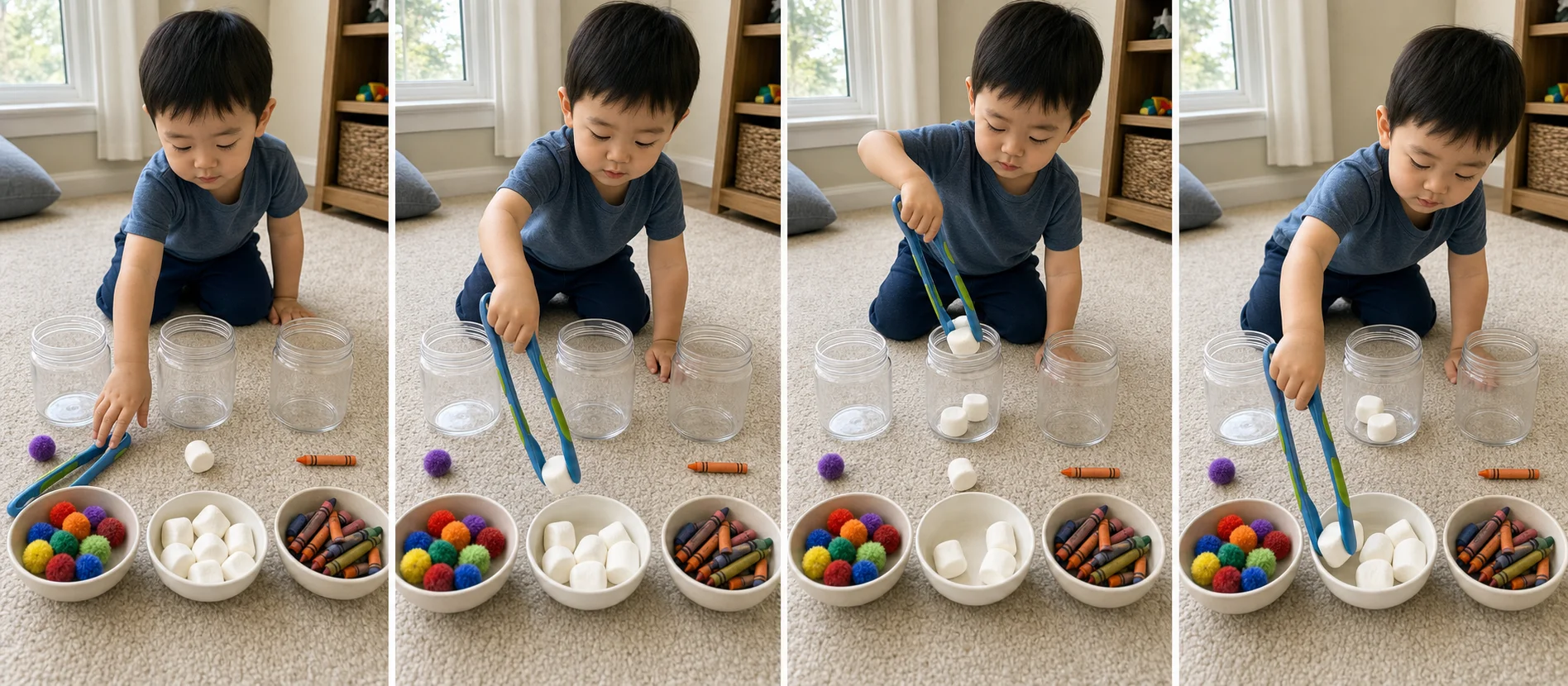
A step-by-step play sequence showing bowls of pom-poms, marshmallows, and crayons, matching jars, one tong grab, and the final shove through the opening.
  1. 01
    Use the tongs to place 1 item in its matching jar and say, "Pom-pom goes here. Your turn."
  2. 02
    Let your child pick 1 item, carry it to the matching jar, and shove it through the opening. Fingers count if the tongs feel like too much.
  3. 03
    Keep going one item at a time until the bowls are empty, the jars are full, or your child starts dumping instead of placing.
  4. 04
    If an item misses or lands in the wrong jar, slide it back for another turn and keep the game moving.

Safety Check

  • Stay close because the loose items and marshmallows are small enough to mouth.
  • Use non-breakable jars instead of glass.
  • Use child-safe tongs and supervise the tong play, especially for younger toddlers.
Supporting the play

What to say in the moment

Match what you say to what you see.

Prompt ladder
Level 1 (Start)
"Watch one pom-pom go in, then you try one."
Level 2 (Keep going)
"Pick one piece and shove it in."
Level 3 (Stretch)
"Can you find the jar that matches this one?"
Level 4 (Extend)
"Let's fill this jar before we switch."
If your child seems...
What you'd see
Focused
What to do
Say
"You are working those tongs."
Add
Name the item after it lands in the jar.
Extend
Invite 1 more matching piece before changing bowls.

Make it easier

Younger end
  • -Start with only the softest, easiest-to-grab material.
  • -Place the bowl right beside the matching jar so there is almost no carry distance.
  • -Pre-load the tongs with 1 item and let your child do the final push.

Make it harder

Older end
  • +Ask your child to finish 1 jar before starting another.
  • +Move the bowls a little farther from the jars so your child carries each item carefully.
  • +Let your child choose which jar gets filled first, then keep that plan for the round.

If it's not working

If you see
If child ignores it
Start with only 1 bowl and 1 jar. Shove 2 pieces in yourself, then slide the tongs to your child.
If you see
If child misuses it
If items get dumped, pause and say, "One at a time," then leave only a small handful in reach.
If you see
If child gets frustrated
Let your child use fingers for a few turns, then offer the tongs again for just the last push into the jar.
Skill spotlight
Squeeze And Release

Tong squeeze and release

This helps the child adjust finger pressure, coordinate the wrist and hand, and handle small objects during snack, cleanup, container play, and simple helping routines.

  • The tong squeeze, carry, and shove loop gives little hands the same job over and over, so the practice stays clear.
  • Matching each item to its jar adds a simple sorting choice without changing the core movement.
  • The jar opening gives your child a clear target and a visible finish for each turn.
  • Repeating one item at a time keeps the play predictable and easy to follow.
Real-world transfer
  • Using child-safe tongs, scoops, and clips.
  • Putting small items into containers.
  • Adjusting grip pressure during snack, cleanup, and dressing tasks.
  • Noticing same-type objects during simple sorting and putting away.