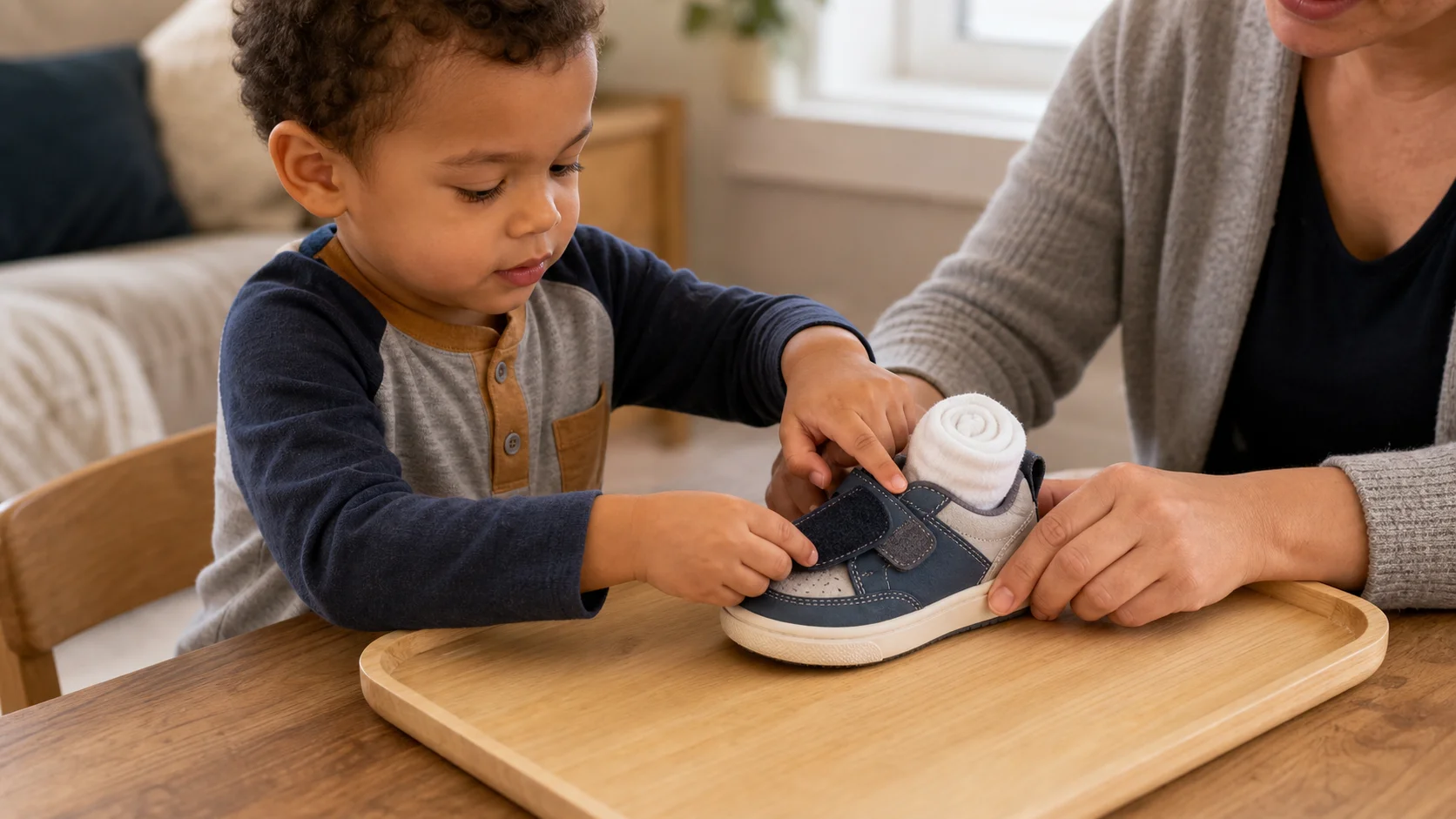
Toddler pressing a Velcro shoe strap over a rolled sock pretend foot on a tray.
Fine motorSensory-friendly supportPeel And Press`Indoor

Shoe Tight-Loose Check.

A simple off-foot shoe strap game that lets your child open, press, compare, and stop.
Play time
3-7+ min
Age
2-4 years
Energy
Low
Mess
No
Effort
Low
Where
Indoor
Start here

The recipe.

Low parent effort
5 things

What you need

  • 1 clean child-sized Velcro shoe
  • 1 clean sock
  • 1 clear table, tray, or floor spot
  • 1 grown-up
  • 1 child
3 min minimum

Setup

Then start the loop
Step 01
On a clear table, tray, or floor spot, place the shoe with the opening and strap facing the child.
Step 02
Beside the shoe, roll the sock into a soft pretend foot.
Step 03
Inside the shoe, tuck the rolled sock so it is visible and the shoe keeps its shape.
Step 04
Leave the Velcro strap open.
Step 05
Sit beside the child so you can model the strap without taking over their hands.
"Open or press?"
The loop

How play unfolds.

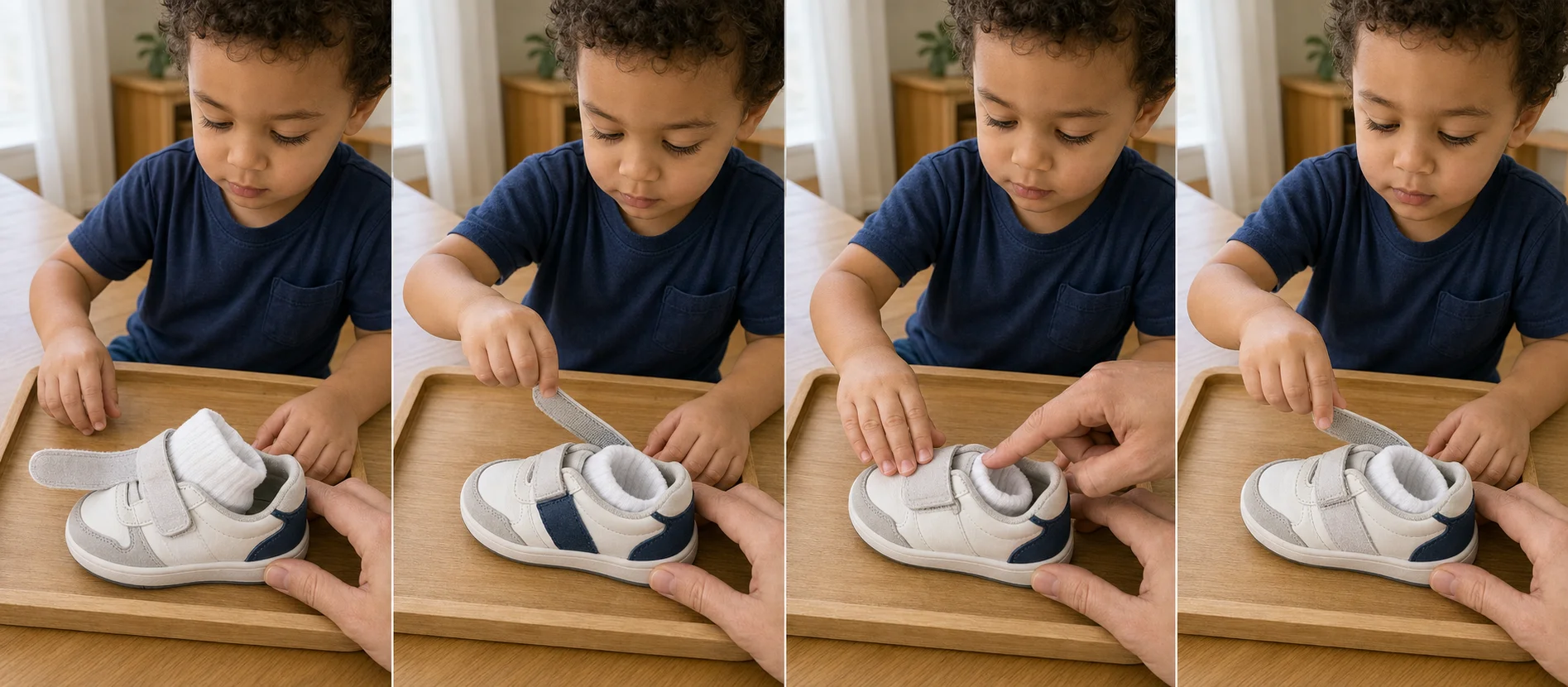
Panels showing a grown-up opening a shoe strap, a child pressing loose and snug, and the sock wiggle check.
  1. 01
    Peel the strap open, press it down lightly, lift it again, and say, "Loose. It opens. Your turn."
  2. 02
    Let your child touch, peel, press, watch, or point to the strap.
  3. 03
    Help your child press the strap lightly for loose, then nudge the sock so they can see it wiggle.
  4. 04
    Open the strap again, then press it flatter for snug so the sock stays still without squeezing the shoe closed.
  5. 05
    Open to reset and ask, "Loose or snug?" One chosen press can finish the round.
  6. 06
    End with, "Open. All done," before putting the shoe away.

Safety Check

  • Use a clean, dry shoe with no loose parts, sharp seams, hard edges, or scratchy Velcro surfaces where the child will hold it.
  • Keep the shoe off the child's foot. This game practices control with a pretend foot, not real shoe wearing.
  • Stop or switch to watching if the child mouths the sock, rubs the shoe on their face, pulls the strap hard enough to snap back, freezes, or avoids the shoe.
  • Keep "snug" gentle. The strap only needs to hold the sock still.
Supporting the play

What to say in the moment

Match what you say to what you see.

Prompt ladder
Level 1 (Start)
Touch the strap and choose open or press.
Level 2 (Keep going)
Press it loose, then open it again.
Level 3 (Stretch)
Press it snug enough that the sock stays still.
Level 4 (Extend)
Choose loose or snug before each reset.
If your child seems...
What you'd see
Focused
What to do
Say
"You made it loose. Now try snug."
Add
Ask one quick choice: "Loose or snug?"
Extend
Let the child be the shoe helper and set the strap for your pretend foot.

Make it easier

Younger end
  • -Start with the strap partly lifted so the first peel succeeds quickly.
  • -Count one touch, one peel, or one press as a full turn.
  • -Keep the choice visual by tapping the open strap for loose and the closed strap for snug.

If it's not working

If you see
If child ignores it
Do one quick open-close yourself and say, "My turn, all done." Then offer one choice: "Open or press?"
If you see
If child misuses it
If the child mouths the sock, rubs the shoe on their face, or pulls the strap hard, take the shoe back and switch to watching you do one round.
If you see
If child gets frustrated
Make the round smaller. Try open only, press only, or choosing loose or snug by pointing. Stop if the Velcro sound, texture, or word "snug" seems uncomfortable.
Skill spotlight
Fastener Control`

Velcro control, Loose-or-snug checking

This gives the child a low-pressure way to control a clothing fastener and notice fit before it is on their own body.

  • Peeling and pressing the strap practices fastener control while the shoe stays off your child's body.
  • The loose-or-snug choice gives your child a clear way to compare fit without needing to wear the shoe.
  • The open-press-reset loop makes the task predictable, short, and easy to finish after one success.
Real-world transfer
  • Adjusting a shoe strap during dressing.
  • Noticing when clothing feels too loose or too snug.
  • Using words or gestures to ask for a fit change.
  • Staying calmer when a clothing step has a clear reset.

Parent questions