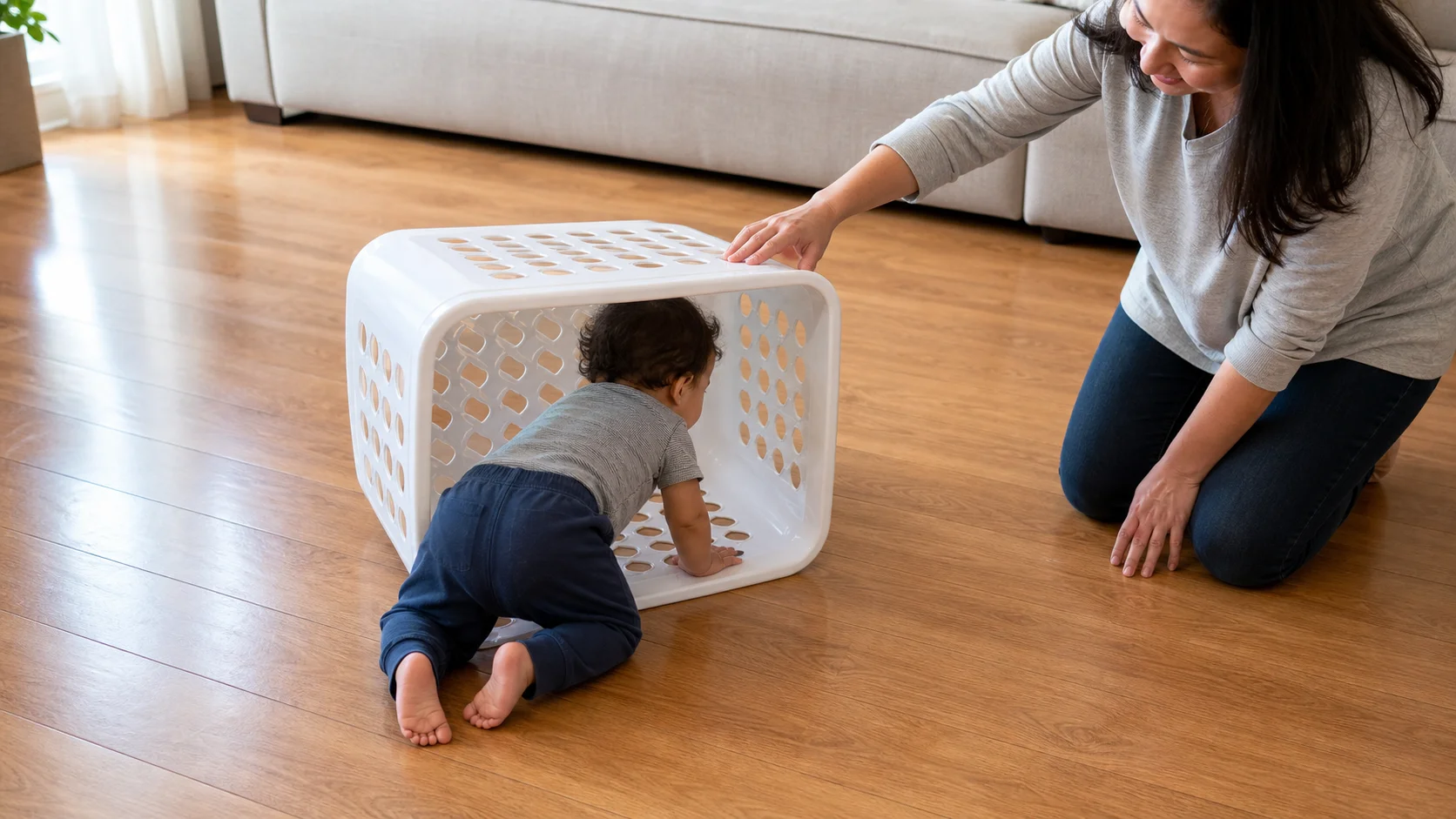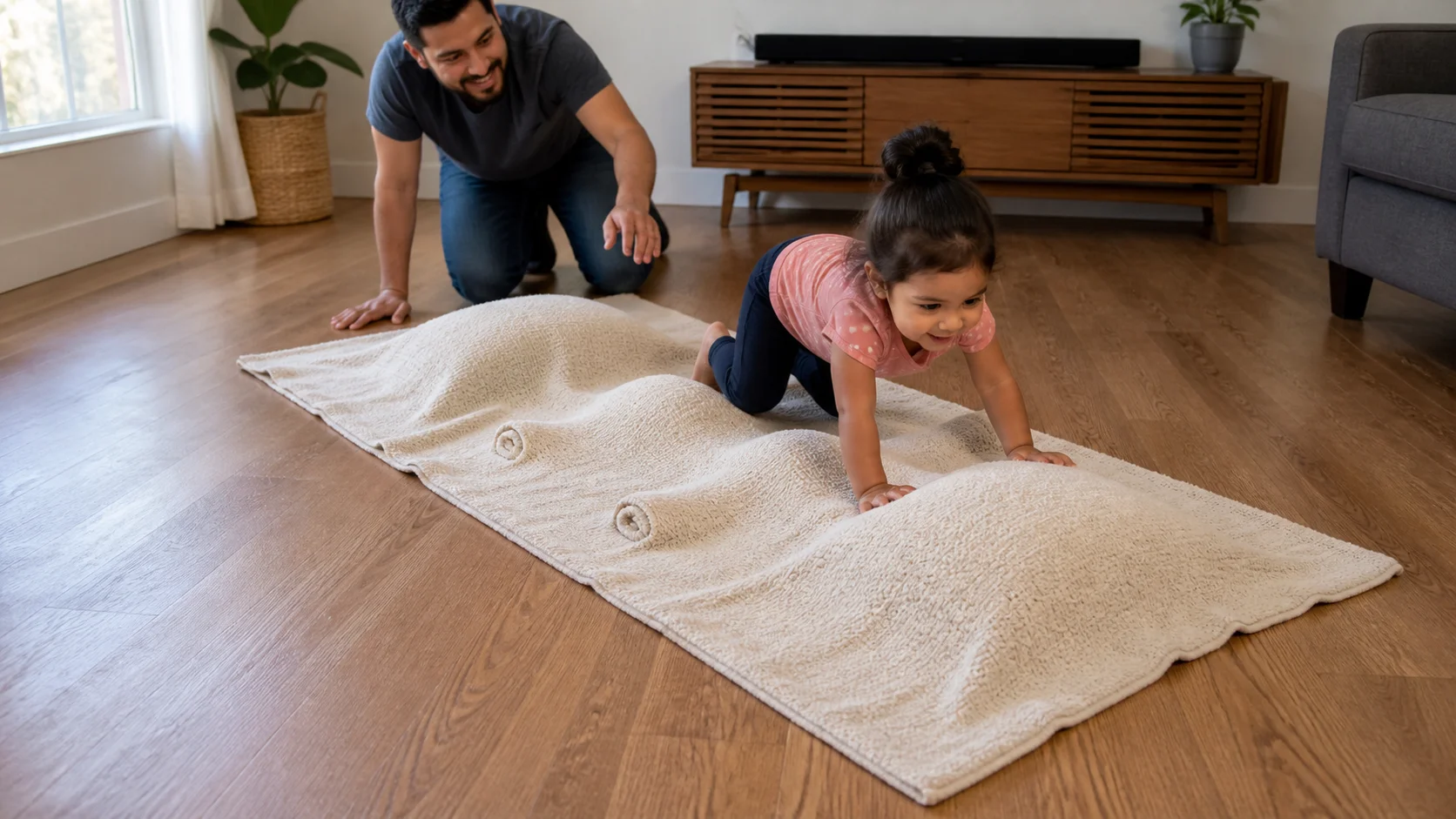
A young child crawling across a blanket with pillows and rolled towels hidden underneath while a grown-up stays beside the path.
Gross motorNavigate PathIndoor

Bumpy Blanket Path.

Turn a blanket, pillows, and balled-up towels into a soft indoor obstacle path. Your child crawls or walks over the hidden bumps and back again to practice balance, whole-body coordination, and moving across uneven ground.

Play time
5-10+ min
Age
1-3 years
Energy
Medium To High
Mess
No
Effort
Medium
Where
Indoor
Start here

The recipe.

Medium parent effort
4 things

What you need

  • 1 blanket
  • 1 or more large pillows
  • 1 or more small pillows
  • 1 or more towels or small cloths balled up
5 min minimum

Setup

Then start the loop
Step 01
Spread a blanket flat on the floor.
Step 02
Place a few pillows and 2 or 3 balled-up towels under the middle, spreading them into low bumps.
Step 03
Smooth the blanket over the bumps and keep the edges flat.
"Bumpy path."
The loop

How play unfolds.

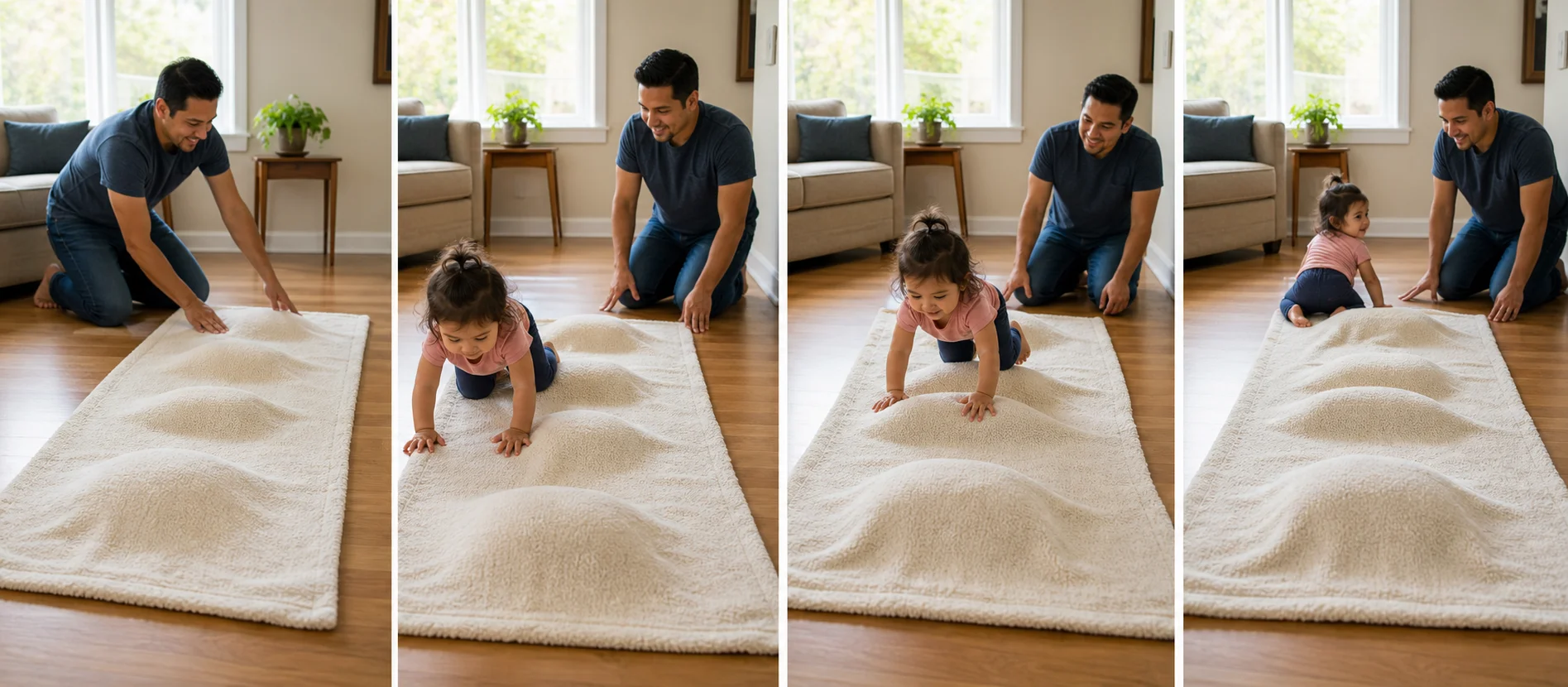
Four panels showing a grown-up laying a blanket on the floor, tucking pillows and rolled towels underneath, smoothing the path, and a child crawling across the bumps and back again.
  1. 01
    Have your child crawl or walk across the blanket to the far side.
  2. 02
    Have them turn and cross back.
  3. 03
    Smooth any bumps that shifted, then repeat.

Safety Check

  • Stay beside your child because the hidden bumps can cause trips, slips, or face-first falls.
  • Use soft items only under the blanket.
  • Keep the path away from hard furniture edges.
  • Flatten any tall hump or loose blanket edge before the next turn.
Skill spotlight
Navigate Path

Moving through a short uneven path with body control

This helps a child coordinate the whole body while moving across uneven ground, adjusting balance, and sticking with a short start-to-finish route.

  • Early. Your child may stop at the first bump, step off the blanket, or need you beside them the whole way.
  • Later. Your child crosses the path and comes back with steady movement and fewer reminders.
  • Middle. Your child starts crossing with more confidence but still pauses at bigger bumps or needs help turning around.
Real-world transfer
  • Walking or crawling over uneven ground, blankets, or soft play surfaces.
  • Adjusting balance when the floor feel changes.
  • Following a short movement route and doing it again.
Supporting the play

What to say in the moment

Match what you say to what you see.

Prompt ladder
Level 1 (Start)
"Over the bumps."
Level 2 (Keep going)
"Now back again."
Level 3 (Stretch)
"Can you do one more trip?"
Level 4 (Extend)
"Slow feet over the big bump."
If your child seems...
What you'd see
Focused
What to do
Say
"You found the bumps."
Add
Start the return trip right away while your child is still in motion.
Extend
Offer one more out-and-back before cleanup.

Make it easier

Younger end
  • -Let your child crawl instead of walk.
  • -Keep the bumps low and spread out.
  • -Count one crossing as a full success.

Make it harder

Older end
  • +Ask your child to cross without stepping off the blanket.
  • +Pause at the middle bump before finishing the path.
  • +Have your child turn and come straight back without stopping off the blanket.

If it's not working

If you see
If child ignores it
Pat the first bump, do one quick crossing yourself, and invite just one trip across.
If you see
If child misuses it
If your child jumps on the pile or pulls the blanket apart, flatten the path and restart with fewer bumps.
If you see
If child gets frustrated
Use one pillow and one towel only, shorten the path, and count one crossing as enough.