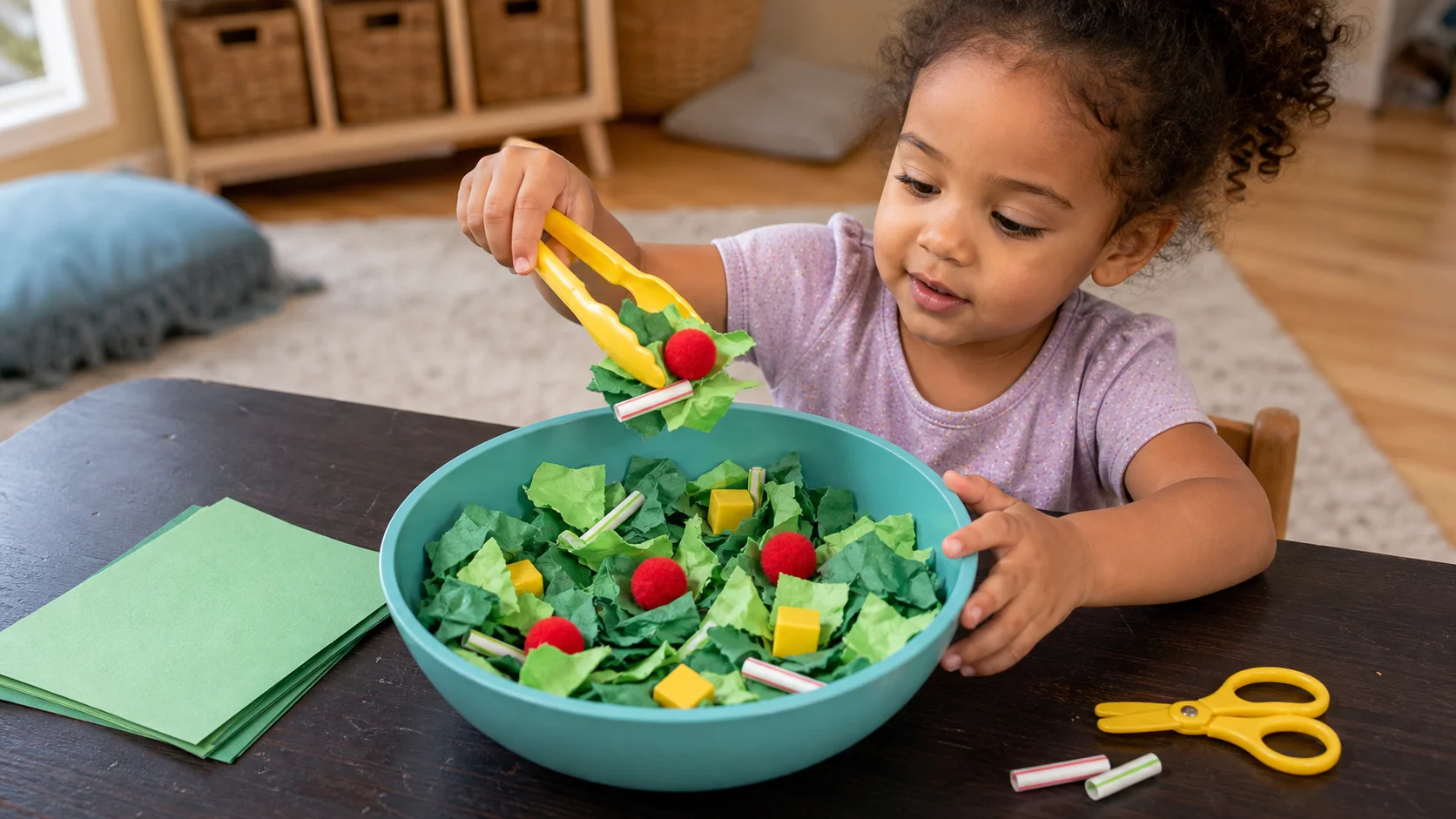
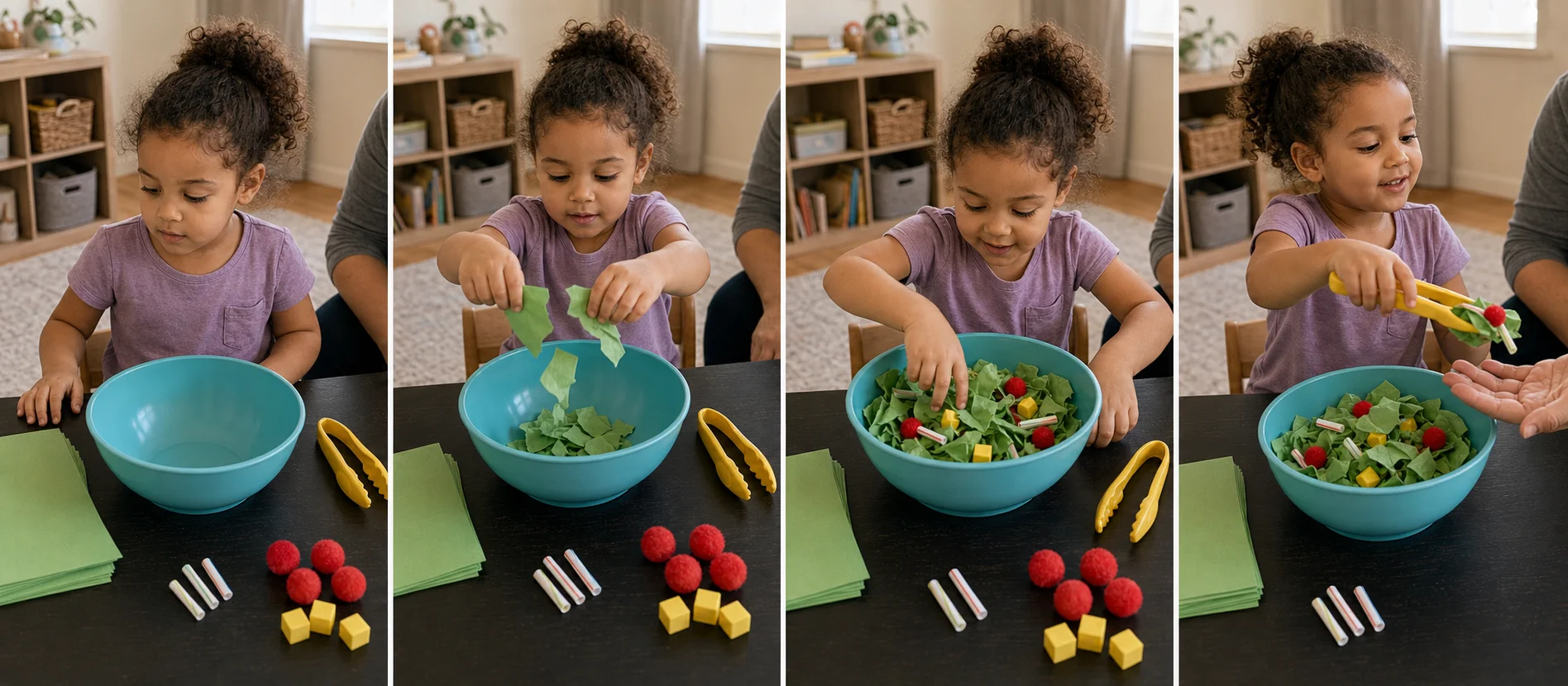
A child sits at a low table, tears green paper into a bowl, adds textured toppings, and serves a pretend salad with tongs while a grown-up stays close.
Fine motorOT-adjacent supportTwo Hand CoordinationIndoor Table Or Therapy Workspace

Sensory Salad Serve.

Paper, toppings, and tongs turn one pretend salad into a contained tactile play loop with a visible finish.

Play time
10-15+ min
Age
3-5 years
Energy
Low To Medium
Mess
Low
Effort
Medium
Where
Indoor Table Or Therapy Workspace
Start here

The recipe.

Medium parent effort
7 things

What you need

  • 1 medium bowl
  • A few sheets of green construction paper
  • A few straws
  • 1 pair of child-safe scissors
  • A small handful of textured toppings, such as pom-poms, buttons, or small blocks
  • 1 pair of tongs
  • 1 adult for setup and direct supervision
10 min minimum

Setup

Then start the loop
Step 01
On a low table, place the bowl in the center.
Step 02
Set the green paper in a small stack on one side of the bowl.
Step 03
Put the straws and child-safe scissors on the other side so cutting stays separate from tearing.
Step 04
Place a small handful of textured toppings beside the bowl.
Step 05
Rest the tongs next to the bowl for the serving round.
Step 06
Stay close enough to remove scissors or small pieces right away if the play shifts.
"Lettuce first."
The loop

How play unfolds.

Four panels show a grown-up setting out the bowl and paper, a child tearing paper into lettuce, the child mixing in toppings, and the child serving a pretend salad portion with tongs.
  1. 01
    Say, "We're making a pretend salad. Tear the paper into lettuce and put it in the bowl."
  2. 02
    Help your child cut a few straw pieces if needed, then add them and a few textured toppings to the bowl.
  3. 03
    Let your child toss the salad gently by hand and serve 1 pretend portion with the tongs. Model a short phrase such as "more please" or "no more, thank you."
  4. 04
    Put the served pieces back in the bowl or add 1 new topping, then make another serving round.

Safety Check

  • Supervise the whole activity. This play uses scissors and small loose pieces.
  • Keep buttons, pom-poms, small blocks, and straw pieces out of mouths.
  • Use larger safe toppings or skip small loose pieces when mouthing risk is present.
  • Keep the salad toss gentle and inside the bowl.
  • Pause if the textures feel upsetting, pieces start flying, or scissors stop being a tool and start becoming the activity.
Supporting the play

What to say in the moment

Match what you say to what you see.

Prompt ladder
Level 1 (Start)
Tear 1 lettuce piece and drop it in the bowl.
Level 2 (Keep going)
Add 1 topping and toss the salad gently.
Level 3 (Stretch)
Serve 1 pretend bite with the tongs.
Level 4 (Extend)
Ask who needs the next salad bite.
If your child seems...
What you'd see
Focused
What to do
Say
"You are mixing it."
Add
Name 1 texture while the hands keep moving.
Extend
Offer a second serving request.

Make it easier

Younger end
  • -Use only paper and 1 larger soft topping for the first round.
  • -Hold the tongs open so your child only has to squeeze and release.
  • -Let your child toss with 2 fingers instead of the whole hand if texture is too much.

Make it harder

Older end
  • +Ask your child to serve 2 people in a chosen order.
  • +Invite your child to pick toppings by pretend food name before adding them.
  • +Have your child cut 1 straw piece, add it, and serve it in the same round.

If it's not working

If you see
If child ignores it
Make 1 tiny salad yourself first, toss it once, and say, "I need lettuce. Can you tear one piece?"
If you see
If child misuses it
If toppings start flying or head toward the mouth, pause the bowl, remove the loose pieces, and restart with only paper and tongs for 1 turn.
If you see
If child gets frustrated
Skip straw cutting for now. Let your child tear paper, add 1 soft topping, toss once, and serve 1 easy portion.
Skill spotlight
Two-Hand Coordination

Using two hands for different jobs

This helps your child use one hand to steady while the other hand works, adjust finger pressure, and handle small tools during everyday helping, feeding, dressing, and cleanup routines.

  • Tearing paper, cutting a few straw pieces, and squeezing tongs give your child several small hand jobs inside one simple loop.
  • The bowl keeps the textures and pieces contained, so your child can explore touch and serving without the whole table turning into cleanup.
  • The pretend order gives the hand work a purpose. Your child is not just picking things up, but making and serving a finished salad.
Real-world transfer
  • Holding a container while putting items in.
  • Using child-safe tools with steadier hands.
  • Helping set up, serve, and clean up simple play or snack routines.
  • Using short social phrases during turn-based play.