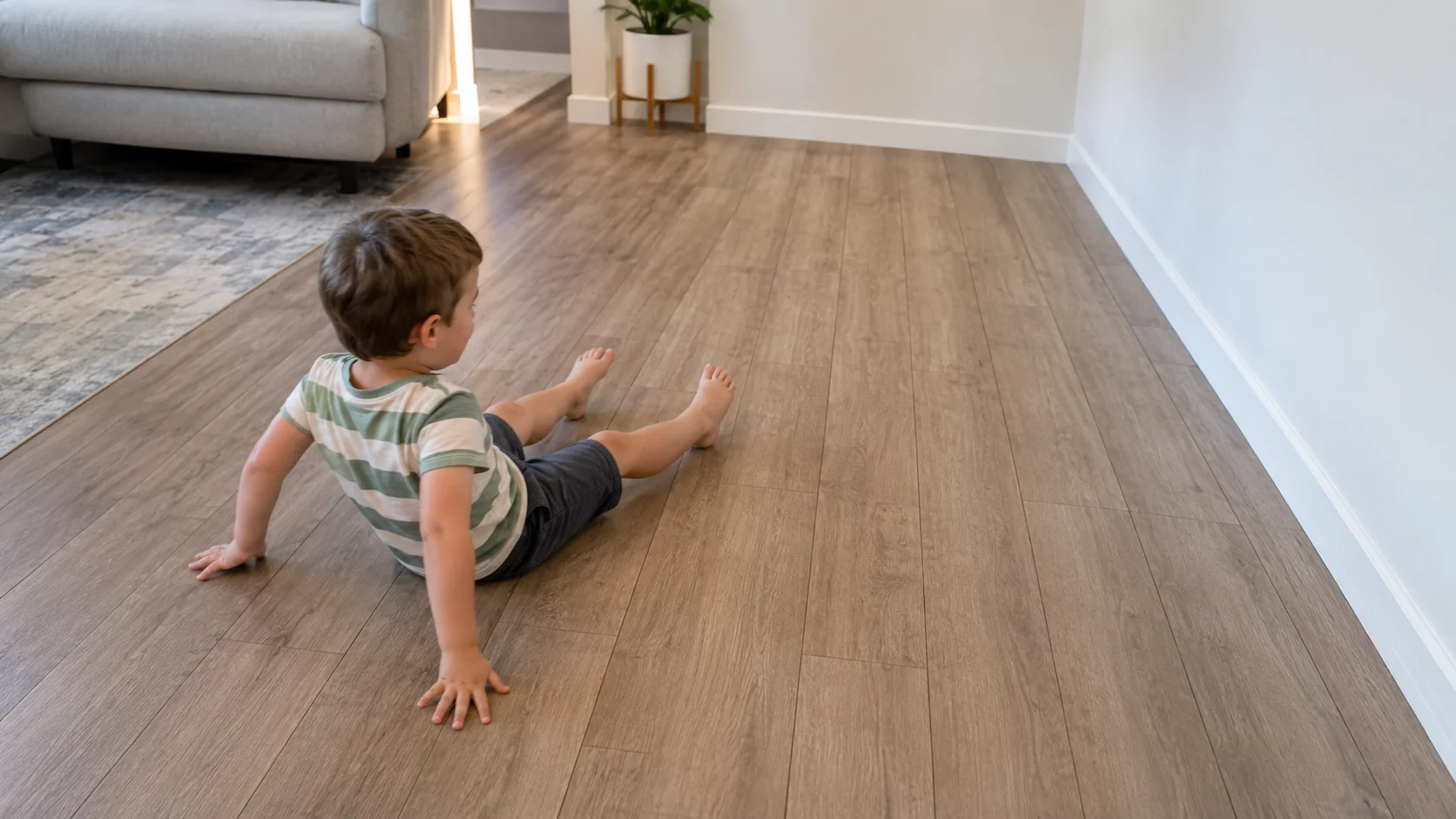
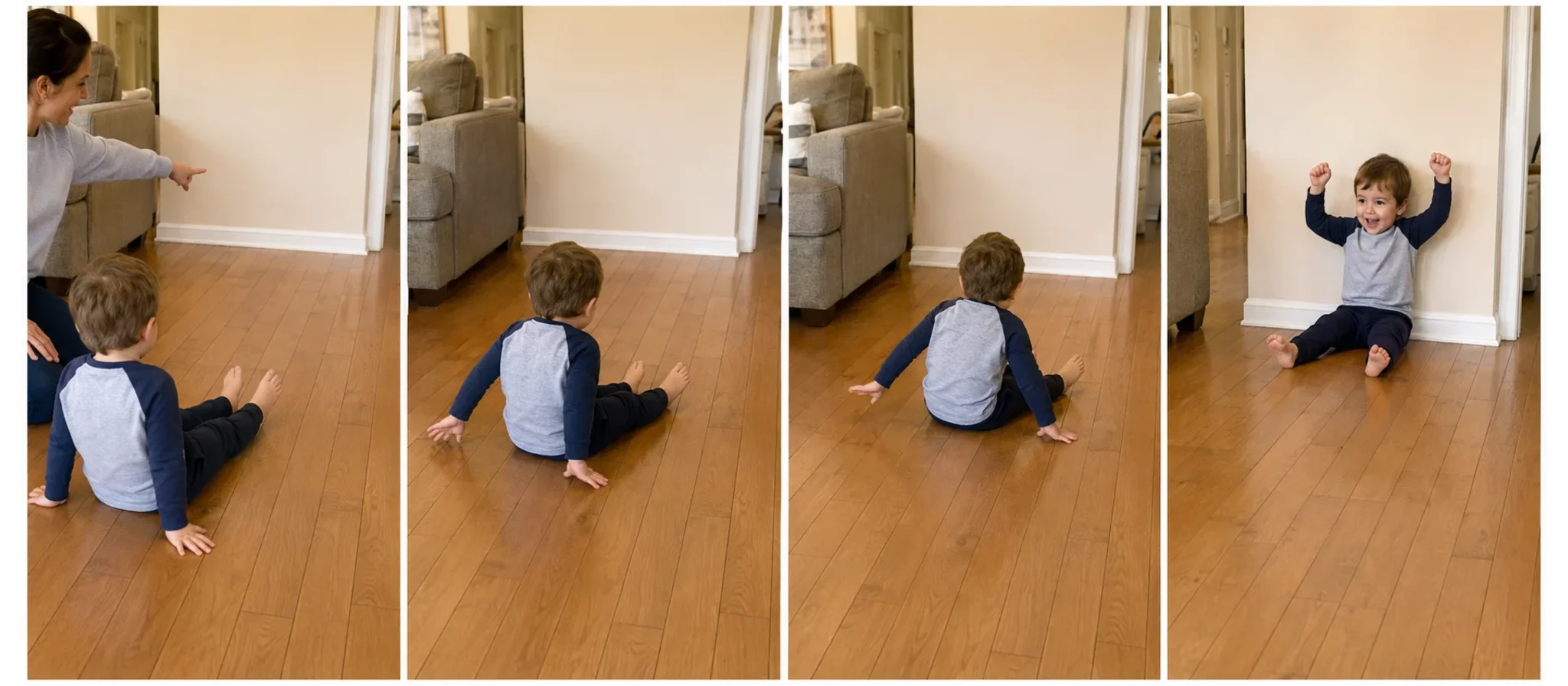
A young child sitting on the floor and scooting side to side toward a wall while a grown-up watches from nearby.
Gross motorSensory-friendly supportPush Against ResistanceIndoor

Seat Walk Race.

Turn a short patch of floor into a no-equipment scooting challenge. Your child sits with legs forward, shifts side to side to push across the lane, and reaches a clear finish while practicing whole-body coordination and controlled force.

Play time
1-5+ min
Age
1-5 years
Energy
Medium To High
Mess
No
Effort
Low
Where
Indoor
Start here

The recipe.

Low parent effort
2 things

What you need

  • 1 short clear stretch of indoor floor
  • Optional timer for the race variation
1 min minimum

Setup

Then start the loop
Step 01
Choose a short, non-slip floor lane with a clear start and finish.
"Scoot to the wall."
The loop

How play unfolds.

Four panels showing a clear floor lane, a child seated at the start, the child scooting toward the finish, and the child resetting for another short race.
  1. 01
    Have your child sit at the start with their legs and arms straight in front.
  2. 02
    Have them lean to one side, lift that side of their bottom, push forward, then repeat on the other side.
  3. 03
    Continue alternating side-to-side scoots until they reach the finish.
  4. 04
    Return to the start and repeat. Let your child move backward if forward scooting is too difficult.

Safety Check

  • Use a clear, non-slippery floor.
  • Stop if your child shows discomfort in the hips, lower back, or wrists.
  • Shorten the route or switch to backward scooting if forward scooting is too hard to control.
Skill spotlight
Resistance Movement

Using side-to-side body pushes to move across space with control

This helps with noticing where the body is, using force to move the body on purpose, and keeping a repeated movement pattern going toward a clear goal.

  • The side-to-side scoot gives your child clear heavy work through the whole body without needing extra equipment.
  • The visible finish makes the movement easier to understand and easier to stop.
  • The same short route can be repeated, shortened, or flipped backward without changing the game.
Real-world transfer
  • Using whole-body effort in floor play and movement games.
  • Noticing body position during crawling, climbing, and other heavy-work play.
Supporting the play

What to say in the moment

Match what you say to what you see.

Prompt ladder
Level 1 (Start)
"Seat walk to the wall."
Level 2 (Keep going)
"Side, side, keep scooting."
Level 3 (Stretch)
"Can you reach the finish in one more scoot?"
Level 4 (Extend)
"Now scoot back the other way."
If your child seems...
What you'd see
Focused
What to do
Say
"You are scooting all the way there."
Add
Name one action already happening, such as push or scoot.
Extend
Let your child choose forward or backward for the next trip.

Make it easier

Younger end
  • -Use a very short route for the first round.
  • -Let backward scooting be the main version if it feels smoother.
  • -Stop after one finish instead of repeating right away.

Make it harder

Older end
  • +Time one round after your child already understands the movement.
  • +Ask your child to pause at the finish before resetting.
  • +Add one extra trip only if the first one stayed controlled.

If it's not working

If you see
If child ignores it
Do one quick scoot yourself and invite one short race back.
If you see
If child misuses it
Reset to the seated start position and begin again with one visible finish.
If you see
If child gets frustrated
Make the route shorter or switch to backward scooting.

Parent questions