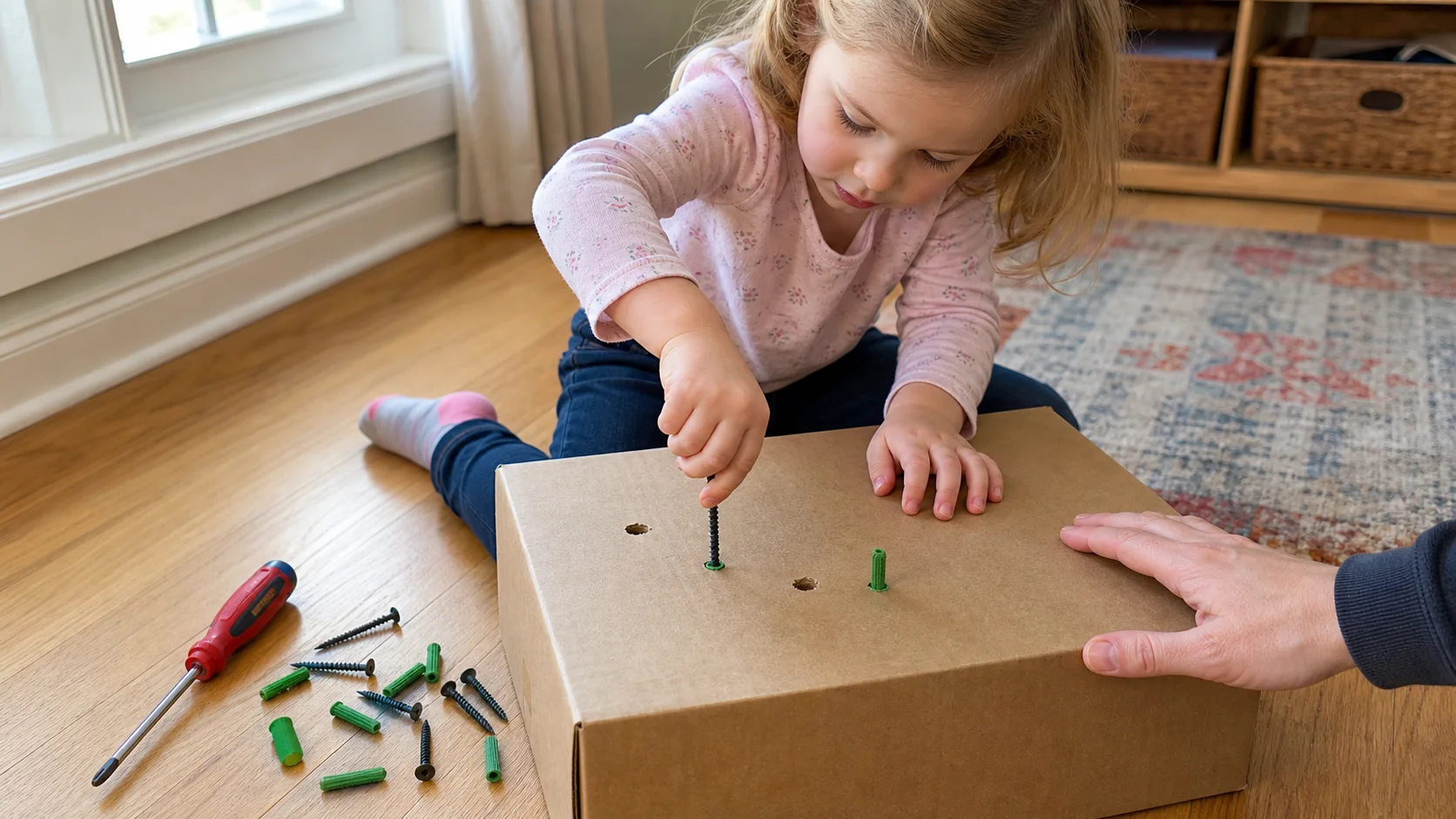
A child twists a screw into a cardboard box while a grown-up steadies the box and keeps extra anchors nearby.
Fine motorPush Through ResistanceIndoor

Screws and Anchors Box.

Turn a cardboard box into a supervised twist-and-fit station with screws, anchors, and simple repeated tool play.

Play time
10-15+ min
Age
2-4 years
Energy
Low To Medium
Mess
Low
Effort
Medium
Where
Indoor
Start here

The recipe.

Medium parent effort
5 things

What you need

  • 1 cardboard box
  • About 5 to 10 screws
  • About 5 to 10 wall anchors
  • 1 screwdriver
  • 1 adult for close supervision
10 min minimum

Setup

Then start the loop
Step 01
On the floor or a low table, turn the cardboard box upside down so one flat panel faces up and does not wobble when pressed.
Step 02
Keep a small pile of screws and wall anchors on your side of the box so you can hand over one or two at a time.
Step 03
In the box top, pre-punch a few holes, or make 1 starter hole and keep the screwdriver in your hand if you plan to add holes during play.
Step 04
Next to the first hole, place 1 screw so your child sees an easy first target.
Step 05
Beside your child, sit close enough to steady the box and take the screwdriver back immediately if needed.
"Twist, twist."
The loop

How play unfolds.

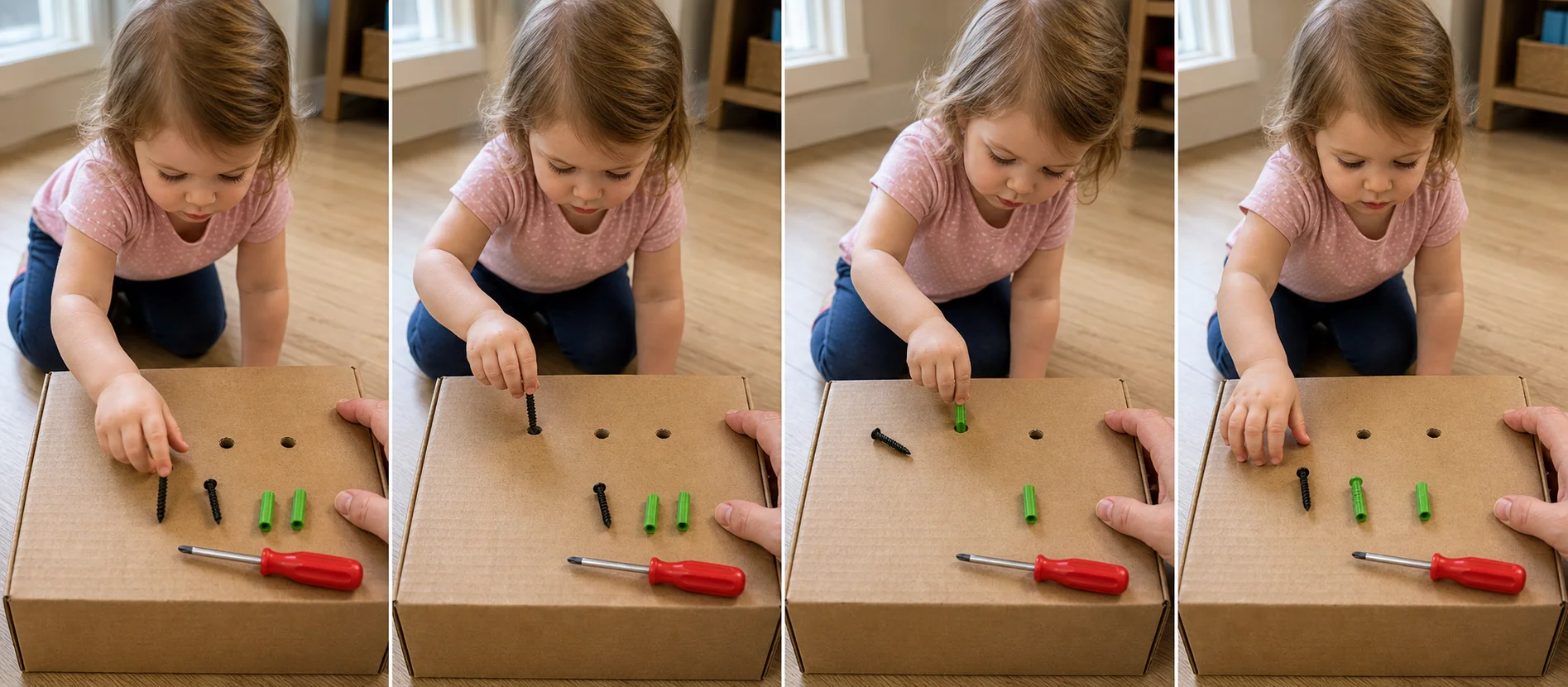
A step-by-step play sequence showing pre-punched holes in a cardboard box, a child testing a screw and anchor, a pull-out reset, and another fit try.
  1. 01
    Place 1 screw tip in the starter hole and say, "Can you twist this into the box?"
  2. 02
    Let your child push, twist, or wiggle the screw or anchor while you steady the box.
  3. 03
    If the piece catches, gets stuck, or does not fit, help your child pull it back out and offer the next choice: "Same hole or new hole?" or "Screw or anchor?"
  4. 04
    Make a new hole yourself when needed, then repeat the twist-and-fit loop until your child is done or the tool needs to be put away.

Safety Check

  • Stay close because real screws, wall anchors, and a screwdriver need direct adult supervision.
  • Use pre-punched holes if you are unsure your child can handle the screwdriver safely.
  • Avoid cardboard that is too thick, too slippery, or too thin; thick cardboard can make the screwdriver slip, and thin cardboard can let it punch through suddenly.
  • Skip this activity for children who still mouth small objects.
  • Take the screwdriver back if it slips, points away from the box, or turns into unsafe play.
Supporting the play

What to say in the moment

Match what you say to what you see.

Prompt ladder
Level 1 (Start)
Put one screw tip in the starter hole and say, "Twist it in."
Level 2 (Keep going)
Point to another hole and say, "Try this one next."
Level 3 (Stretch)
Offer one screw and one anchor and say, "Which one fits here?"
Level 4 (Extend)
Invite a repair turn by saying, "Pull it out and fix the hole."
If your child seems...
What you'd see
Focused
What to do
Say
"You are testing the fit."
Add
Offer one different-size piece to compare.
Extend
Ask for one slow twist before the pull-out.

Make it easier

Younger end
  • -Use only anchors for a few turns if twisting screws is too hard.
  • -Keep one hand on the box so your child only has to manage the piece.
  • -Pause after each pull-out and slide the same piece back for a repeat turn.

Make it harder

Older end
  • +Ask your child to find a hole where the piece fits with less help.
  • +Try one screw-anchor pair after your child has a steady single-piece turn.
  • +Invite your child to remove the piece without tipping the box.

If it's not working

If you see
If child ignores it
Start with the easiest win by putting the screw halfway into the starter hole and saying, "Finish this twist."
If you see
If child misuses it
Put the screwdriver in your hand and keep the play going with pre-punched holes and hand-twist turns.
If you see
If child gets frustrated
Offer two choices only: "This screw or this anchor?" If both are hard to fit, widen one hole slightly and restart with a piece that slides in with effort but not force.
Skill spotlight
Push Through Resistance

Twisting into resistance, Fit testing with small tools

This helps the child use finger pressure, tool control, and fit checking for small everyday jobs like turning, fastening, opening, and helping with safe household tasks.

  • The twist-and-fit loop gives your child a clear reason to push into resistance, adjust finger pressure, and try again.
  • Screws and anchors give fast feedback because each piece either catches, slips, or needs a different hole.
  • Pulling pieces back out keeps mistakes inside the game, so a miss becomes another supervised turn instead of a dead end.
Real-world transfer
  • Turning lids, knobs, and small twist toys.
  • Managing simple fasteners with adult help.
  • Placing small objects carefully instead of forcing them.
  • Helping with safe tool-like household jobs later.