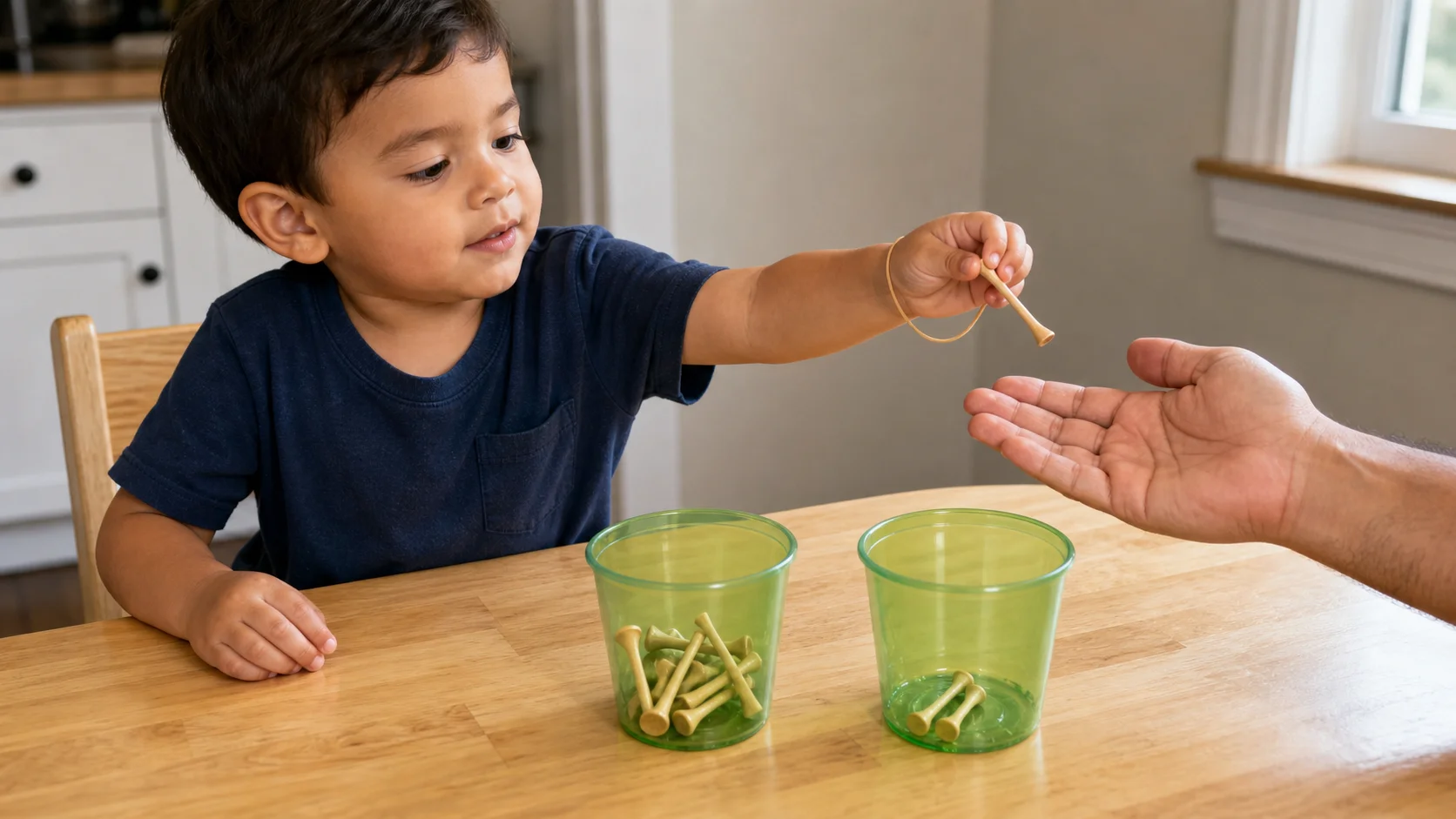
A child sits at a low table, opens a rubber-band-resisted hand, lifts one golf tee from a cup, and passes it to a grown-up.
Fine motorSqueeze And ReleaseIndoor

Rubber Band Tee Pass.

Two cups, a loose rubber band, and a few tees turn one careful pass into a simple hand-opening game.

Play time
5-10+ min
Age
2-5 years
Energy
Low
Mess
Low
Effort
Low
Where
Indoor
Start here

The recipe.

Low parent effort
4 things

What you need

  • 1 loose rubber band
  • 2 cups
  • 1 cupful of golf tees or similar small objects
  • 1 helper or partner to receive the tees
5 min minimum

Setup

Then start the loop
Step 01
On a low table or clear floor spot, place 2 cups side by side within easy reach.
Step 02
In 1 cup, place the golf tees or similar small objects. Leave the second cup empty.
Step 03
Beside the empty cup, seat or stand the helper so your child can pass 1 tee without reaching far.
Step 04
Slide the rubber band onto your child's working fingers only if it sits loosely enough to open and close the hand without pinching.
Step 05
Show 1 slow open-grab-pass turn before handing over the game.
"Pass one tee."
The loop

How play unfolds.

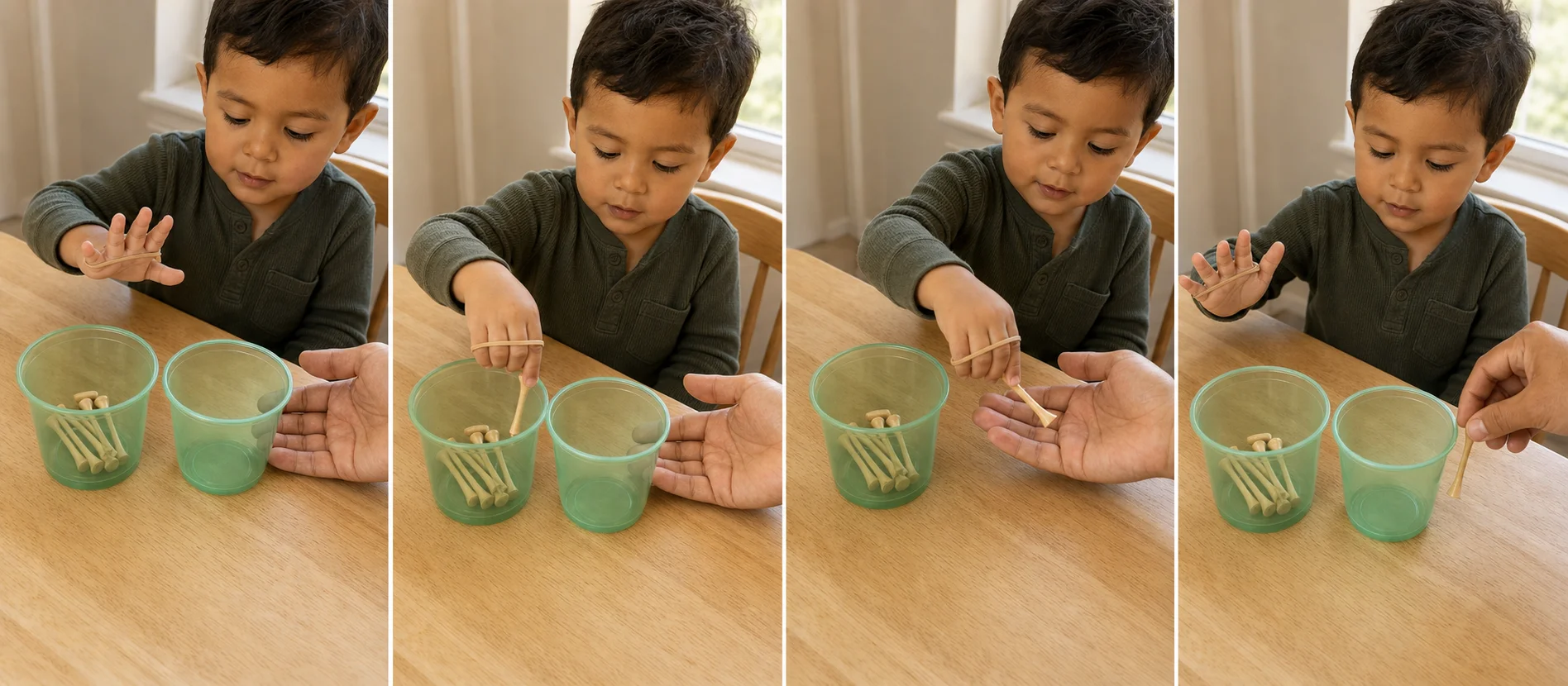
Four panels show a grown-up setting out two cups, sliding a loose rubber band onto the child's fingers, the child passing one tee to a helper, and the empty cup filling up across the round.
  1. 01
    Say, "Open your band hand, grab one tee, and pass it to me."
  2. 02
    Let your child open the banded hand, pick up 1 tee from the full cup, and pass it to the helper's ready hand.
  3. 03
    The helper drops the tee into the empty cup and says, "Ready for the next one."
  4. 04
    Repeat until the first cup is empty or your child's hand needs a break.

Safety Check

  • Supervise the whole round. Golf tees are small parts, and the rubber band can snap or flick.
  • Keep small pieces out of mouths.
  • Keep the banded hand low and away from faces and eyes.
  • Stop or remove the band if it pinches, slips, snaps, or gets pulled upward.
Supporting the play

What to say in the moment

Match what you say to what you see.

Prompt ladder
Level 1 (Start)
Call it the tee passing game and ask for 1 tee.
Level 2 (Keep going)
Wait with an open hand and say when you are ready.
Level 3 (Stretch)
Ask for the next pass to be slow and careful.
Level 4 (Extend)
Let your child choose whether the next pass is quiet or silly.
If your child seems...
What you'd see
Focused
What to do
Say
"You opened, grabbed, and passed."
Add
Count 1 tee after it lands in the cup.
Extend
Ask for 1 extra-slow pass.

Make it easier

Younger end
  • -Put only 1 tee at the top of the full cup so the target is obvious.
  • -Let the helper say "ready" before each pickup so your child does not rush.
  • -Use a shorter round with 1 clear finish line, such as 5 passes.

Make it harder

Older end
  • +Ask your child to pause until the helper's hand is open.
  • +Try a gentle fingertip pass instead of dropping the tee into the helper's palm.
  • +Let your child switch between normal speed and slow-motion passes.

If it's not working

If you see
If child ignores it
Call it a passing game and start with just 3 tees so the finish is easy to see.
If you see
If child misuses it
Remove the band, reset calmly, and model 1 safe open-grab-pass turn before trying again.
If you see
If child gets frustrated
Use fewer tees, move the helper's hand closer, or let your child do 1 unbanded pass before trying the resistance again.
Skill spotlight
Squeeze And Release

Finger strength for careful grabbing

The same finger strength and control help with small daily jobs, including holding craft pieces, managing clothing pulls, using crayons, and handling utensils with more care.

  • Opening the fingers against light band resistance gives your child a clear reason to practice hand opening, not just squeezing.
  • Passing one tee into a helper's ready hand turns the grab into a small shared job, which helps slow the pace and gives waiting a purpose.
  • Watching one cup empty and the other fill gives the round a visible finish, so repeats feel manageable.
Real-world transfer
  • Holding small snack pieces or craft pieces without dropping them.
  • Pulling fabric, tabs, or simple clothing parts with better finger control.
  • Using crayons, utensils, and small toys with more care.
  • Waiting for another person's ready hand before passing something.

Parent questions