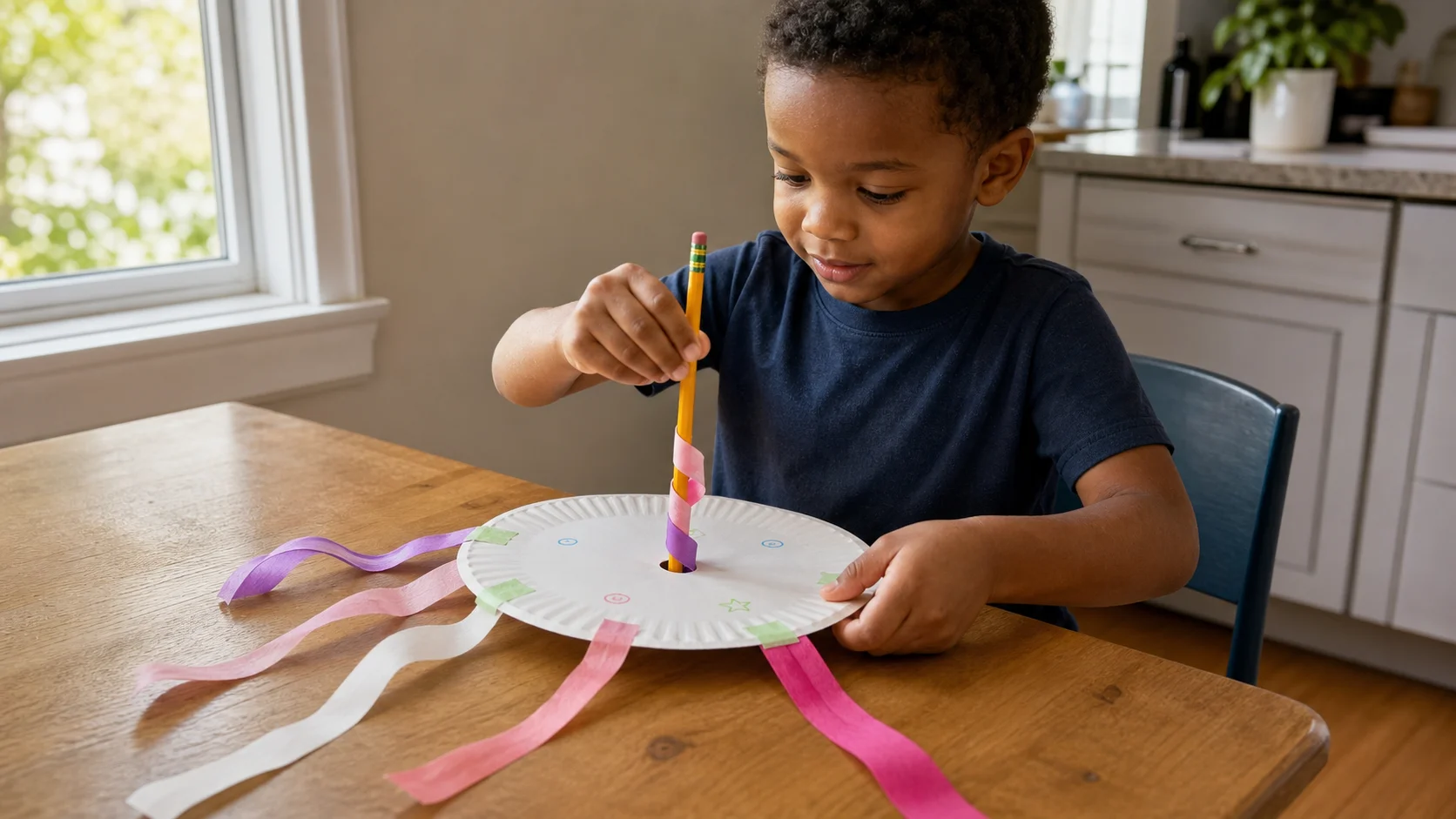
A child holds a pencil-handled paper plate spinner while long ribbons wrap and loosen as a grown-up stays nearby.
Fine motorOT-adjacent supportTwo Hand CoordinationIndoor Open Space

Ribbon Twirl Spinner.

Ribbons and a paper plate spinner turn wrapping and unwinding into colorful coordination practice.

Play time
5-10+ min
Age
3-5 years
Energy
Low
Mess
Low
Effort
Medium
Where
Indoor Open Space
Start here

The recipe.

Medium parent effort
7 things

What you need

  • 1 paper plate
  • 1 pencil
  • 4 to 5 long ribbon strips
  • Masking tape
  • 1 pair of scissors
  • 1 adult for setup and direct supervision
  • 1 child
5 min minimum

Setup

Then start the loop
Step 01
Poke the pencil through the center of the paper plate.
Step 02
Near the eraser end, tape the plate to the pencil shaft so it stays in place during a slow turn.
Step 03
Cut a few long ribbon strips.
Step 04
Tape 1 end of each ribbon around the plate edge so the loose ends hang free and do not start wrapped around the pencil.
Step 05
Clear enough open space for the ribbons to move without hitting walls, furniture, people, or faces, then test 1 slow wrap-and-reverse turn.
Step 06
Hand your child the pencil handle and stay close enough to untangle ribbons, retape the plate, or slow the spinner if it starts swinging.
"Slow spin."
The loop

How play unfolds.

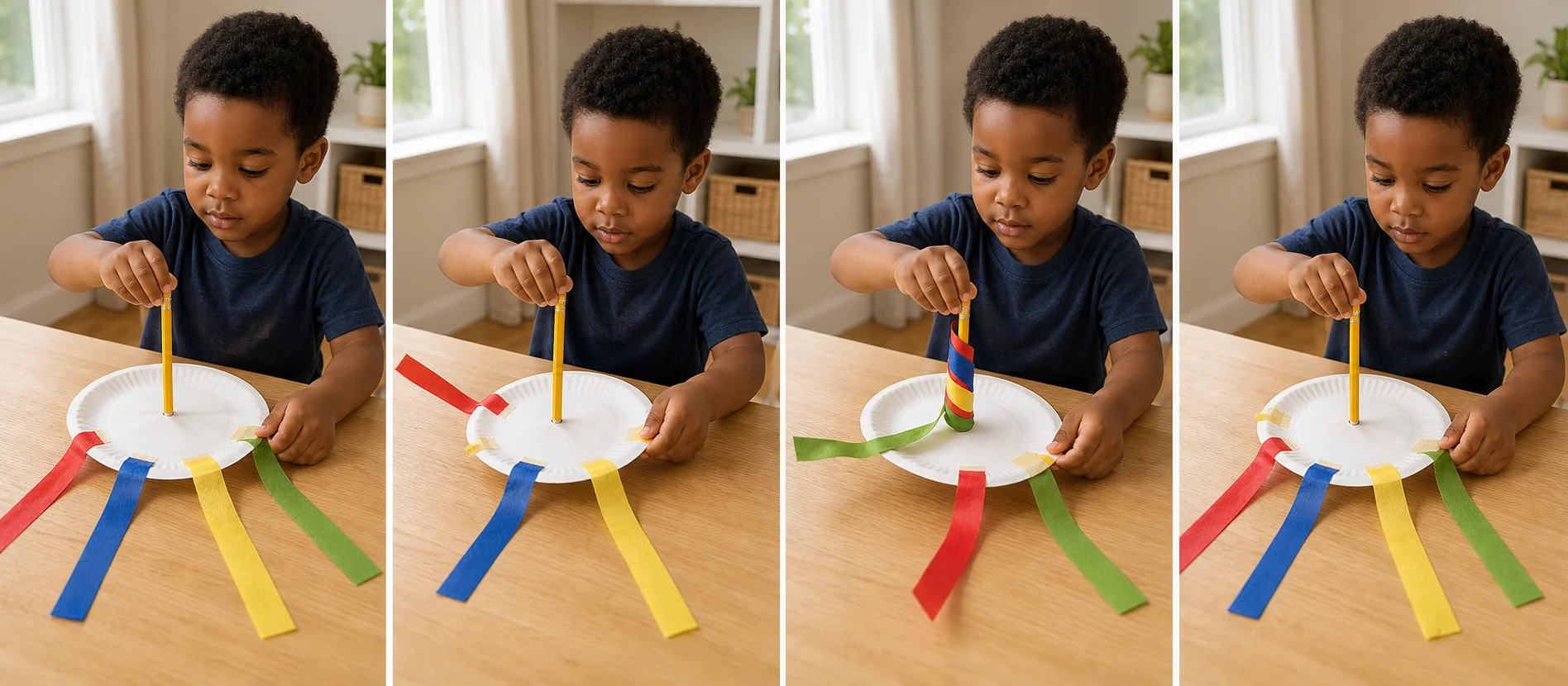
A step-by-step play sequence showing ribbons taped around a paper plate, the pencil handle, one wrap turn, one reverse turn, and a quick reset.
  1. 01
    Show 1 slow wrap and say, "Hold the pencil still with one hand. Spin the plate with the other."
  2. 02
    Let your child hold the pencil handle and turn the plate until the ribbons wrap around the pencil.
  3. 03
    Say, "Now reverse," and let your child turn the other way until the ribbons loosen again.
  4. 04
    Count the round done when the ribbons wrap and loosen, then straighten any crossed ribbons and repeat.

Safety Check

  • Supervise all pencil and scissor use.
  • Check that the plate is taped securely before each round.
  • Keep enough open space so the ribbons cannot hit people, furniture, or faces.
  • Stop if your child swings the spinner near faces, pulls the ribbons instead of turning the plate, mouths ribbon or tape, or the plate keeps wobbling after retaping.
Supporting the play

What to say in the moment

Match what you say to what you see.

Prompt ladder
Level 1 (Start)
Spin slowly until one ribbon starts to wrap.
Level 2 (Keep going)
Turn the plate the other way and watch the ribbon loosen.
Level 3 (Stretch)
Try one smooth wrap and one smooth unwind.
Level 4 (Extend)
Choose a ribbon and keep watching it for the whole turn.
If your child seems...
What you'd see
Focused
What to do
Say
"Keep the pencil hand steady."
Add
Name the direction after the spin starts.
Extend
Invite one more wrap-and-unwind with the same steady grip.

Make it easier

Younger end
  • -Start with the ribbon ends already separated so the first turn does not snag.
  • -Hold the pencil handle while your child turns only the plate.
  • -Ask for a half-turn wrap before trying a full wrap-and-unwind cycle.

Make it harder

Older end
  • +Ask your child to stop when one chosen ribbon reaches the pencil.
  • +Try reversing before the ribbons get fully tight.
  • +Use quieter, smaller wrist turns instead of big arm movements.

If it's not working

If you see
If child ignores it
Do 1 big slow wrap-and-unwind turn yourself so the moving ribbons become the invitation, then hand over the handle.
If you see
If child misuses it
If your child pulls the ribbons, swings the spinner, or drops the pencil hand, pause and reset with, "Hands on the pencil and plate."
If you see
If child gets frustrated
Shrink the goal to 1 small wrap and 1 reverse, then untangle the ribbons, help hold the pencil, or add fresh tape before trying again.
Skill spotlight
Two-Hand Coordination

Two-hand spinner control

This helps the child use two hands for different jobs, like holding one thing still while turning, opening, or pulling with the other.

  • The wrap-and-reverse loop gives your child a clear reason to keep 1 hand steady while the other hand works.
  • The ribbons make direction changes easy to see, so your child gets fast visual feedback without a lot of extra directions.
  • A tangle or loose turn resets quickly, so small mistakes stay inside the game instead of ending it.
Real-world transfer
  • Turning door handles with a steady opposite hand nearby
  • Opening simple containers with one hand holding and one hand twisting
  • Pulling a zipper while the other hand holds the fabric steady
  • Watching a moving object long enough to adjust the next movement