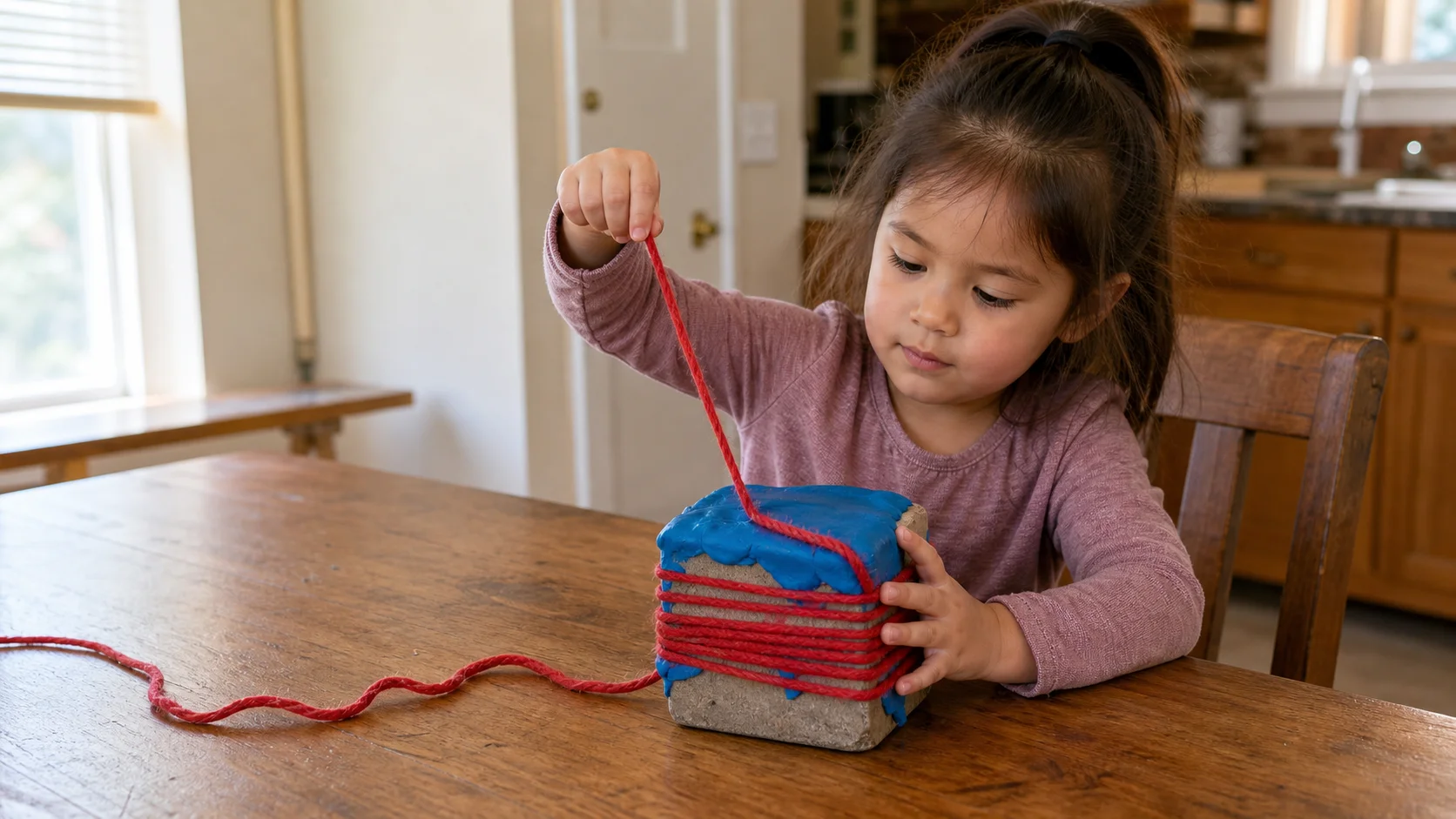
A child sits at a table, holds a playdough-covered block with one hand, and pulls a yarn tail with the other while a grown-up stays close.
Fine motorOT-adjacent supportTwo Hand CoordinationIndoor Table

Resistant Yarn Unravel.

Damp yarn pressed into playdough creates a slow pull-and-unravel challenge for hand strength.

Play time
5-10+ min
Age
3-5 years
Energy
Low
Mess
Low
Effort
Medium
Where
Indoor Table
Start here

The recipe.

Medium parent effort
7 things

What you need

  • 1 heavy block
  • 1 large lump of firm playdough
  • 1 long piece of yarn
  • A small amount of water to dampen the yarn
  • 1 stable table
  • 1 adult for setup and direct supervision
  • 1 child
5 min minimum

Setup

Then start the loop
Step 01
On a stable table, place the heavy block in the center.
Step 02
On top of the block, press the firm playdough down until it feels like one solid base.
Step 03
At the table, dampen the long yarn slightly with water so it has more friction.
Step 04
Around the playdough-covered block, wrap the damp yarn tightly and leave one short tail sticking out.
Step 05
At the table, give the yarn one adult test tug so the block stays put and the wrap still feels resistant.
Step 06
At your child's seat, check that your child can keep one helper hand on the block and one pulling hand on the yarn tail without standing or leaning across the table.
Step 07
Beside your child, stay close enough to pause the play quickly if the yarn or playdough goes near their mouth.
"Pinch and pull."
The loop

How play unfolds.

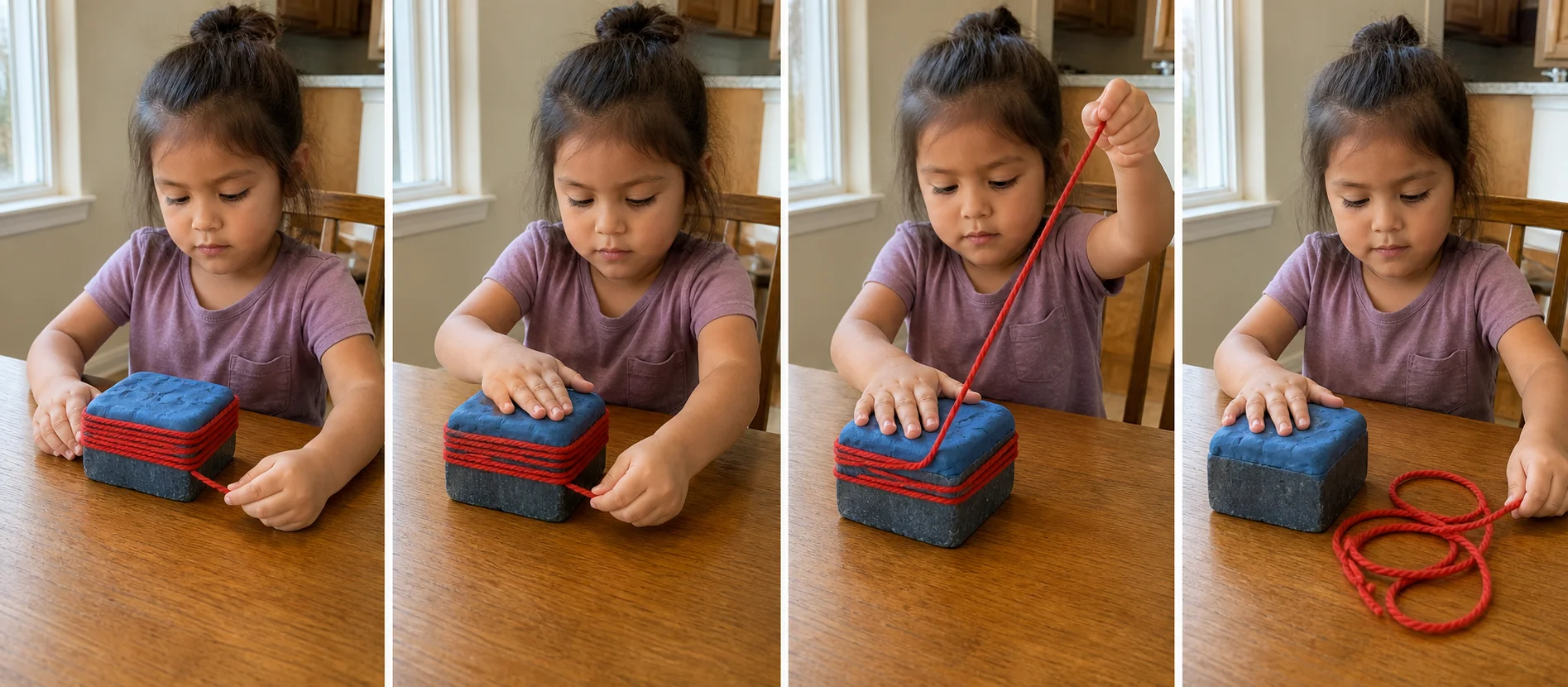
Four panels show a grown-up wrapping damp yarn around a playdough-covered block, a child holding the block, the yarn peeling away during the pull, and the block rewrapped for another turn.
  1. 01
    Point to the helper-hand spot on the block and the yarn tail, then say, "Hold the block still with one hand and pull the yarn tail with the other."
  2. 02
    Let your child keep one hand on the block and pull the tail steadily until the yarn unwraps.
  3. 03
    Count the full unravel as one finished turn.
  4. 04
    Wrap the same yarn tightly around the block again, leave the tail showing, and repeat if your child wants another turn.

Safety Check

  • Stay beside your child for constant direct supervision. Yarn and playdough are choking hazards for children who still mouth objects.
  • Keep your child seated and stable while pulling.
  • Start only after the block stays steady during your test tug.
  • Pause and put the materials out of reach if your child puts the yarn or playdough near their mouth.
Supporting the play

What to say in the moment

Match what you say to what you see.

Prompt ladder
Level 1 (Start)
Pinch the yarn tail and give it one strong pull.
Level 2 (Keep going)
Keep your helper hand still while the pulling hand works.
Level 3 (Stretch)
Pull slowly and watch the yarn unwrap around the block.
Level 4 (Extend)
Wrap it again and try a longer steady pull.
If your child seems...
What you'd see
Focused
What to do
Say
"You are holding with one hand and pulling with the other."
Add
Ask, "Is the yarn tight or loose?"
Extend
Let your child choose where the short tail starts before the next pull.

Make it easier

Younger end
  • -Leave a longer yarn tail so the first pinch is easier to grab.
  • -Rewrap fewer turns while keeping the yarn snug enough to resist.
  • -Hold the block steady for the first pull, then fade your help.

Make it harder

Older end
  • +Ask for one slow pull instead of quick jerks.
  • +Start the tail on the opposite side so your child reaches across the block.
  • +Invite your child to rewrap one short section before pulling again.

If it's not working

If you see
If child ignores it
Pull the yarn partway yourself so your child can watch it peel off, then hand over the tail for the last part of the turn.
If you see
If child misuses it
If your child swings the yarn, digs at the playdough, or loses the helper hand, reset the block in the middle of the table and say, "One hand holds, one hand pulls."
If you see
If child gets frustrated
Leave a longer tail and loosen only the first wrap so the pull can start more easily while the rest of the yarn still gives resistance.
Skill spotlight
Two-Hand Coordination

Two-hand pulling with control

This helps a child use one hand to hold while the other hand works, a pattern used for dressing, opening packages, managing containers, and later tool use.

  • Holding the block with one hand while the other hand pulls gives your child repeated practice with one hand stabilizing while the other one works.
  • The snug yarn offers clear resistance, so your child can feel how much steady pull it takes to move something stuck.
  • The visible unwind gives the pull a real finish, which helps the job feel complete and easier to repeat.
Real-world transfer
  • Pulling socks or sleeves into place
  • Opening a stuck wrapper or bag
  • Holding paper steady while drawing or cutting
  • Using two hands for simple household jobs