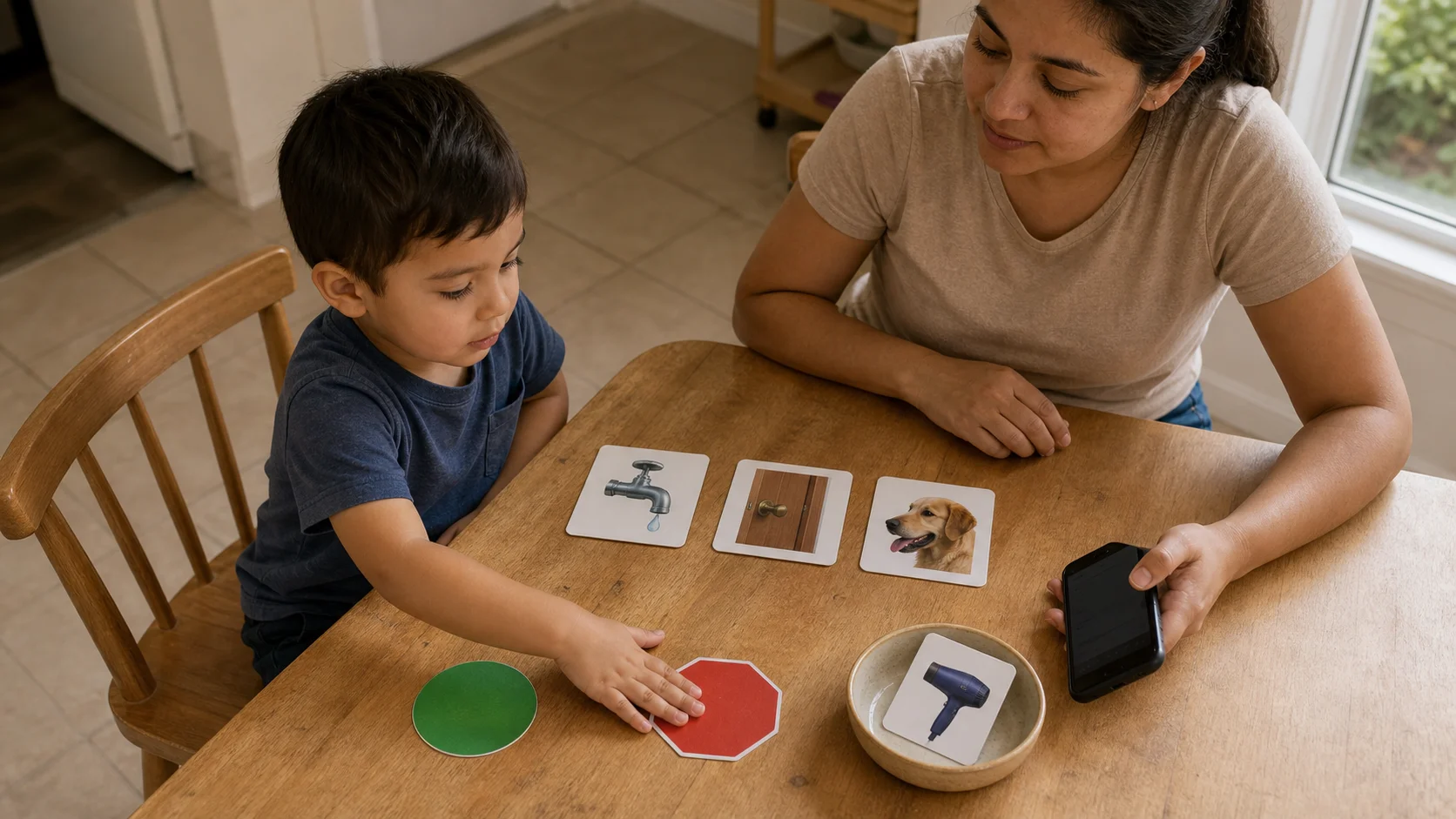
Toddler pointing to a sound picture card beside GO and STOP cards while a grown-up holds a phone ready to play a quiet clip.
Skill builderSensory-friendly supportRepeat LoopIndoor

Quiet Sound Switch.

One quiet sound plus start-and-stop control turns listening practice into a calm toddler game.

Play time
5+ min
Age
2-4 years
Energy
Low
Mess
Low
Effort
Medium
Where
Indoor
Start here

The recipe.

Medium parent effort
6 things

What you need

  • 1 phone or recorder loaded with 1 to 3 short everyday sound clips
  • 3 picture cards that match the recorded sounds
  • 1 GO card
  • 1 STOP card
  • 1 small done bowl or tray
  • 1 table or clear floor spot
5 min minimum

Setup

Then start the loop
Step 01
On an indoor table or clear floor spot, spread the 3 sound picture cards in a short row where your child can point to each choice easily.
Step 02
Below the picture row on the same surface, place the GO card and STOP card where your child can tap them without reaching across the picture cards, then set the done bowl beside the row.
Step 03
On the adult side of the play spot, keep the phone or recorder at a very low volume, test that it starts and stops immediately, and sit beside your child so you can warn before each sound and stop it fast.
`Your sound choice.`
The loop

How play unfolds.

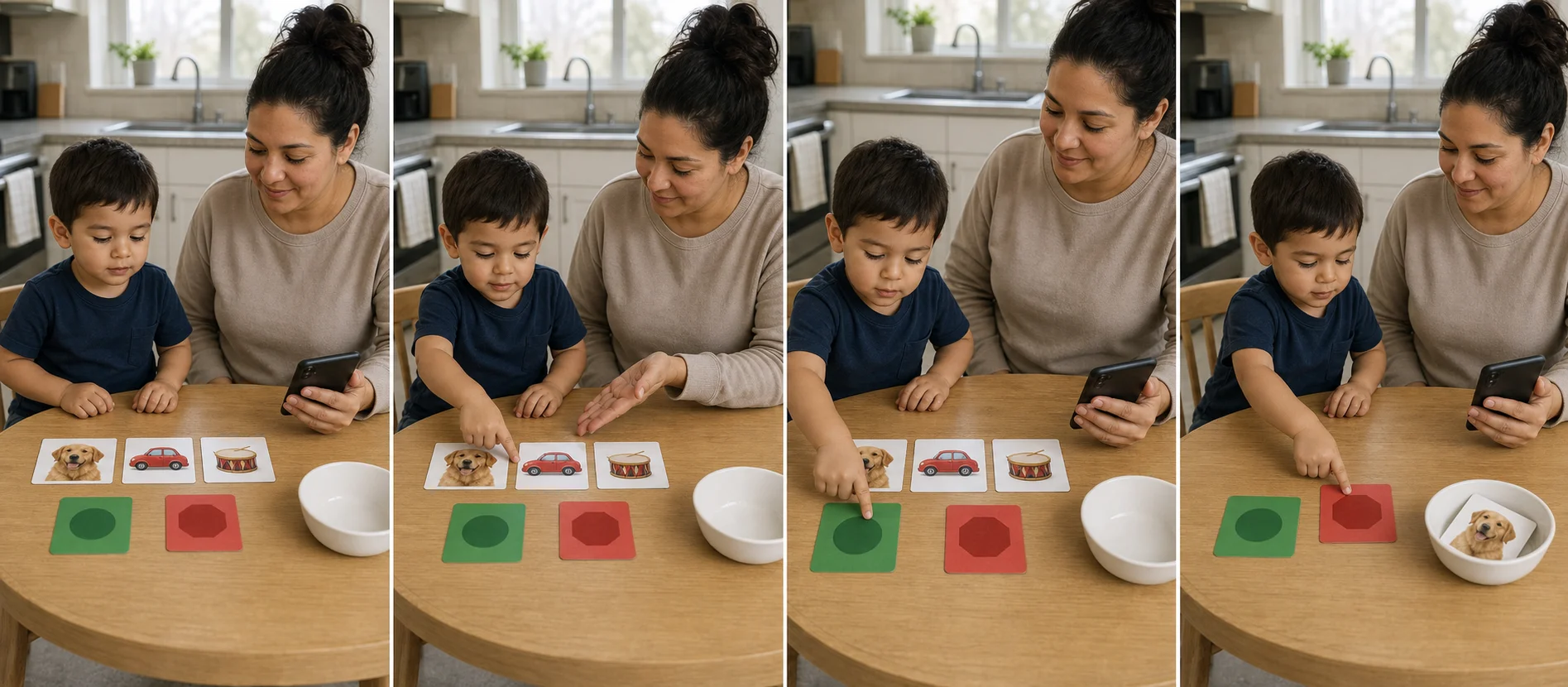
Sequence showing picture cards on a table, a child tapping GO, a grown-up playing a very low-volume sound clip, and the child tapping STOP before moving a card to a done bowl.
  1. 01
    Let your child choose one sound picture, or skip that choice and finish.
  2. 02
    Name the picture, give the warning, wait for GO, and play the matching clip at the same very low volume.
  3. 03
    Let your child tap STOP at any point or let the short clip finish.
  4. 04
    Move the picture to the done bowl if that sound is done, then choose another picture, replay one favorite sound, or finish with all done.

Safety Check

  • Start every clip at very low volume and keep the device on the adult side so the sound can stop immediately.
  • If your child covers ears, pulls away, or shows distress, stop the sound, move the cards aside, and end the session instead of pushing through.
  • Keep the volume fixed for this session. Do not use ear defenders as the normal setup or raise the sound mid-session.
Supporting the play

What to say in the moment

Match what you say to what you see.

Prompt ladder
Level 1 (Start)
`Pick one sound.`
Level 2 (Keep going)
`Tap GO when ready.`
Level 3 (Stretch)
`Tap STOP when you want it off.`
Level 4 (Extend)
`Choose one more or all done.`
If your child seems...
What you'd see
Focused
What to do
Say
`You picked it and stopped it.`
Add
`Ask one quick prompt like, "Which sound is that?"`
Extend
`Let your child run the next turn with only the warning and GO wait.`

Make it easier

Younger end
  • -Keep the chosen picture centered above the GO and STOP cards so your child tracks only 1 sound at a time.
  • -Let your child signal GO with a point or nod while you tap the GO card for that turn.
  • -Count the round as done after 1 warned start and 1 stop, even if the picture stays out of the bowl until cleanup.

Make it harder

Older end
  • +Pause after the warning and wait to see whether your child taps GO without your finger pointing to it.
  • +Let your child move the finished picture to the done bowl and find the next choice without help.
  • +Use all 3 picture choices in one session without replaying the same sound twice in a row.

If it's not working

If you see
If child ignores it
Cover 2 picture cards, offer 1 familiar sound, and invite your child to do just the STOP tap after 1 very short warned start.
If you see
If child misuses it
Keep the phone on your side, count an early STOP as the whole turn, and restart with only 1 picture visible if your child slaps cards or grabs for the device.
If you see
If child gets frustrated
Stop the sound immediately, move the cards aside, comfort your child, and end the session. On another day, return with 1 easier sound at the same or lower volume.
Skill spotlight
Repeat Loop

Repeating a short sound-control routine.

This helps your child get through 1 small everyday sound turn with less surprise, show ready or stop with a simple tap or point, and stay with a short start-stop-finish routine.

  • The warning and GO cue tell your child exactly when the sound starts instead of letting it arrive out of nowhere.
  • STOP gives your child a real exit, which makes the whole sound turn easier to try.
  • Picture cards keep the choice visible, so the routine can run with very little talking.
Real-world transfer
  • Getting through short everyday sound moments with more warning and control
  • Showing ready or stop during a noisy moment
  • Handling a small choose-start-stop routine during play or transitions

Parent questions