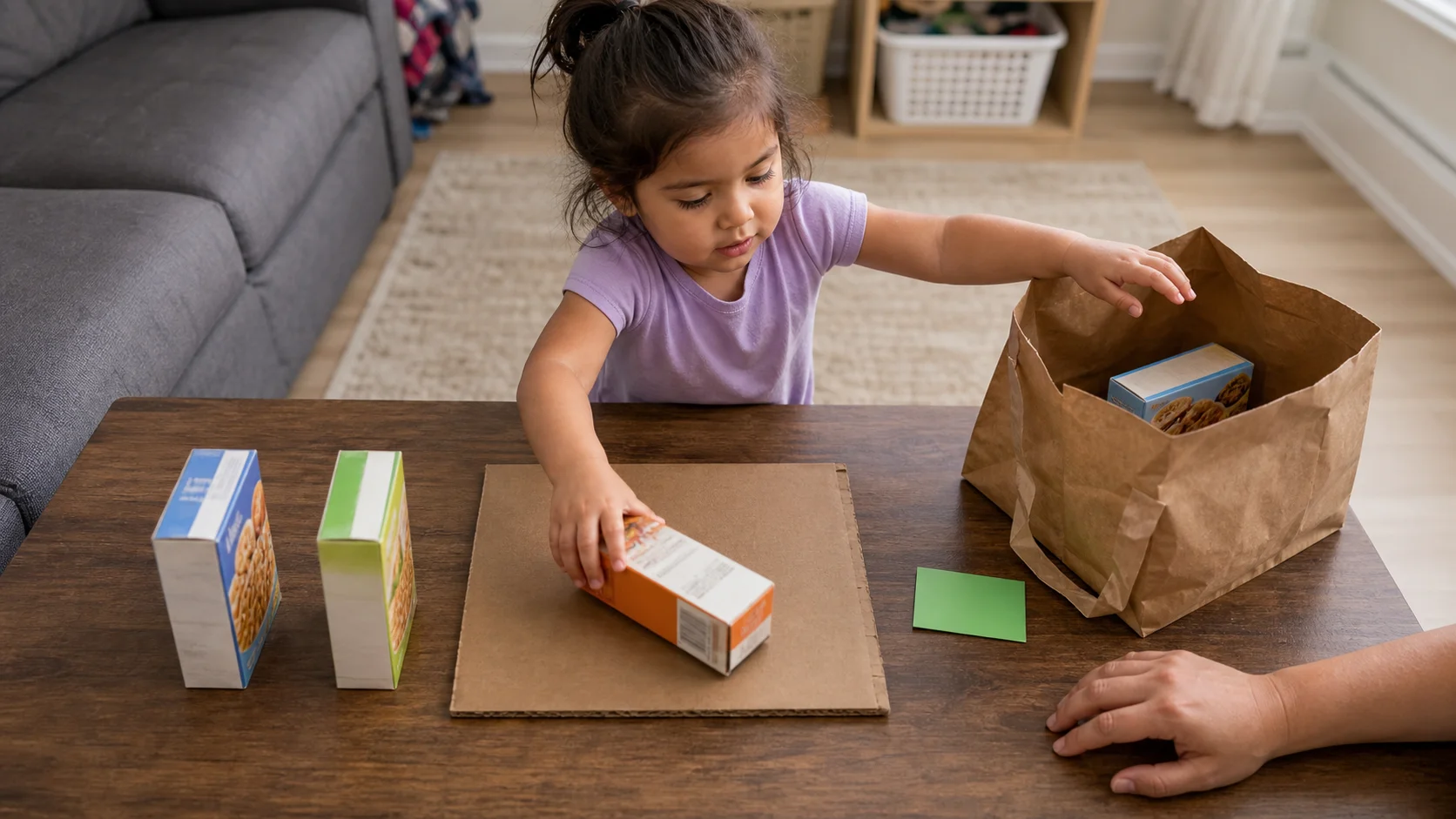
A toddler at a low table sliding a small grocery box across a pretend scanner while a grocery bag and done card sit beside it.
Skill builderAutism supportSensory-friendly supportRepeat LoopIndoor

Quiet Checkout Scan.

A pretend scanner, a bag, and a done card turn grocery play into one short repeatable checkout routine.

Play time
5-10+ min
Age
2-3 years
Energy
Low
Mess
Low
Effort
Low
Where
Indoor
Start here

The recipe.

Low parent effort
6 things

What you need

  • 2 to 3 empty food boxes or other light pretend grocery items
  • 1 paper scanner card or small cardboard scanner spot
  • 1 grocery bag
  • 1 small receipt card or done card
  • 1 child
  • 1 adult
5 min minimum

Setup

Then start the loop
Step 01
On the floor or at a low table, place the paper scanner card in front of your child and set the grocery bag open right beside it with the handles flattened away from your child.
Step 02
Beside the scanner, place 2 to 3 empty food boxes in a short line or small pile and put the done card beside the bag so all three steps stay visible.
Step 03
Beside your child, sit or stand close enough to model one turn, hand over the next box quickly, and stop while the routine still feels easy.
Scan it.
The loop

How play unfolds.

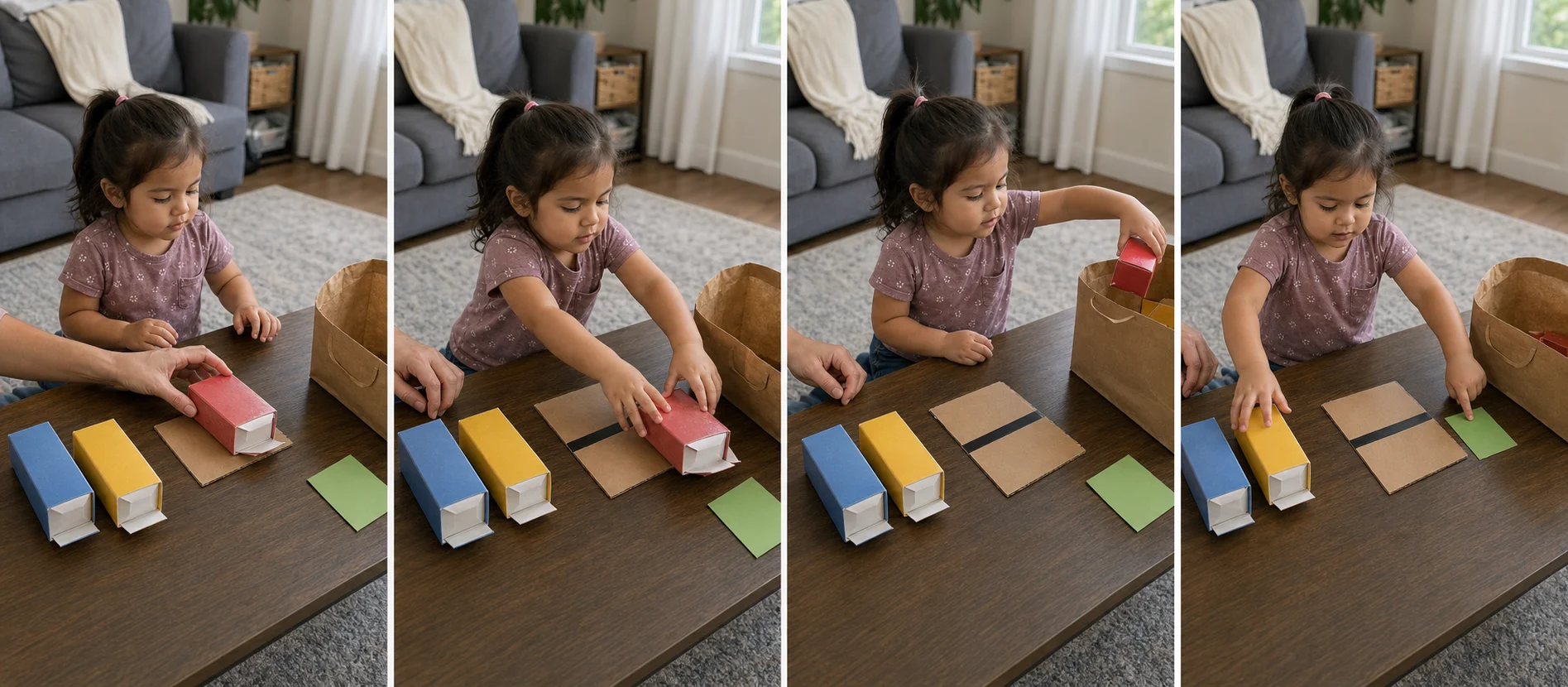
A multi-panel sequence showing a child scanning a box, dropping it into a grocery bag, tapping a done card, and reaching for the next item.
  1. 01
    Hand over one box or point to it and say, `Scan it.`
  2. 02
    Let your child slide the box across the scanner spot and drop it into the bag.
  3. 03
    Have your child tap, move, or flip the done card to finish that turn.
  4. 04
    Start the next box and repeat until the short set is packed, or stop after one smooth round if that is enough for today.

Safety Check

  • Stay with your child for the whole activity because cardboard edges, loose tabs, and grocery-bag handles can become mouthable, tearable, or snagging items during repeat turns.
  • Remove staples, torn tabs, or sharp cardboard edges before play if you use real empty packaging.
  • Keep the bag handles flat and away from your child's face, hands, and neck, and stop if the bag becomes the main focus instead of the checkout routine.
Supporting the play

What to say in the moment

Match what you say to what you see.

Prompt ladder
Level 1 (Start)
Scan this one.
Level 2 (Keep going)
Bag it.
Level 3 (Stretch)
Tap done.
Level 4 (Extend)
Find the next box.
If your child seems...
What you'd see
Focused
What to do
Say
Scan, bag, done.
Add
After the box lands, use one learning prompt such as `What comes next?` while pointing to the done card.
Extend
Let your child pick the next box from the short line and start the next turn right away.

Make it easier

Younger end
  • -Keep the next box in the same starting spot every turn so the routine feels identical.
  • -Turn the bag opening toward your child so the drop is short and easy to see.
  • -Point to the done card before each tap instead of waiting for your child to remember that step.

Make it harder

Older end
  • +After `scan it`, pause to see whether your child adds the bag step without the second cue.
  • +Let your child choose which of the two visible boxes goes next before the next turn starts.
  • +Have your child tap the done card and reach for the next box before you say anything.

If it's not working

If you see
If child ignores it
Do one full model turn yourself, place the first box in your child's hand, and restart with `scan it, bag it, done`.
If you see
If child misuses it
Pull the extra boxes back, offer only one box, and guide one slow scan-and-bag turn if your child throws, crushes, or fixates on the bag.
If you see
If child gets frustrated
Shorten the round to one final box, help with the bag step, and stop after that success instead of pushing through the whole set.
Skill spotlight
Checkout Sequence

Repeating a short checkout routine from start to finish, Staying with one small errand-style job

This helps a child stay with a short everyday routine, move from one clear step to the next, and finish a small helper job without the whole task falling apart halfway through.

  • The scanner spot, bag, and done card keep the same order visible every turn, so your child does not have to guess what comes next.
  • Dropping one box into the bag gives the routine a real finish step instead of stopping halfway through the job.
  • Repeating the same short checkout pattern can make grocery-style helping feel calmer and more familiar.
Real-world transfer
  • Following a short errand routine with a clear finish step
  • Putting items into a bag or container during everyday helping play
  • Staying with a small checkout-style job instead of rushing off after one move

Parent questions