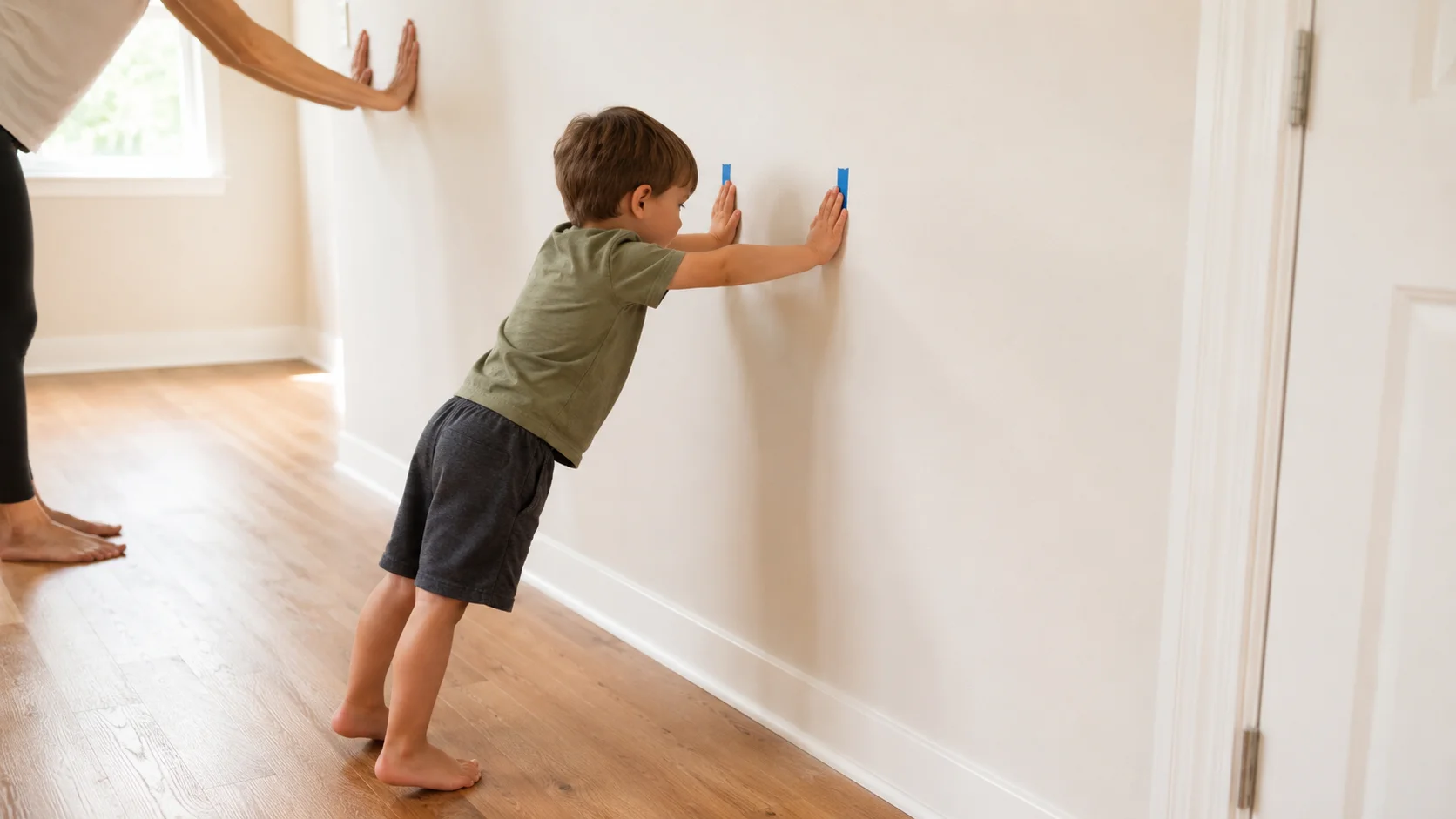
A child standing with both hands on a clear wall while a grown-up models a hands-only push nearby.
Gross motorOT-adjacent supportPush Against ResistanceIndoor

Push the Wall.

A no-mess wall-pushing activity where your child presses both hands into a sturdy wall, stops, shakes out, and repeats.

Play time
1-5+ min
Age
2-5 years
Energy
Medium
Mess
No
Effort
Low
Where
Indoor
Start here

The recipe.

Low parent effort
3 things

What you need

  • 1 clear, sturdy wall or closed door that does not move
  • Open floor space in front of the wall
  • Optional painter's tape for hand marks
1 min minimum

Setup

Then start the loop
Step 01
On a sturdy wall or closed door, choose a plain spot that does not move when you press it.
Step 02
On the floor in front of the wall, clear enough space for your child to stand with both feet planted.
Step 03
Around the pushing spot, move picture frames, cords, shelves, and sharp furniture edges out of reach.
Step 04
On the wall, add 2 small painter's tape marks at your child's shoulder height if a visual hand target would help.
"Hands on, push."
The loop

How play unfolds.

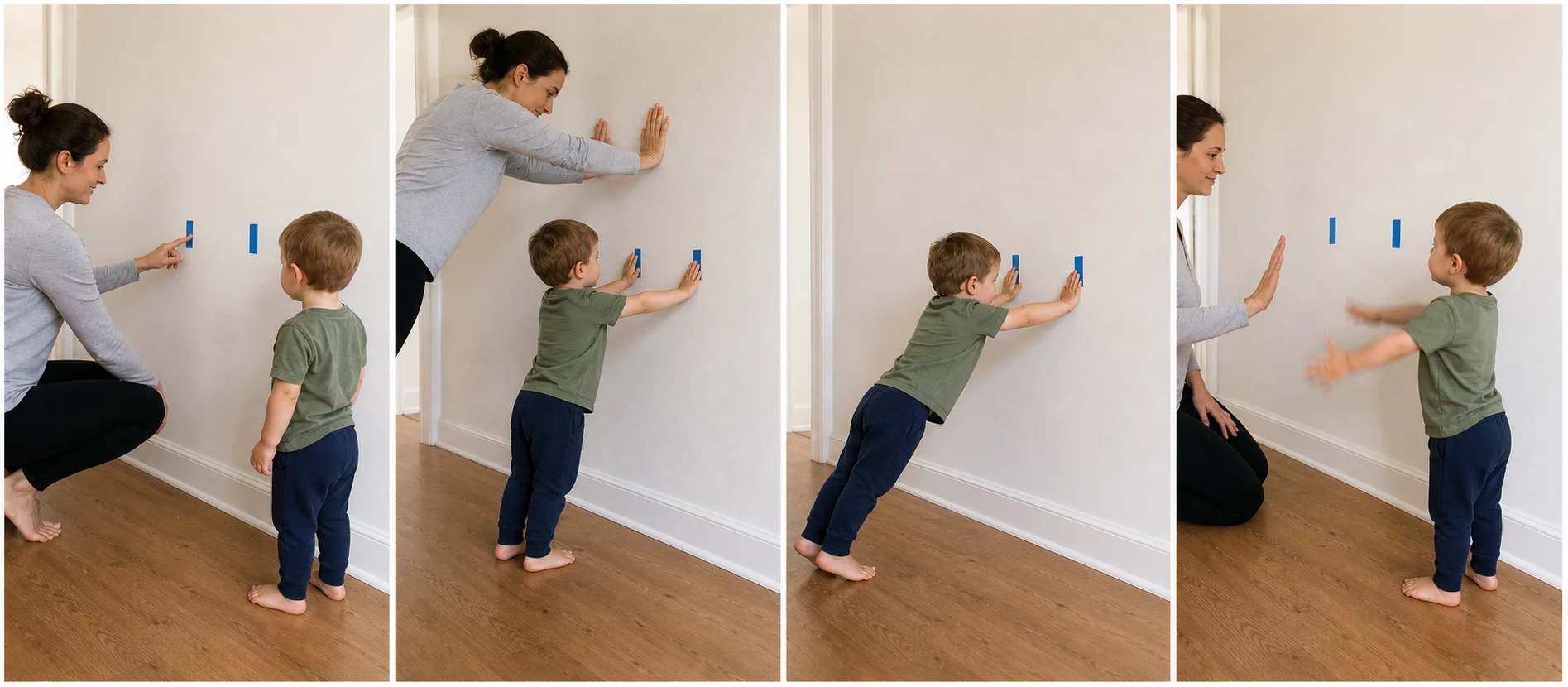
Four panels showing a grown-up clearing a wall spot, modeling a wall push, a child pushing with both hands, and the child stopping to shake out arms.
  1. 01
    Put both palms on the wall and say, "Push the wall. Make it strong."
  2. 02
    Let your child put both hands on the wall and push for one short round.
  3. 03
    Say, "Stop," then release hands and shake out arms.
  4. 04
    Reset feet and hands before another push.
  5. 05
    Repeat while your child stays comfortable and controlled.

Safety Check

  • Use a stable wall or closed door that does not move.
  • Keep frames, cords, shelves, and sharp furniture away from the pushing spot.
  • Stop if your child crashes into the wall, complains of pain, gets dizzy, avoids the wall, or keeps pushing past the stop cue.
  • Follow OT guidance for duration and frequency if your child already has a sensory plan.
Supporting the play

What to say in the moment

Match what you say to what you see.

Prompt ladder
Level 1 (Start)
"Put your hands here and push."
Level 2 (Keep going)
"Push, stop, shake it out."
Level 3 (Stretch)
"Can you make the wall almost move?"
Level 4 (Extend)
"Try a tiny push, then a strong push."
If your child seems...
What you'd see
Focused
What to do
Say
"Your hands are doing the pushing."
Add
Name one body part already working, such as hands, arms, shoulders, or feet.
Extend
Try one tiny push and one strong push.

Make it easier

Younger end
  • -Stand beside your child and push together.
  • -Use only 2 short pushes before stopping.
  • -Skip tape marks if they become a distraction.

Make it harder

Older end
  • +Alternate tiny pushes and strong pushes.
  • +Add a quiet stop cue after each push.
  • +Try pushing with feet a little farther from the wall while the body stays controlled.

If it's not working

If you see
If child ignores it
Put your hands on the wall first and say, "Help me move it," then let your child add hands beside yours.
If you see
If child misuses it
Pause and say, "Hands push. Bodies stay back." Restart with one slow hands-only push.
If you see
If child gets frustrated
Make it shorter. Count "push, two, stop," then shake out arms together.
Skill spotlight
Push Against Resistance

Whole-body pushing through resistance, Stopping and resetting the body

This helps children feel where their body is, use force on purpose, and practice stopping after a big body action.

  • Pushing against the wall gives your child a clear resistance target without needing loose equipment.
  • The stop-and-shake reset helps your child practice ending a big body action on a simple cue.
  • The same short loop can stay low-language, predictable, and easy to repeat.
Real-world transfer
  • Pushing a door or heavy object safely.
  • Using body force without crashing.
  • Stopping a movement when a grown-up gives a clear cue.
  • Resetting before a sit-down or transition moment.

Parent questions

Back to library
Keep playing

Related activities.